 David Noyce
 Peggy Fletcher Stack
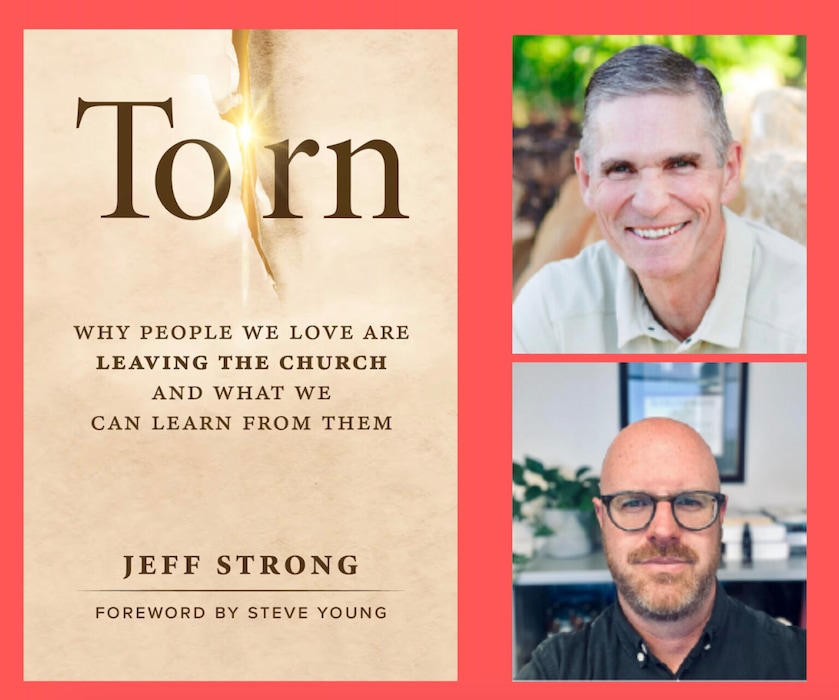
Jeff Strong, a former bishop, mission president and Brigham Young University faculty member, finds himself in a similar position to an increasing number of parents in The Church of Jesus Christ of Latter-day Saints. While he remains a believing, practicing and devout member, he has loved ones (including three of his five children) who have left the faith. Thus, his new book, titled “Torn: Why People We Love Are Leaving the Church and What We Can Learn From Them,” is more than instructive and insightful; it’s personal.
The volume includes a sweeping study on Latter-day Saint disaffiliation, revealing that about 40% of active members in the United States have stopped participating over the past quarter century.
Is the reason church doctrine, policy or culture? Is it, for instance, the faith’s opposition to same-sex marriage or the occasionally cruel comments about the LGBTQ+ community that may spring up in Sunday school? Does the tension come from the racist remarks Brigham Young made about Black people or from diminished trust in the church for not sharing that part of the faith’s history?
Here are edited excerpts from a recent episode of The Salt Lake Tribune’s “Mormon Land” podcast in which Strong discussed the church’s disaffiliation “crisis,” why so many Latter-day Saints are abandoning the faith, what the stayers get wrong about the leavers, and how members of every stripe can better find belonging no matter where they are in their spiritual journeys.
Why did you write this book?
(Trent Nelson | The Salt Lake Tribune) Missionaries at the Missionary Training Center in Provo. Jeff Strong's son left the MTC just days after arriving there and ultimately left the church.
It really started with my son Cale. We were kind of your prototypical traditional Latter-day Saint family. We were running the playbook the way that we do, and it was working great — until it didn’t. That morning arrived with some explosive tension when I got an email from Cale. He was at the [Missionary Training Center]. He’d just been there a few days. I opened the email and read that he was coming home, and it was pretty clear to me from the tone and the word choices he used that it was much bigger than just serving or not serving a mission. He probably was going to leave the church. That was a tectonic-plate-shifting moment for me personally, which ushered me into [a new] space in a big way. I had this narrative that was very common in 2013, and it still persists today, of “oh, yeah, those people leave — the people who lack the faith and character to be Latter-day Saints have always left.” But Cale doesn’t fit that profile, nor did other families in the ward [congregation] where I was a bishop, and so my stubborn brain wouldn’t let go of that. I look back on it now, and I feel like I was so naive at the time, but I started to dig in, and that was the beginning of the journey.
Three of your five children have stepped away. Did you consult them before including them in your book?
Yes, of course. They helped shape it. If I had included the names of any of my family members without their express permission, my wife would have literally killed me, and I mean literally.
How did you do the research? What aspects did you study in how to compile the data?
There are conflicting narratives in the Latter-day Saint community on how many are leaving and why they’re leaving. I just wanted a good database to answer how many have left and why, and then what role is our culture playing in either relieving or amplifying those tensions.
I did what any smart researcher does first — you just talk to people; you do focus groups, you do one-on-one interviews. That’s to inform your construction of a survey, so the survey is well done.
The second thing you do is ask if anybody else out there has already done this type of work that we could learn from? The answer was yes.
The third thing you do is you say, “In a perfect world, I would design a representative national probability sample that I can generalize to the total Latter-day Saint population perfectly.” But that study would cost many millions of dollars. So somewhere between having a perfect probability sample study and where we were before — which is just rumor, speculation, anecdote and folklore — is this middle ground called a nonprobability sample.
What you do is you try to approximate representation as best you can, and that’s what we did. Then you also get really smart people who are deeply experienced researchers, and even better people who have done so for decades. You ask them, based on everything else you’ve seen over the last 30 years, are these findings consistent with what you’ve seen elsewhere? The answer was always yes. So that gave us a degree of confidence.
The key finding in the research is that 40% — it’s an estimate — but 40% of formerly active Latter-day Saints have stepped away over the last 25 years.
(Strong and Dotson, “Why People Are Leaving the Church” survey via RNS) Conversations with local church leaders were the least helpful, and exchanges with friends and spouses the most helpful.
What did you discover are the main reasons members leave the church?
We asked people to cite the primary reason that they had stepped away, and they gave us four reasons.
The first one was “lifestyle” — about 6%. The second was “church history” — 42%. The third was “social issues” — 33%. The fourth was “church experience” — 18%.
We offered them a fifth choice, “none of the above.” Very few people picked that one. …Then we asked them an open-ended question, “Why did you leave?” and they got to type whatever they wanted. In total, we got about 15,000 respondents and over 10,000 pages of verbatim comments. The combination of multiple choice plus the verbatims gave us a pretty good feel.
What about church history concerns?
(The Church of Jesus Christ of Latter-day Saints) A depiction of church founder Joseph Smith's "First Vision." Some who have left the church doubt Smith's account.
For anybody informed on church history issues, there’s nothing new here. There’s just a confirmation of what people kind of already know. The number one area was 39% of people cited church truth claims and doctrines. … For example, we believe the [Heavenly] Father and Son [Jesus] appeared to [church founder] Joseph Smith… That the Book of Mormon and Book of Abraham were translated by the gift and power of God. People don’t believe some of that, and they don’t believe some of the doctrines, polygamy … the [former] priesthood and temple ban [against Black members]. They also cited problematic history. This would be things where you get into like Joseph Smith and polygamy and his personal behavior in regard to how that was handled. Ditto for Brigham Young, some of the things he may have said. Troubling temple practices. … The endowment has changed, and so people would kind of put that in a church history bucket.
… One of the things that was interesting to me is that not trusting church leaders was frequently mentioned as a church history issue. There were comments like, “Look, I understand people are not perfect. History is complex. You have to be careful about interpreting what happened 200 years ago through a modern lens. But the bigger issue for me is not the historical problems, but how the church has handled them. How much openness, transparency and accountability have there been?” … This is clearly an issue for people.
(Strong and Dotson, “Why People Are Leaving” survey via RNS) “How did your faith transition impact your relationship with God and the Church?”
What about social issues?
It’s all the things that you would expect. So the number one issue: 33% of respondents cited sexual identity concerns. And 27% cited financial stewardship, 20% cited racism, which is also a historical issue, and 13% cited gender equality. That last number feels a little low to me. ... Importantly, it wasn’t priesthood ordination for most respondents. It wasn’t, “Hey, the issue for me is women need to hold the priesthood, hold priesthood office.” It was voice. It was recognition of the power and value that women have.
What do faithful members get most wrong about those who leave?
It’s relatively simple. First, they underestimate how many are leaving. That’s in part because the public narrative really does say not very many are leaving. Second, they misunderstand the reasons people leave.
The narrative that people are leaving because they lack the faith and character to be Latter-day Saints is the most popular narrative around among active members of the church, and the idea that not very many are leaving is also the most popular statement. I actually wanted to pressure-test that, so I asked people to tell me. I gave them a list of four choices, below 25%, 25% to 50%, and so on. How many people in the church under age 39 have left, and the vast majority of active Latter-day Saints pick 25% or below, which is not correct. So 75% of Latter-day Saints couldn’t pick the right answer from a list.
Why do you call this trend of disaffiliation “a crisis”?
You notice I didn’t call it a faith crisis, which is a misrepresentation of what’s happening. I do think it’s a crisis of trust and belonging. When 40% of your community — and a round number estimate for that in the United States would be about a million people — step away from a faith community over 25 years, to me that’s a crisis. When you lose the kind of people we’re losing — intelligent, high character, good people — there’s a vacuum that’s created. To me, that’s a crisis.
Does church culture tolerate members with doubts and questions?
Not very well. … I had a hypothesis from all those interviews that it doesn’t, right, and that it’s actually quite critical of doubt. So I put a question in the survey, where I asked people: “How accepted would a Latter-day Saint who has issues with the church’s historical narrative be in their local ward or branch?” They overwhelmingly responded, “Oh, they’d be totally accepted.” And then I asked a follow-up question: “What if they talked about those concerns?” They would not be accepted.
… Try it in your home ward sometime in Sunday school or Relief Society or priesthood meeting. Raise a controversial issue, and tell people you have a concern about that, and watch the reaction that you get.
(The Church of Jesus Christ of Latter-day Saints) Teaching a Sunday school class. The author wonders how welcoming these classes are of members who challenge church teachings.
You said in the book that true faith is born when certitude dies. What did you mean?
Conviction is a really, really good thing. We should have conviction in the things that we believe. To not have conviction is probably not a good idea. But conviction minus humility is certitude. … Certitude is an absence of faith. It says when I encounter unknowable things, I’m going to make up my mind, and be dogmatic about that, and I’m not going to entertain the possibility that maybe I don’t have all the answers. Certitude is a tough master. It’s very rigid, but when it goes, it falls hard.
Note to readers • To hear the podcast, go to sltrib.com/podcasts/mormonland. To receive ad-free “Mormon Land” episodes, along with our complete newsletter and access to all Tribune religion content, support us at Patreon.com/mormonland.