 Mark Eddington
St. George • Proselytizing missionaries for The Church of Jesus Christ of Latter-day Saints may talk the talk, but young service missionaries for the faith walk the walk — often with tools, soup ladles, and, most importantly, hands-on help.
In southern Utah, President Nels Thorderson said the faith’s St. George Mission that he and his wife, Gina, oversee are fortunate to have plenty of both — 132 teaching missionaries and 108 young service ones.
“They are all full-time missionaries who have volunteered to be here and put their hearts, minds and souls into the work,” said Thorderson, an orthopedic surgeon who hails from Elvis’ hometown of Tupelo, Mississippi.
Beginning in January 2024, the church began integrating service “elders” and “sisters” into regular teaching missions, enabling them to labor under the direction of mission presidents and attend the same meetings as their proselytizing counterparts. At the end of 2025, according to statistics released earlier this month, the church had 78,596 full-time missionaries around the world, along with 31,613 senior service missionaries and 4,518 young service missionaries.
While young service missionaries generally lag behind proselytizing missionaries in number, Thorderson noted that this gap often narrows in the Intermountain West, where there is a strong Latter-day Saint presence. Other than the nature of their work, and the fact most live at home and serve in their communities, there is little separating their service from that of teaching missionaries.
The age requirements — 18 to 25 for men and 18 to 29 for women — are the same. Like teaching missionaries, young men can serve up to two years and women up to 18 months, as much as their physical and mental health and other circumstances allow, according to the global faith’s website.
“One of the best things about service missions is that it makes it so that everybody can serve,” said Chett Gardner, a Latter-day Saint missionary from Enterprise who oversees other missionaries serving homeless individuals in the soup kitchen at the Switchpoint in St. George. “At the start of my mission, I served with an elder who was in a wheelchair. That wouldn’t work so well in a proselyting mission.”
Mission struggles, home transfers
(Mark Eddington | The Salt Lake Tribune) Ella Faldmo, a service missionary for The Church of Jesus Christ of Latter-day Saints, crochets a scarf to be sent to Ukrainian refugees in St. George on Thursday, April 9, 2026.
Ella Faldmo, who is from Mapleton but lives with her grandparents in St. George, considers her service mission a godsend, particularly after mental health issues forced a change from her initial assignment. Although her time at the Provo’s Missionary Training Center was positive, she said, her mental health deteriorated once she began her proselytizing mission in Henderson, Nevada.
“As soon as my airplane landed in Las Vegas, I was a completely different person,” said Faldmo, who transferred home for a service mission after 10 days in Nevada.
Now she can’t imagine a better way to serve God. She is site leader for a humanitarian service project that makes sleeping mats out of plastic grocery bags for people who are homeless. She also makes quilts for women and children leaving polygamy and crochets hats for premature babies at Intermountain Health’s St. George Regional Hospital.
In addition, Faldmo serves as an American Sign Language interpreter in the faith’s two area temples and in schools for the deaf. She further labors alongside teaching missionaries in the St. George Temple Visitors’ Center.
“This mission was tailor-made for Sister Faldmo,” she said. “I can now just be myself and work on what I do best and serve where the Lord needs me.”
‘Roughest thing I ever had to do’
(Utah St. George Mission) Service missionary Shadyn Sparks and her fellow missionaries at a quilt-making event.
Shadyn Sparks encountered similar issues. After nine months as a teaching missionary in Tampa, Florida, she returned home to St. George for a service mission due to health concerns. She now echoes Faldmo’s optimism about the joys of the role.
“Coming home was the roughest thing I ever had to do,” Sparks said. “It took a lot of healing in my discipleship. … But I think there’s a lot of power in coming home and continuing to serve, no matter what happens to you.”
Sparks serves as an ordinance worker in the Red Cliffs Temple and splits the remainder of her time among the St. George Temple Visitors’ Center; elementary schools, where she tutors Spanish‑speaking children; and community sites like Deseret Industries and the Children of Hope Academy, often using her Spanish to minister to those she meets.
Crohn’s disease led to Reid Clayson’s transfer from his proselytizing duties in San Antonio, Texas. The St. George resident still struggles with an inflammatory bowel malady that keeps him largely at home. But he works remotely as much as he is able by doing computer-based family history and other church work.
Recently, he was able to speak at a sacrament worship service. As he sat up on the stand, he thought he would be the first to talk and be able to go home immediately thereafter. Alas, several spoke before him, and he didn’t know if he could last. As uncomfortable as he was, the missionary said the talks given that day were exactly what he needed to hear, and he was able to give his speech as well.
“Even though it was really hard,” Clayson said,” I was grateful because if it was not for the hand of the Lord and I had spoken earlier, I would not have heard those sacrament talks. That was a really powerful witness to me of the Savior’s love.”
Labor of love
(Mark Eddington | The Salt Lake Tribune) From left: Ella Faldmo, Reid Clayson and Shadwyn Sparks pose for a group photo at the Utah St. George Mission headquarters on Thursday, April 9, 2026.
All told, according to mission leaders, service missionaries can labor at up to 90 sites in the mission, which extends from Cedar City south to Mesquite, Nevada.
Martin and Louise Nygaard, senior advisers to the service elders and sisters, say they typically try to pair missionaries with service opportunities that are suited to their health, talents and interests.
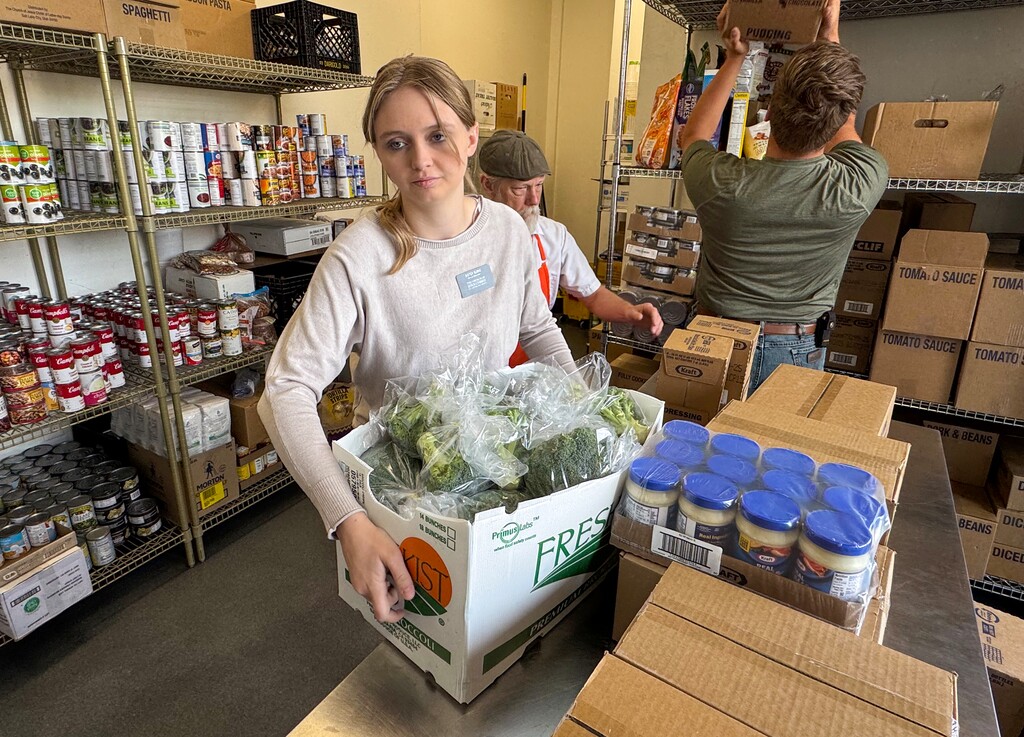
Service missionaries can be found at ranches, church temple grounds and historical sites, food pantries and at Bed ‘N’ Biscuits, Switchpoint’s day care and boarding facility for pets, to name a few. They also pop up at Liberty Village, a replica colonial outpost taking shape in Hurricane aimed at enshrining religion as a central focus of the American Revolution.
Louise Nygaard said a willing heart is essential to missionaries’ service.
“I love what [apostle Dale] Renlund said, ‘God can make the willing able, but he cannot or won’t make the able willing,’ ” Nygaard said. “These missionaries are willing. They really want to serve.”
Wherever they serve, Thorderson said, service missionaries bring love and compassion to their labor and the people they meet.
“People glow when they feel the light of Christ come through these missionaries,” the president said. “That’s the special part to me.”
Overcoming stigma, misunderstanding
(Mark Eddington | The Salt Lake Tribune) Ella Faldmo makes a sleeping mat for the homeless out of plastic bags in St. George, Thursday, April 9, 2026.
Thorderson noted that while all Latter-day Saint missionaries struggle at times, service missionaries often face a social stigma from those who misunderstand the vital role they play in the community.
Faldmo concurs, saying some fellow members don’t understand service missionaries are not home by choice.
She remembers attending a training session at a temple visitors’ center and feeling like her service paled in comparison to the proselytizing missionaries and questioning whether she belonged there. When she began to cry, Faldmo said, a new teaching sister, whom she had helped with mental health struggles, hugged her.
“She said, ‘Sister Faldmo, the only reason I’m still on my mission is because of you.’ Then another sister hugged me and said, ‘You’ve helped me so much. The only reason I’m still in St. George is because of you,’” the service missionary recalled. “That was so sweet to hear and to go from feeling less than and questioning if I was supposed to be there to knowing I really did have an impact.”