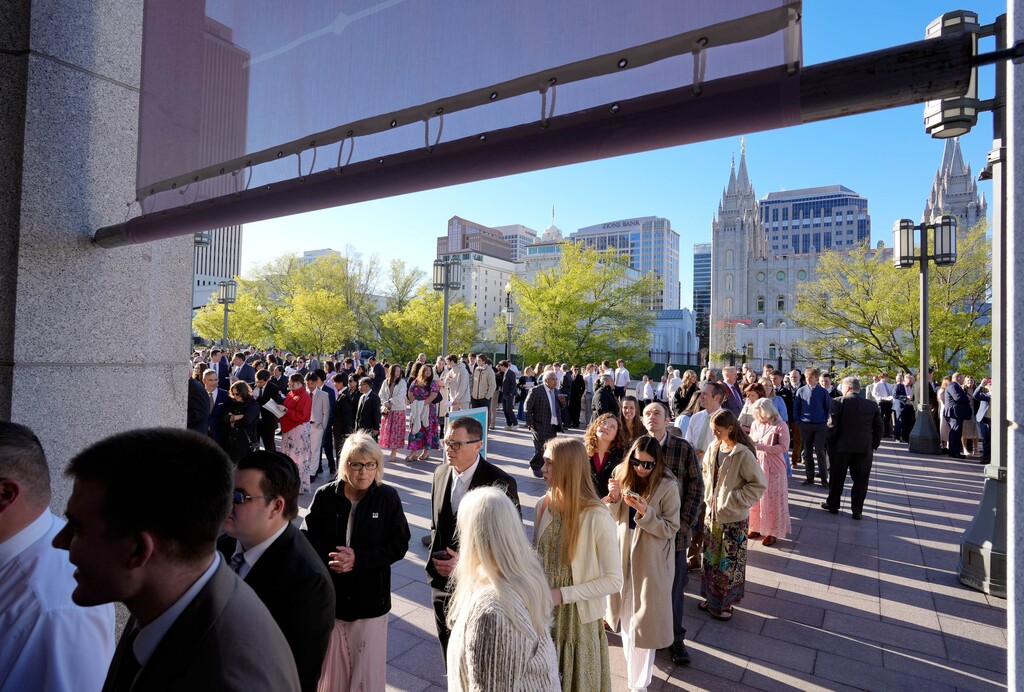
The Church of Jesus Christ of Latter-day Saints just reported its highest convert growth in history. Over the weekend at its semiannual General Conference, the church released its 2025 membership statistics that indicate an almost 25% increase in convert baptisms in 2025, compared to 2024.
But at the same time, 2025 data from the Cooperative Election Study, also made available last week, tells a different story. In the United States at least, fewer adults are self-identifying as Latter-day Saints than at any other time since the survey began nearly 20 years ago.
Both of these stories are true. But how? Let’s dive into the data, starting with the church’s rosy internal membership numbers.
A surge of growth
(Christopher Cherrington | The Salt Lake Tribune)
Each April, the church releases its global statistics about the number of members, congregations, missionaries, enrolled students and temples it has. There have been some lean years in the past decade, even before the COVID-19 pandemic. A decade ago this month, I wrote a column about how Latter-day Saint growth had slowed to its lowest level since the Great Depression of the 1930s. In 2016, year-over-year growth was just 1.7% — an alarming downturn for a denomination that used to report 5% growth a year.
But things got worse. Growth technically remained in positive territory by hovering around 1% a year but wasn’t keeping pace with worldwide population growth. And during the pandemic, church growth slowed to just six-tenths of a percentage point a year, likely largely due to missionary activity being stalled by COVID-19.
Things began turning around in 2022, though many people (myself included) thought this might have been a post-COVID-19 blip, reflecting a temporary backlog of deferred missionary service and baptisms. I expected that things would soon return to “normal” (i.e., slow), given global trends toward secularization.
But the turnaround has persisted and has gotten even better. Here are some of the main highlights from the church’s 2025 report:
• The church baptized 385,490 new converts from around the world last year. That’s an almost 25% increase over 2024 and the highest-ever rate of convert baptisms in a single year in church history. The previous record was from 1990, when 330,490 converts joined.
• The church now has nearly 17.9 million members and is on track to hit 18 million this year.
• The growth has been fueled by an increased volunteer missionary force. More than 78,000 proselytizing missionaries served in 2025, in addition to more than 36,000 service missionaries. All told, the church had over 114,000 missionaries serving in various capacities.
Time will tell us more about the longevity of this upturn and why it is happening. But two contexts are helpful for understanding the renewal.
The first is that organized religion is starting to have a moment, even in areas of long-term religious decline and more recent decline (such as the United States). It’s overblown to call this a revival yet, but there are signs of life. For example, Religion News Service reported that Roman Catholic churches in the U.S. are now receiving a surprising number of adult converts who have gone through Christian initiation classes. Many were welcomed into Catholic churches at Easter vigil services this past weekend.
This is not a reversal of overall trends in the U.S., especially since the youngest generations continue to be the least religious. Demographically, that’s not a foolproof recipe for religious revival. But several years of data from national surveys now show that the “rise of the nones” has slowed down. Statistician Ryan Burge reported last week that the share of Americans who say they are atheist, agnostic or “nothing in particular” declined for the third straight year, from a high of 36.2% in 2022 to 31.8% in 2025, according to the Cooperative Election Study.
The second contextual item I’d point to is that Latter-day Saints have smoothed the way for their impressive missionary force by investing heavily in social media advertising around the world. And I do mean heavily — these ads often show good-looking young missionaries from the church without actually spelling out which church is sponsoring the ads. They have the appearance of being created by grassroots, local groups of Christians rather than by the church’s highly centralized Missionary Department.
(The Church of Jesus Christ of Latter-day Saints) Two of tens of thousands of Latter-day Saint missionaries.
For example, check out the Instagram page for Followers of Christ — PNW. It depicts a mostly generic, upbeat Christian message. Visitors can consider questions about their lives — like, “Do you struggle with mental illness?” — and find comfort in healing memes. Sometimes these memes are optimistic, feel-good messages about self-esteem and faith in God. Occasionally they have a quote from a church leader, who is identified by first and last name but not by the name of the church.
Even the account’s “about us” section neglects to identify the actual name of the church. In six Instagram stories, it says the account was created by “people just like you” — Jesus followers who love Washington and Idaho, who can help you by sharing a message of peace and hope.
It’s a genius move, marketing-wise, to erase the Mormon/LDS brand name in favor of a cheerful, nondenominational Christian calling card. Nondenominational Christianity has been one of the few growth areas of religion in the United States and abroad.
I can confirm that, in my own Latter-day Saint ward, or congregation, we’ve had recent converts who first met missionaries because they answered an ad on social media. I spoke with one last week who clicked on a link to have people come and pray with her, and the church’s missionaries showed up. She began attending sacrament meetings and told me that her overall emotional and physical health have been improving ever since. God, she said, is good.
A retention problem
I really liked this new convert, and I hope she stays active in our ward. We’ve seen a steady uptick in baptisms in the past two years but relatively few of those new folks continue coming.
My ward is not alone in this. And this is the other half of the story I alluded to earlier. Shortly before the church released its glowing annual report about global growth, the Cooperative Election Study released 2025 data showing a steady decline in Americans who self-identify as LDS/Mormon. In 2025, this dipped below the 1% mark for the first time, to 0.9% of the U.S. population.
The CES numbers used to be close to the church’s own membership numbers, which have stayed mostly flat in proportion to the overall U.S. population. This means that the church’s internal records of everyone still on the official rolls put its share of the population right around 2% consistently for the past 20 years.
The CES, by contrast, counts only those adults who self-report that they’re Latter-day Saints. And that population has been nearly cut in half over the same period.
Researcher Alex Bass of Mormon Metrics said the 2025 CES had only 161 Latter-day Saint respondents out of the total sample of 17,000 people, the lowest sample size for that group to date. This creates “more uncertainty compared to previous CES years,” he cautioned.
Still, the 2025 numbers continue the overall trend. The gap continues to widen between the church’s records of how many U.S. members are on the rolls and the national data of how many Americans actually say they are Latter-day Saints.
A lot of this is driven by people leaving the church in the U.S. Most who leave don’t remove their names from the official records, so the church still counts them as members even though they may no longer see themselves as such.
So, there you have it: an encouraging internal church report about Latter-day Saint baptisms around the world, alongside a mostly discouraging independent report about the decline of Latter-day Saint membership in the U.S. specifically.
But it’s not wholly discouraging. Bass said that among the CES respondents in the U.S. who still regard themselves as Latter-day Saints, the past two years of data have shown a small uptick in their religious behaviors. There’s an increase in members who pray several times a day, say religion is very important in their lives and attend church at least once a week.
Bass will unpack those findings in greater detail in a future Mormon Metrics Substack. Overall though, he said the tentative finding that Latter-day Saint religiosity is increasing while its population share goes down “may suggest that some of the people on the fringes are leaving.”
(Francisco Kjolseth | The Salt Lake Tribune) Religion News Service columnist Jana Riess.
Note to readers • The views expressed in this opinion piece do not necessarily reflect those of Religion News Service.