Erika Kirk, wife of murdered conservative activist Charlie Kirk, recently described the strange power her husband had over light bulbs. She said that sometimes when he entered rooms, lights would flicker. That brought her comfort in the wake of his death, for the night after he died, a light in her hotel room pulsed dim then bright again.
“It’s a total frequency thing,” Kirk said.
That word — frequency — made my ears perk up. It’s hardly the sort of word that pops up in the New Testament or in traditional Christian liturgy. But it has a long tradition in American religion. And, more and more, people who call themselves “Christian” are using it. That worries some leaders of The Church of Jesus Christ of Latter-day Saints, but the trend is hardly slowing down.
Frequencies
The way Erika Kirk uses “frequency” comes in part from the 18th-century mystic Emanuel Swedenborg and his followers among 19th-century spiritualists. They believed the spirits and voices of the dead traveled along vibrating waves of sound and energy that could be sensed and heard by those with skill or gifts.
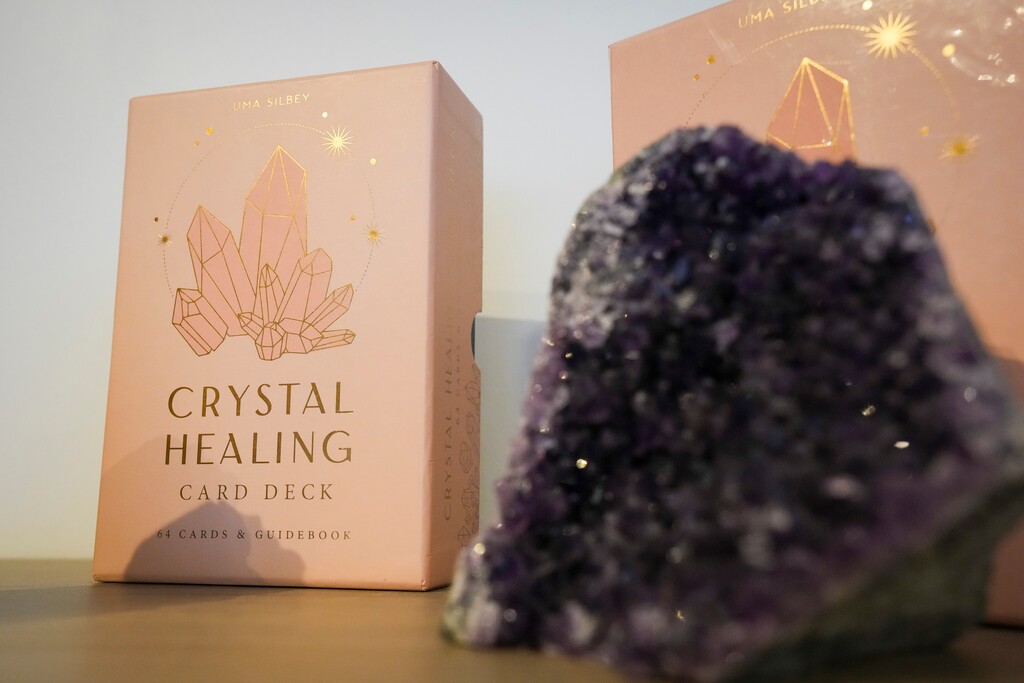
Since then spiritualist beliefs have found their way into the melting pot of American popular culture, in books, on late-night radio, at conferences and on YouTube. People blend the spiritualist language of “frequencies” and “vibrations” with Americanized interpretations of Hindu and Buddhist terms like “chakra” and “qi,” with speculation about quantum physics and signs of the zodiac. They create narratives about how energy flows through the body and the world, and embrace practices with names like “Reiki” and “orgone” and “crystal work.”
This messy and vibrant stew is sometimes called the New Age movement.
The New Age is a disparate and sometimes contradictory amalgamation of practices and beliefs. But there are common threads: the belief that the universe flows with energy conventional science does not recognize; the faith that we can use this energy to heal ourselves and our world. The New Age is a product of suspicion of established institutions coupled with profound optimism about human potential.
Which is why, despite angst among the leaders of many Christian groups, it has become so pervasive in American Christianity.
A Christian New Age
(Kenny Holston | The New York Times) Erika Kirk, widow of Charlie Kirk, speaks at a memorial service for her late husband.
Erika and Charlie Kirk were raised in traditional Christian denominations — he a Presbyterian and she a Roman Catholic. Most such denominations have warned against practices like these. The U.S. Conference of Catholic Bishops, for instance, has urged American Catholics to seek healing through Jesus Christ rather than through impersonal forces like “energy.” This is typical of leadership from Christian denominations, which often are more concerned with doctrinal consistency than their followers.
Unfortunately for those leaders, statements like these can accelerate the appeal of New Age movements. When mainstream medicine or state agencies fail to heal cancer or stop your allergies, energy workers will happily intervene. And when conventional authorities warn that New Age practices often cannot demonstrate that they are effective in clinical trials, the response from believers is often to cast doubt on those authorities.
By the end of Charlie’s life, both Kirks had moved into a new form of American Christianity. It’s sometimes called “nondenominational,” and it is larger than any other single group of Christians in the United States, save for Roman Catholics.
Lacking any denominational leadership or centralized structure, nondenominational Christianity thrives on charismatic leaders and cultural blending of the sort that lends itself to populist suspicion of established authority and improvisational meetings that freely adapt popular cultural trends — and thus, ultimately, to Erika Kirk’s embrace of New Age language. She is hardly the only one. Many nondenominational Christians use the language of “energy” or “frequencies” to describe what they believe to be the power of God working in the world.
Christian organizations like the Latter-day Saint faith or Catholicism may believe that centralized administration might stave off such adaptations. But that is not always the case.
A Latter-day Saint New Age
(The Church of Jesus Christ of Latter-day Saints) The church's General Handbook warns against energy healing.
At the end of 2020, Latter-day Saint leaders updated their General Handbook to state that church members “are discouraged from seeking miraculous or supernatural healing from an individual or group that claims to have special methods for accessing healing power outside of prayer and properly performed priesthood blessings. These practices are often referred to as energy healing.”
This condemnation came at the end of a decade when energy practices had become more prominent in the church — and not always in a good way.
In 2019, Julie Rowe was excommunicated. She had published a book in 2014 describing her detailed visions about the end of the world. In the intervening five years, she grew increasingly famous for her prophecies and her claims to be a “quantum healer in energy medicine,” which she touted through a series of speeches and online videos.
Later, Rowe’s publisher, Chad Daybell and his wife, Lori Vallow, were arrested and charged with multiple murders of their family members. Vallow and Daybell held a variety of esoteric beliefs. Among them were that people had “light” or “dark” energies and that those energies had “vibrations.” Certain vibrations were associated with certain powers like teleportation or telepathy or healing.
I hesitate to cite these notorious cases, because the dramatics of the Daybell, Vallow and Rowe cases are hardly typical. But they did direct new attention to how common energy practices really are in the church.
For instance, the organization known as the FIRM Foundation holds a conference twice a year in Utah. While the foundation itself is devoted to proving the historicity of the Book of Mormon, it is sympathetic to antiestablishment beliefs of all sorts. The conference hosts representatives from the far-right John Birch Society and doomsday preppers alongside advocates for what speakers call “energy healing” or “the Light of Christ and Energy Medicine” or “energy clearing.” Those are only three of the presentations slated for the April 2026 conference. Every year the gathering attracts thousands of Latter-day Saints.
Energy healing is also thriving in many quieter and more mainstream spaces: congregations, women’s Relief Societies and book clubs. Scholar Doe Daughtrey has documented dozens of contemporary women who believe they are capable energy workers and devout Latter-day Saints. These women often describe their capabilities as a “spiritual gift” and believe it is compatible with the Latter-day Saint tradition.
In that light, energy healing is a source of spiritual authority for women who cannot be ordained to priesthood office. The community around energy work on social media is entrepreneurial, populist and expressive — values that emerged in communities Mormon women began building online a generation ago in the “mommy blog” era.
Ultimately, then, the language of energy work in Latter-day Saint contexts reveals much the same thing as the famous mommy blogs and reality television shows starring Latter-day Saint women and perhaps the fading of traditions like Relief Society bazaars and roadshows. Increasingly, the church is becoming integrated into the wider swath of American culture, less an independent subculture and more like those other denominations that have given way to the mainline of American life.
(Matthew Bowman) Tribune guest columnist Matthew Bowman is the Howard W. Hunter Chair of Mormon Studies at Claremont Graduate University.
Note to readers • Matthew Bowman is the Howard W. Hunter Chair of Mormon Studies at Claremont Graduate University and the author of 2024’s “Joseph Fielding Smith: A Mormon Theologian,” and co-author of 2025’s “Game Changers: AJ Dybantsa, BYU, and the Struggle for the Soul of Basketball.”