 David Noyce
 Peggy Fletcher Stack
Faithful Salt Lake Tribune readers know Eli McCann well. He’s the award-winning columnist who has them cracking up one minute about coming out as a coffee drinker and tearing up the next minute about the Latter-day Saint youth group in the western Pacific who won his heart.
Now his monthly humor columns have been compiled into one bright, breezy book titled “We’re Thankful for the Moisture: A Gay Guy’s Guide to Mormon Faith, Family, and Fruit Preservation.” It’s a valentine of sorts to Latter-day Saint culture, containing classics like his first date with his future, non-Mormon husband at, of all places, the Kirtland Temple; his adventures (and misadventures) in the kitchen after unearthing a missionary cookbook; and the awkward (but somehow appropriate) chuckles he shared with a bishop when he signed his resignation letter from The Church of Jesus Christ of Latter-day Saints.
(Signature Books) Eli McCann's new book is a collection of his Salt Lake Tribune columns.
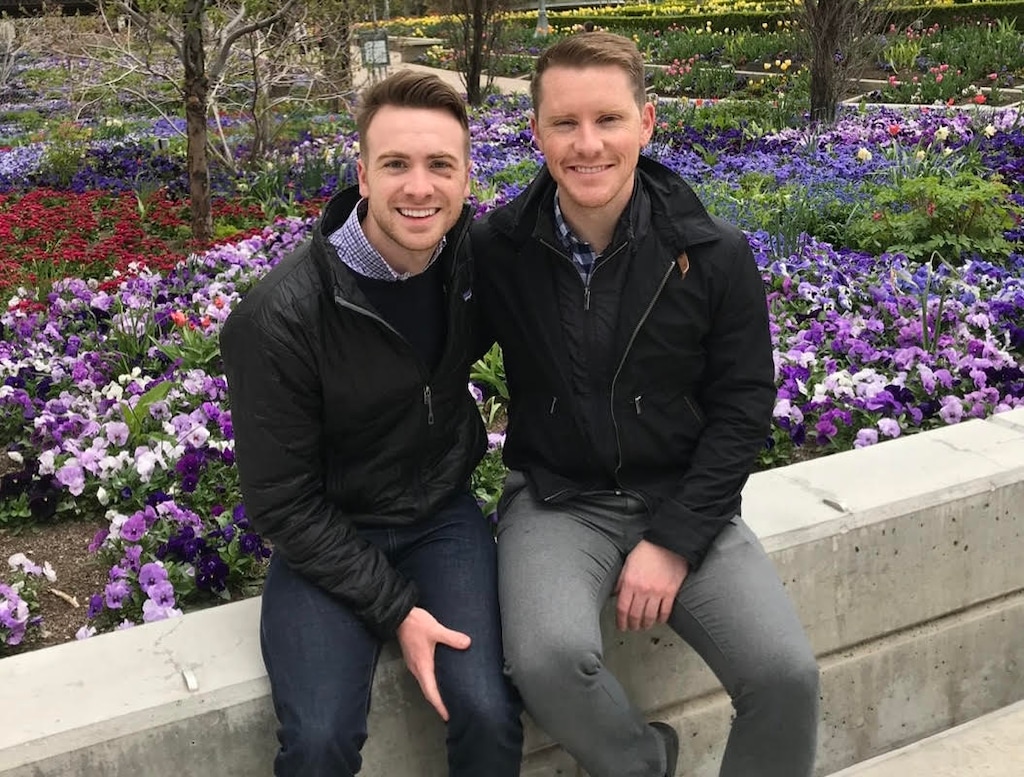
Eli, a practicing attorney, lives in Salt Lake City with his husband, physician Skylar Westerdahl, their toddler son, West, and, as Eli puts it, “two naughty (yet worshipped) dogs.”
Here are lightly edited excerpts from a recent “Mormon Land’ podcast in which Eli and Skylar talk about his writings, their life and why they find laughter and love in the religious culture that bred Eli.
What have you, Eli, learned about your Mormon roots since marrying Skylar?
Eli • Oh, so much. It has actually been really fascinating to see my own culture reflected through Skylar’s eyes. …It was really interesting to see what amused him, what touched him, what confused him. … I write in one of the columns about Skylar asking me a lot of questions about the Holy Ghost “going to bed at midnight.” …. I thought it was a funny phrase, but the concept of a Holy Ghost, and what the Holy Ghost is, I’ve always sort of taken for granted, because I’ve known and heard about it. Who knew how scary it could be? … It was so funny when he started asking me questions: “So why is it called a ghost? Does it haunt people?”
On the other hand, I wrote as well about a time that my mom wrote in a birthday card to Skylar, “We’re so happy to have you in our forever family.” I initially saw the phrase and was like, “Oh, there’s my mom, pushing religion on us.” But his reaction was, “Oh, what a lovely thing that families want to be together forever.”
(Heather Wrigley) Cathie McCann, right, pays tribute to son Eli McCann, left, and his husband, Skylar Westerdahl, on the couple's wedding day.
Skylar, when Eli first started writing about you, it was always as this wide-eyed observer who didn’t know that much about Mormonism or religion, kind of naive, but not really cynical or harsh. Now that you know more about Latter-day Saint culture and traditions, has your view changed?
Skylar • I don’t think it’s changed; maybe it’s just more complicated. With knowledge comes complications. I feel more protective nowadays with other people who are maybe coming with more stereotypical views, now that I know a bit more.
Eli • A lot of it comes from Skylar being very protective of my family, because my family has been so remarkably good and welcoming of Skylar. So when he hears criticism of Mormons, you know, the people, he is picturing my family, and I’ve noticed that’s when his kind of defensiveness will come out, like, “let’s not paint everybody with a broad brush. Let’s not assume the worst in people just because they belong to this group, this religious body.”
Do you sometimes find yourself surprised you’re defending some Mormon culture?
Skylar • Yeah, definitely. Usually it’s with people who are not in Utah, or it’s when Eli is feeling cynical. I don’t like people speaking out of ignorance.
Tell us about your first date at the Kirtland Temple.
(The Church of Jesus Christ of Latter-day Saints) The Kirtland Temple in Kirtland, Ohio, was the site of the couple's first date.
Eli • It is the funniest first date for me to have had with this man. We met through a dating app and were living a thousand miles apart. Skylar lived in Wisconsin. I was living in Salt Lake City, and so we actually didn’t meet in person for about a month. … One day, Skylar called me and said, “I have to go to a wedding in Cleveland. Why don’t you come and meet me for this wedding?” It sounded like a crazy idea, but I ultimately did end up going. And I got to Cleveland about 12 hours before Skylar arrived. I flew there, and he was driving in, and so I had a day to kill in Cleveland, and I found out right before I went there that Cleveland is right next to Kirtland. And so I went and had sort of a hilarious day there as this ex-Mormon going on a tour of the Kirtland Temple. I was on a one-on-one tour with this guide because it was a quiet Thursday morning. He gave me an extended tour that was incredibly awkward. He made me sing the [Latter-day Saint hymn] “Spirit of God” with him. He made me play the piano while he sang, weeping down his beard. And I was just like, “I flew out here to go on a gay date with a man from the internet, and I’m now doing the ‘Spirit of God’ with Dumbledore in the Kirtland Temple.”
When Skylar arrived in Cleveland, we met in person for the first time. Skylar asked me what I had been up to all day. And so I sort of word-vomited to him, “Well, I went to this place. It’s called Kirtland, because I grew up Mormon, and there’s a temple there, because the Mormon pioneers were there, and the temples are …. well, it’s an everlasting covenant thing. And he’s sort of staring at me, like, “What? Who is this? What is this?” As I’m saying all this, I’m hearing myself talk, and I’m just like, “Oh my gosh, I need to bury the weird stuff. What am I doing?” And when I finished, he asked, “Do you want to go back there? I would love to go back there with you and see this.” He was so fascinated by it. … So we did this tour and because I had told Skylar all about the Kirtland Temple and my experience there, he went into this somewhat of an expert on the temple, and we have this tour guide who is not in great shape. And the guide kept getting out of breath. We’d go up those stairs, and he’d get out of breath, and he would say, “Somebody else take over while I catch my breath.”
Skylar • [Imitating the wheezing guide] “Does anybody have any … facts to say about … this room?”
Eli • I had just done a three-hour tour so I actually am loaded with information. And Skylar’s chiming in and like, “Isn’t that Joseph Smith’s desk over there?”
Skylar • The whole day was charming, just everything. … Eli told me this whole story [about Kirtland] and I remember the entire time, kind of mouth a little open, but definitely smiling. And he was like describing Stars Hollow from “Gilmore Girls” — this cute, adorable, little place with a cast of characters, and I immediately felt like I wanted to see it.
(Eli McCann) Eli McCann attends a youth conference in Palau with a group of smiling Latter-day Saints.
Do you ever receive any anti-Mormon sentiment about your columns?
Eli • Do people look at my columns as apologetics and are negative? I have never had anyone say that to my face or had anyone I know write that to me. I only ever see that kind of feedback from anonymous people on the internet. But I do see it, and I’m not offended by it. … I don’t think I am writing apologetics or criticism. It’s interesting — and I’m sure you’ve seen this — I will write a column and, literally back to back, have comments from people I don’t know who accuse me of apologetics or accuse me of being anti-Mormon for the exact same piece of writing.
Eli, you freely acknowledge the pain the church has caused you, but you still hold a soft spot for its culture and its people. How are you able to do that?
Eli • I don’t know that I would say I hold a soft spot for the church. When I say that, I’m talking about the corporation, the organization. I think it’s a nuanced organization. I think it does some good in the world. I think it does some bad in the world as well. I think it’s a huge ship that no one is able to steer by themselves. And sometimes the church makes public statements, official statements that piss me off. And sometimes they say and do things that I’m applauding.
I hold a very soft place in my heart for huge aspects of the culture, and, for me, as a gay man, that is probably really possible because of my family and how accepting and supportive they’ve been of me. Because my family has been so good to me over the years, even as I’ve come out and left the church, and because they’ve been such big cheerleaders in my life, it’s a lot easier for me to look at the pieces of culture that really shaped me as a child through a warm lens. … The fact that people say from the pulpit, “We’re thankful for the moisture,” because it’s just a thing that we say in the desert, those kinds of things are warm and fun for me. But I have plenty of friends who have just horrible experiences coming out of the closet and leaving the church and being disowned from their families. It is hard for them to find any of it funny, and I totally get that.
Why do you use the word Mormon instead of Latter-day Saint?
Eli • Mormon is a broader term than Latter-day Saints, right? … I like the word Mormon. I know it’s a “victory for Satan” [as former church President Russell M. Nelson taught] but it’s the word that we used as a kid, and Gordon B. Hinckley, who was the president of the church for a big part of my adolescence and young adulthood, praised this word and used it in a way that made me feel like I was a part of a community that was interesting. I don’t like any effort to try and remove the word Mormon from our vocabulary. … Now, if somebody said to me, “Please don’t call me a Mormon. I want to be called a Latter-day Saint, I’ll respect that.” … But whenever anybody tries to police that, I say, “No, no, you don’t get to decide what I call myself.”
(Eli McCann) Tribune guest columnist Eli McCann says he still likes to use the word Mormon.
OK, who’s funnier at home?
Skylar • I think it’s me.
Eli • I think it might be you. I’m grumpier.
Note to readers • To hear the podcast, go to sltrib.com/podcasts/mormonland. To receive ad-free “Mormon Land” episodes, along with our complete newsletter and access to all Tribune religion content, support us at Patreon.com/mormonland.
David is a managing editor at The Tribune, where he has worked since 1984. He oversees coverage ranging from local government and west-side issues to growth, development and housing. In addition, he directs religion reporting, co-hosts the award-winning “Mormon Land” podcast and writes the Mormon Land newsletter.
Hired in 1991 to cover Utah's various faiths, particularly Mormonism, Peggy has talked forgiveness with Archbishop Desmond Tutu, nearly fainted waiting for the Dalai Lama, fasted with Muslims during Ramadan — and has reported on 50 consecutive semiannual LDS General Conferences.