 Dylan Eubank
Note to readers • This story was updated to reflect passage of this measure in the final hour of the 2026 legislative session.
Utahns could soon get a new legal holiday.
A half-day one, at least.
In the last hour on the last day of the 2026 legislative session late Friday, the Utah Senate gave final passage to an amended version of SB193, making Good Friday a legal holiday — with state employees receiving four hours of paid time off.
Sponsoring Sen. Keven Stratton had sought a full day off but later shortened the paid holiday to help the measure win final bipartisan approval.
If the bill is signed into law, Utah would become the 13th state to recognize Good Friday as a legal holiday, joining Connecticut, Delaware, Florida, Hawaii, Indiana, Kentucky, Louisiana, New Jersey, North Carolina, North Dakota, Tennessee and Texas.
It would take effect next year.
Stratton said before the measure’s final passage that he hopes this bill fosters goodwill for Utahns and encourages more religious dialogue across the state.
“God was really sterilized from our public dialogue in many ways,” the Orem Republican said. “So it’s been a blessing to open up, in a new way, the opportunity to more comfortably, appropriately and certainly with sensitivity … welcome God back in the public sector.”
What Good Friday means to Christians
Good Friday takes place during Christianity’s Holy Week and commemorates the crucifixion and death of the biblical Jesus Christ. The faith tradition’s holiest day, Easter Sunday, occurs two days later.
The Rev. Jamie White, senior pastor at Salt Lake City’s First Presbyterian Church, said Good Friday plays a particularly important part in her faith and congregation.
“Good Friday is the day we stop everything, right? Our music is somber. We are reading the text again. We are turning our focus to the cross, and we’re acknowledging that things are still not OK in the world,” she said. “It’s really important for us.”
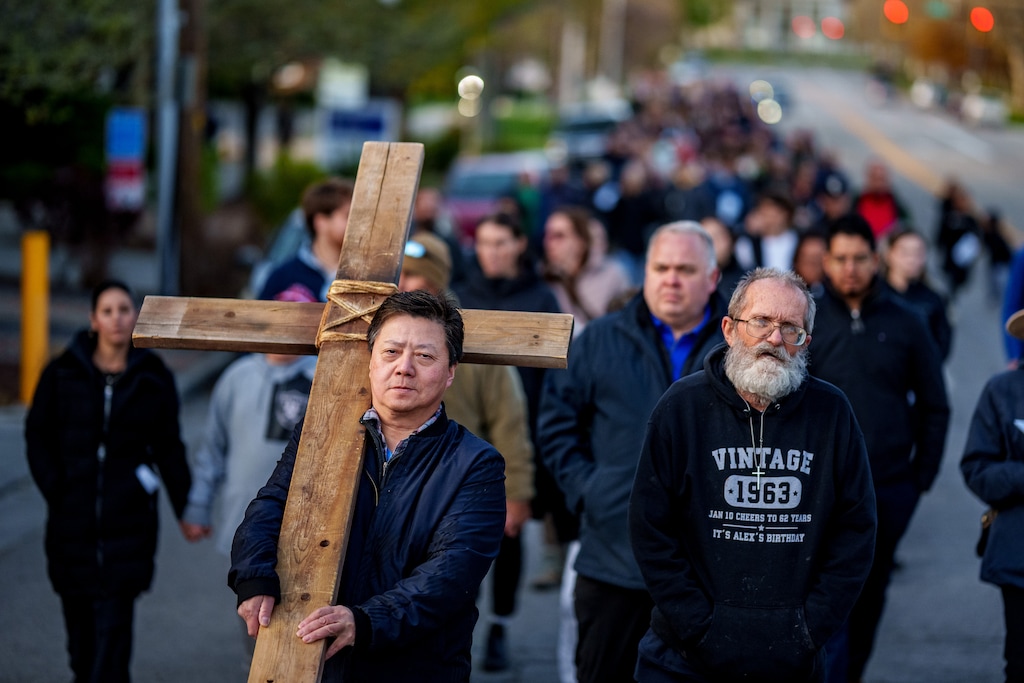
Each Good Friday, Utah Christians unite and take to the streets of downtown Salt Lake City to symbolically retrace Jesus’ steps to his crucifixion on Golgotha, with participants taking turns bearing a cross.
Not everyone, however, believes making Good Friday a legal holiday is a good idea.
(Francisco Kjolseth | The Salt Lake Tribune) A Good Friday procession in downtown Salt Lake City in 2023.
What about church-state separation?
Ian Smith, staff counsel for Americans United for Separation of Church and State, had urged the Legislature to evaluate the purpose of designating a religious holiday as a state holiday.
“There must be a primarily secular purpose for the designation — such as concerns that government offices won’t be able to function because so many employees typically take the day off,” Smith said. “But if the Legislature declares Good Friday a state holiday to encourage religious observance, that would be an unconstitutional violation of church-state separation.”
White echoed a similar sentiment, saying while she herself observes the sacred celebration, she believes that because of the religious density of Utah’s population, there is not much need to emphasize Good Friday as an official state holiday.
“I would love it, of course, for my own faith, my own people, my own family,” White said. “But I’m not sure I feel strongly enough that it should be a mandated day for everyone else to honor.”
Stratton said his Good Friday bill is meant to align with a 2025 measure he successfully passed last year. It recognized 12 different days celebrated by various faith traditions — including Passover, Eid al-Fitr and Holi — as “state holy days.”
Asked whether adding Good Friday as a state holiday gives preferential treatment to one religious group, he acknowledged this bill is intended to elevate the majority of Utahns who identify with a Christian faith.
“Good Friday is a very important day for those groups,” said Stratton, adding that he was open to talks on how to embrace more holidays to cover other religious traditions.
“That’s a valid discussion that we need to have,” he said, “and we’re seeking to do that with our state holy days.”
In the end, lawmakers amended SB193 to encourage public and charter schools, along with the state’s colleges and universities, to prioritize school breaks to coincide with Good Friday and other state holy days.
They also directed state and local governments to place a “high priority on approving an employee’s request to take personal leave on a state holy day.”
— Tribune editor David Noyce contributed to this story.