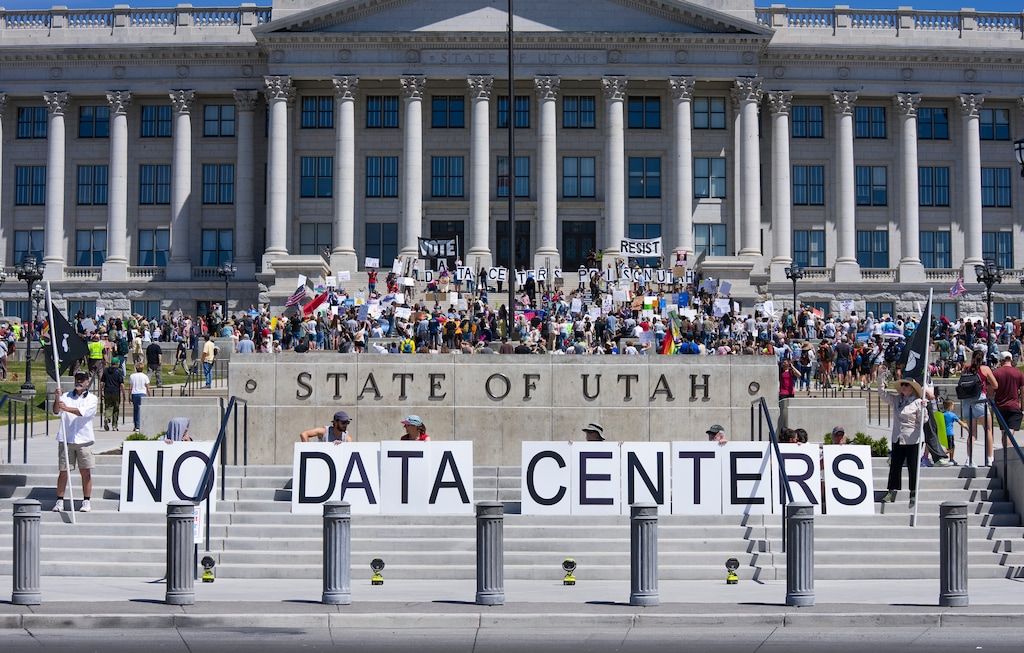
Utah is at a crossroads, and most residents don’t realize it. Massive AI data centers — projects that will reshape entire regions — are advancing with astonishing speed and minimal public scrutiny.
Two enormous developments are already proposed. In Box Elder County, the Stratos/Wonder Valley project would convert 40,000 acres of open desert into an industrial AI and energy complex. In Millard County, Joule Capital Partners is pushing a 4,000‑acre AI campus near Fillmore. Other communities — Cedar City, Nephi, Santaquin and Eagle Mountain — are being eyed next. These are industrial megasites that will permanently alter rural Utah.
Water • Utah is one of the driest states in the nation, yet AI data centers can consume millions of gallons of water per day. In counties already facing groundwater depletion, diverting water to cool servers threatens agriculture, wildlife and long‑term community survival. Residents must demand full water‑use disclosures, challenge water‑rights transfers and insist on low‑water cooling technologies.
Energy • These campuses require electricity on the scale of entire cities. That means new transmission lines, new substations, and potentially higher costs for ratepayers. Utahns should not subsidize private tech infrastructure. Counties must require independent grid‑impact studies and firm commitments to renewable energy.
Land and environment • The Box Elder proposal would fence off tens of thousands of acres, disrupt wildlife corridors, increase dust pollution and sit near the already‑endangered Great Salt Lake. Millard faces similar risks. Utahns must push for environmental impact studies and challenge rezoning of agricultural land.
Transparency • Many counties have moved these projects forward with limited documentation and minimal public notice. Utah’s GRAMA laws give residents the right to obtain contracts, studies and communications — but only if they speak up.
Act now • Attend meetings. Submit comments. Challenge zoning changes. Organize. Contact legislators. Public pressure already forced Stratos to cut its project size by 50%. Utahns can still shape what happens next.
Kathryn Kair, Sandy