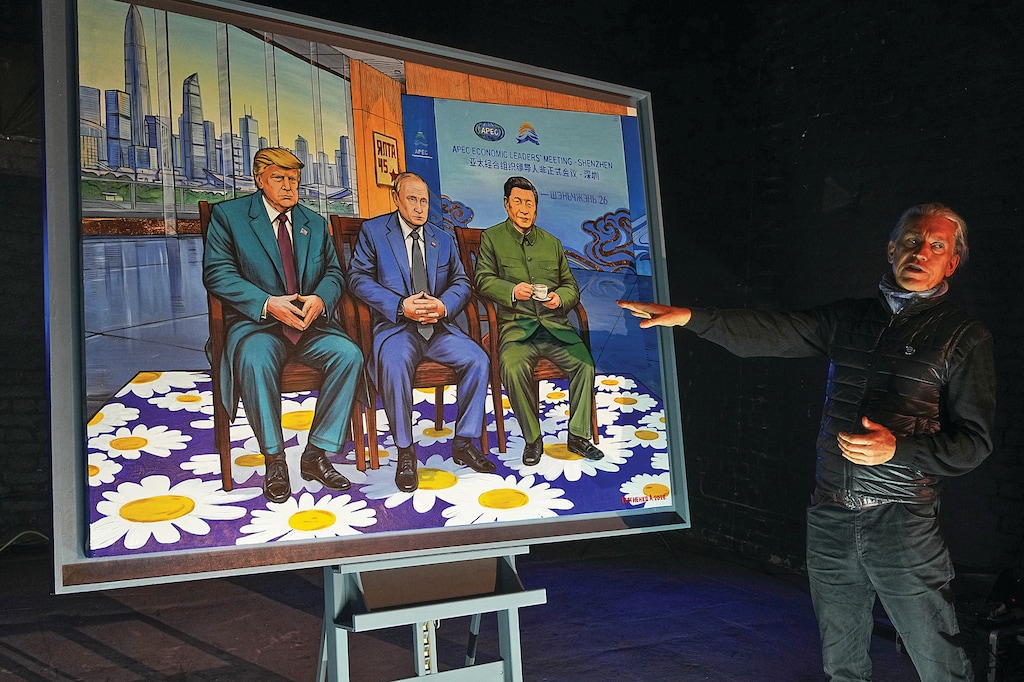
A vexing feature of President Trump’s foreign policy is his unfailing attraction to the world’s two dominant strongmen, President Xi Jinping of China and President Vladimir Putin of Russia. Like a deer drawn toward the intriguing smell of the hunters’ blind, Mr. Trump seems compelled to engage with both authoritarian leaders.
Mr. Trump’s desire has produced generally anticlimactic bilateral engagements so far in his second term. The 2025 Alaska summit with Mr. Putin made no headway on ending the war in Ukraine. The three recent meetings with Mr. Xi made little progress in easing trade tensions or increasing artificial intelligence safeguards. Now, all three leaders are set to convene in an unusual trilateral forum on the sidelines of the Asia-Pacific Economic Cooperation in Shenzhen, China, this week.
For Americans and their like-minded partners, little that is beneficial can come from the meeting.
Most American multilateral gatherings in recent decades have convened states that largely shared our national interests, like the maritime democracies of the so-called QUAD — India, Japan, Australia and the United States. This would be the first time that a sitting American president has jointly met with the leaders of China and Russia, who represent systems and approaches to global affairs that are widely considered antithetical to American interests.
Mr. Trump’s spokesmen and sycophants say doing so will advance peace in Europe and buy time while the United States builds resilience in its critical minerals stockpiles. It is difficult for them to explain the president’s obvious zeal for the gathering when he is so evidently unenthusiastic about Group of 7 summits with the seven richest democracies, or meetings with European Union leaders. It is even harder given what Mr. Xi and Mr. Putin are doing behind the scenes to undermine America.
China is the principal backer of Russia’s war against Ukraine, providing essential supplies that keep Moscow’s missiles and drones flying. Russia is giving Iran satellite imaging and overhead targeting data even as Iran strikes U.S. military assets in the Gulf region. Chinese companies have provided Iran with crucial missile components. Joint Chinese and Russian military exercises in the western Pacific are increasingly active around Japan and near contested island territories. Beneath the appearance of accord at the trilateral summit, Mr. Trump will be making nice with opponents who have daggers drawn against our allies and partners in three of the world’s most dangerous spots.
The Trump administration completely misunderstands the complexities of the Russia-China relationship. In that, it is not alone: There are few bilateral relationships that American strategists have historically so thoroughly misdiagnosed. In the 1960s, the best and the brightest in the United States were very late in realizing the opportunity presented by the Sino-Soviet split; now they underestimate just how significant the Russia-China partnership has become.
Since Mr. Xi came to power in 2012, he and Mr. Putin have met officially about 50 times, an extraordinary tempo of high-level diplomacy. In theory, Russia and China, with their history of distrust, border disputes and conflicting ambitions, should not get along. In practice, these two like-minded men have built one of the most durable security partnerships on the planet. Each side no doubt worries about the future of that collaboration, but for now it is deeply consequential and immune to efforts to split them apart.
What will the three leaders discuss at this summit? China is rapidly and quietly building up its nuclear arsenal, which is much smaller than Russia’s or America’s, and so it will seek to avoid any negotiations that would keep it from catching up. Russia will talk only in ideological generalities about peace in Europe. The United States will be loath to beg for assistance in ending the war in Iran, particularly from the two countries most actively supporting Tehran. Russia will not want to talk much about A.I., as doing so will highlight how it is badly behind. Boosting global energy supplies is an issue tangled up in the disruptions in the Persian Gulf. Global development needs would be an awkward topic now that the U.S. has sharply reduced its humanitarian assistance efforts.
The lack of a clear agenda for the trilateral summit is going to make Mr. Xi uncomfortable, and he is unlikely to agree to any spontaneous deals. He is focused on achieving a fourth five-year term in office next year, the longest stretch in power of any recent Chinese leader, and he does not like surprises. Given Mr. Trump’s proclivity for improvisation, Mr. Xi will be wary of any attempt at a diplomatic breakthrough.
So the primary consequence of the trilateral summit in Shenzhen may be the message conveyed by three would-be strongmen standing together astride the planet, surveying the scene. This will send shivers among America’s traditional allies — clearly a plus for Mr. Putin and Mr. Xi, and probably irrelevant to Mr. Trump. Even if the discussions focus only on the stonework in Mr. Trump’s new ballroom, the flight time from Moscow to Shenzhen or the quality of the local Cantonese cuisine, projecting the image of these three leaders meeting together may well be the real purpose at work in Moscow and Beijing.
Kurt Campbell is the chairman and a founder of the Asia Group, an advisory firm. This article originally appeared in The New York Times.