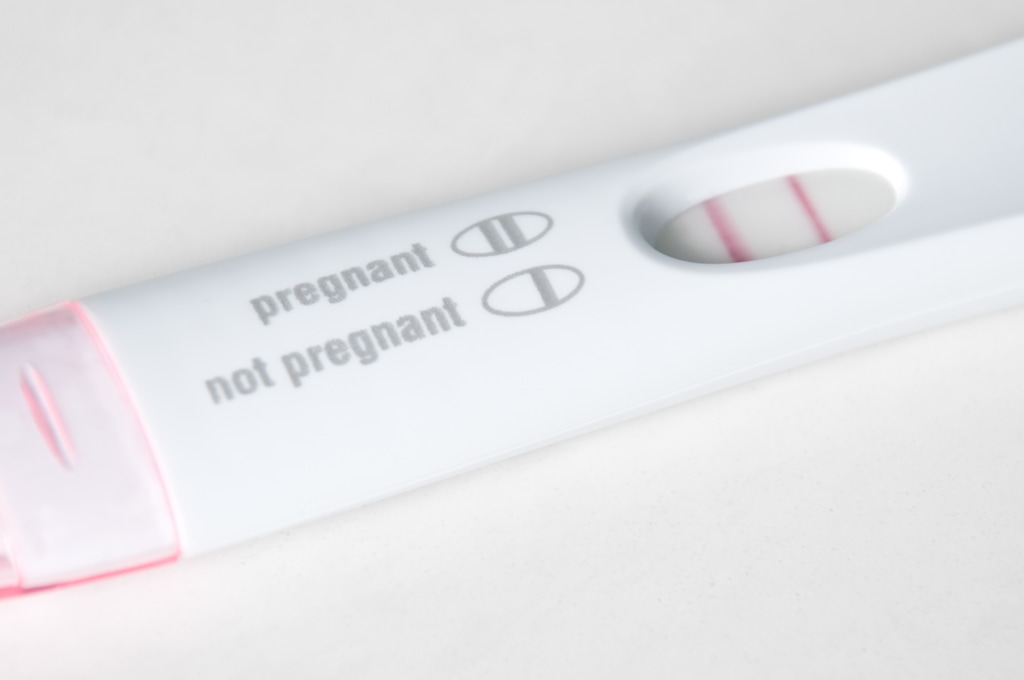
March 15 was gray and brisk, the kind of Utah morning that can’t decide if it’s still winter. I woke up excited and nervous. I’d been waiting two weeks, counting down the days until I could take a pregnancy test. I held my breath and filled with joy when two pink lines showed. Positive!
I’d been trying to get pregnant again for three years. I’d already lost three pregnancies to miscarriage. So, when the two lines appeared, I felt joy, plus a guarded kind of hope, one I needed to ration before I spent it too quickly.
Because of my history, my doctors started blood draws every 48 hours. In a healthy pregnancy, the pregnancy hormone, hCG, doubles. Mine didn’t. It moved up a little, down a little, never the healthy climb that means the baby is growing.
By the first week of April, my doctors and I knew my pregnancy wasn’t viable. But knowing wasn’t enough. My care team moved with caution that had nothing to do with my case and everything to do with the landscape doctors are practicing in today. For the next two weeks I went in every other day, undergoing more than eight ultrasounds, blood draw after blood draw, all while still working full time, and showing up at home to be the mother my son needs.
By late April, my doctors diagnosed me with a Pregnancy of Unknown Location, and treated me with methotrexate, a drug that stops a pregnancy from progressing. But because my pregnancy was already eight weeks along, the medication failed. One week later, I was given a second dose. My hormone numbers started to fall. But on May 5, days after the second dose, my ectopic pregnancy ruptured.
My husband rushed me to the emergency room, where I was taken directly into emergency surgery. The surgeon found the pregnancy in my left fallopian tube, and I lost both my baby and my left tube. I spent the next six weeks on bed rest, deeply grateful to the medical team that got me into the operating room before I bled out, but also mourning what I had lost. I spent Mother’s Day aching for the babies I never got to hold, and reeling from how close I’d come to leaving my son motherless.
A ProPublica analysis published this month found that deaths involving ectopic pregnancy have nearly doubled since 2020. That rise has been steeper in states with strict abortion bans. Maternal health experts told ProPublica that a death from ectopic pregnancy should be a “never event.” With prompt treatment, it almost always is. But doctors described colleagues hesitating to act on a probable diagnosis, waiting instead for one certain enough to survive a prosecutor’s second-guessing.
I didn’t die. But I lived the version of that caution that medical professionals are continuing to struggle with: weeks of testing, and treatment withheld until every other explanation was ruled out, even after the outcome was obvious.
Utah’s near-total abortion ban has been blocked in court since 2022, and abortion here is currently legal up to 18 weeks. But the ban has never gone away, and if it takes effect, it excludes ectopic pregnancy removal from the definition of abortion entirely. What it doesn’t do is say how certain a doctor must be before acting on that exclusion. That silence doesn’t protect doctors, it puts them in an impossible position: treat based on their best medical judgment and risk a felony or wait for more proof and risk their patient’s life. My doctors were excellent. The uncertainty around them, not their judgment, is what cost me those two weeks.
On Oct. 5, the Utah Supreme Court will hear arguments over whether Planned Parenthood’s challenge to that will be heard in a fair forum, after the Legislature requested to reroute the case to a three-judge panel of its own design. What that court decides will determine how much longer this uncertainty hangs over every woman in Utah who gets a positive test and then, days or weeks later, receives a similar diagnosis.
I’m a lawyer. I understand the instinct to write statutory exceptions narrowly. But I know what it costs to build that certainty in real time, in a body quietly bleeding internally while everyone waits for enough proof. It nearly cost me my life. It nearly cost my son his mother.
I want to be a mother again more than I’ve wanted anything. I don’t know if my next pregnancy will end differently. I believe we can write laws that keep women safe if we’re willing to learn from experience. I hope we can do better for the next woman, so she doesn’t have to wait to find out whether the pregnancy she’s grieving is also about to kill her.
(Anastasia Morgan) Anastasia Morgan is an attorney and mother, living in Sandy with her husband and son.
Anastasia Morgan is an attorney and mother, living in Sandy with her husband and son.
The Salt Lake Tribune is committed to creating a space where Utahns can share ideas, perspectives and solutions that move our state forward. We rely on your insight to do this. Find out how to share your opinion here, and email us at voices@sltrib.com.