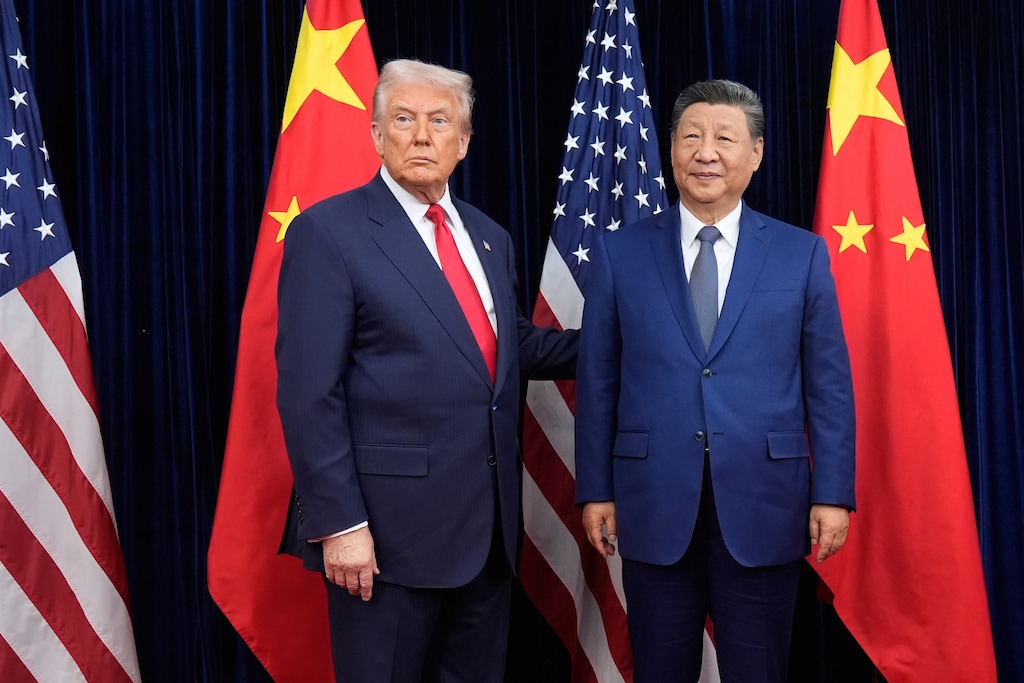
Before Iran, before Iraq, before Afghanistan there is no country that America has gotten as wrong as China. If this is mystifying, it is only because historical memories are short. America struggled through the previous fiascos. Getting it wrong again would be catastrophic. This is why it is crucial that President Trump strike the right balance in his summit this week with China’s leader, Xi Jinping.
During World War II, the United States backed China’s Chiang Kai-shek against the Japanese fascists who had invaded in the 1930s. The Roosevelt administration assumed that China under Chiang’s Nationalists would constitute one of the Big Four powers after World War II, along with the United States, Britain and the Soviet Union. When the Chinese Communists under Mao Zedong swept to victory in the 1946-1949 civil war, Washington was shocked that a movement it had barely acknowledged had toppled the beloved Chiang. It was also enraged that the Soviet Union and China were now both in Communist hands. Someone had to be held to account.
Thus was born the “who lost China?” debate, a critical element of the Red Scare of the 1950s. The State Department officials held to account were precisely the ones who during World War II had been warning, to no avail, that the Communists were likely to militarily triumph. Rather than being celebrated for their clairvoyance, these officials were denounced as traitors whose weak support for the Nationalists had led to Chiang’s fall. The idea that the State Department could have prevented a Communist takeover across a landscape of 550 million people — 37 times the population of South Vietnam during our war there — gravely misjudged the limits of American power.
The Foreign Service officers themselves weren’t innocent. Though accurate about Mao’s chances, they misunderstood the nature of his rule. They conceived of Mao’s Communists as benign compared with Chiang’s Nationalists. Based in the Nationalist wartime capital of Chongqing, they knew intimately Chiang’s authoritarian tendencies. They made only short visits to the Communist base camp in Yan’an, visits that were stage-managed by Mao and his propagandist Zhou Enlai. Impressed by the order and discipline of Yan’an, they were blind to Mao’s totalitarianism, which would eventually result in the murder and starvation of as many as 70 million Chinese.
The 1950s purge of State Department specialists actually lasted into the 1960s. The Vietnam War was encouraged by Europeanists and generalists because the China hands who would have warned against the dangers of guerrilla war in Asia, and who would have noted that Vietnam had never been a puppet of Communist China, were no longer in key positions in government. There is a direct historical link, through China, from the Red Scare of the early 1950s to the fiasco in Vietnam in the middle and late 1960s.
The diplomatic opening to China accomplished by President Richard Nixon and his national security adviser, Henry Kissinger, in 1972 finally ended the Who Lost China debate. China was no longer lost and had instead become a geopolitical chess piece to be played against the Soviet Union. Nixon’s and Kissinger’s conception held until 1989, when the combination of China’s brutal crackdown at Tiananmen Square and the end of the Cold War meant that China was now both reviled, and, with the demise of Communism in Europe, less of an asset.
It was China’s economic and technological flourishing, particularly in the 1990s, that required the United States to treat the country as a great power. So dynamic were Jiang Zemin and his deputy Zhu Rongji that both Democrats and Republicans assumed that if China were admitted to the World Trade Organization, the country would be on a path toward a capitalistic and liberal society. President Bill Clinton held this view — and he was far from alone.
That was Washington’s third misjudgment. The Washington establishment — the wind at its back following the triumphalist end to the Cold War — assumed China would follow Europe’s path toward freedom. Alas, China was not Europe. Admitted to the W.T.O., China would eventually turn back toward full-bore authoritarianism under Xi Jinping.
Each of these mistakes has particular causes. They are also connected by China’s size, complexity and outright cultural difference. Only recently, thanks to pathbreaking scholarship by the Hoover Institution academic Frank Dikötter, have we learned the full story of just how much Stalin was aiding Mao during the civil war, making a Nationalist victory even more remote. Analysis of China, unlike that of the Middle East, is not distorted by intense partisanship, but even for an emotionally detached expert class, China is genuinely hard for the United States to fathom.
What stabilizes the bilateral relationship has been the deliberately vague understanding concerning Taiwan that emerged from Nixon’s visit, known as the Shanghai Communiqué. That formula signaled that there was only one China and its capital is Beijing, but that neither party would attempt violently to change the status quo on Taiwan.
For the first time since 1972, the Shanghai Communiqué may be in particularly serious danger. There have been slip-ups, as when President Joe Biden declared he would defend Taiwan, thus abandoning the Nixon formula of ambiguity. But generally presidents exercised rhetorical restraint.
That is no longer the case in the Trump administration, with the president’s stated position on Taiwan and the Asia-Pacific forever volatile. As for China, it is no longer governed by a mandarinate of enlightened Communist leaders, but by Mr. Xi, a Leninist totalitarian with openly aggressive designs on Taiwan. The guideposts are wobbling. Despite the happy talk at summits, we are back to the Who Lost China era, when fundamental mistakes are possible, this time with incalculable consequences. In addition, because neither China nor the United States seems interested in cooperating to regulate A.I., competition over the technology is poised to further destabilize the relationship.
The ultimate geopolitical catastrophe would be a military conflict over Taiwan and the South China Sea. Avoiding such a conflict is not merely a matter of reducing military tensions. As the Yale Sinologist Odd Arne Westad points out, it was Germany’s assumption that Britain might not come to the aid of its allies in 1914 that helped set off World War I. If China assumes the United States might not come to the aid of Taiwan, that might likewise increase the chances of war.
Wars in Ukraine, Gaza and Iran have led to severe differences of opinion among both the public and the elites, but have not fundamentally changed our lives. A high-end military conflict in the Western Pacific fought between the world’s largest economies would disrupt the most vital supply chains and change our world profoundly. The comparison with World War I is not an exaggeration.
Who Lost China was born of an obsession and a misunderstanding. In the late 1940s, the obsession was with Communism, which replaced German Nazism and Japanese fascism as America’s principal enemy the moment World War II ended. Then, the United States thought it had the power to save Chiang’s weakened regime in a war fought over thousands of miles of territory.
The obsession today is again with Communism, in the shape of China overtaking the United States as the world’s greatest military, economic and artificial intelligence power. The misunderstanding is that a softer, less resolute approach to defending Taiwan and our other Asian allies can somehow prevent a war. In reality, such an approach might embolden China to attack the island, leaving the United States in a hair-trigger crisis over the fate of the entire Pacific.
The most important element in preventing a great war is policy discipline. Boring but true, this leads to steady, predictable signaling. America should not want to confuse China, just as China should not want to confuse us. World War I was in part caused by a misreading of intentions. Mr. Trump, by his vacillation — including using military aid to Taiwan as a bargaining chip with China and toying with the abandonment of Asia to a Chinese sphere of influence — irresponsibly encourages the kind of confusion that can lead to war.
The historian Barbara Tuchman followed her classic book about the outbreak of World War I in 1966 with “The Proud Tower,” about the glittering, cosmopolitan world of 19th-century Europe, and how its texture and brilliance and naïveté was lost because of the Great War. The theme Tuchman chose for her book was taken from an 1845 Edgar Allan Poe poem: “While from a proud tower in the town/Death looks gigantically down.”
No geopolitical conflict in the world today has the capacity, if miscalculated, of bringing ruin upon us all like the one between the United States and China. China tore through our domestic politics three-quarters of a century ago. It could be worse this time.
Robert D. Kaplan is a writer and an analyst of U.S. military and foreign affairs. This article originally appeared in The New York Times.