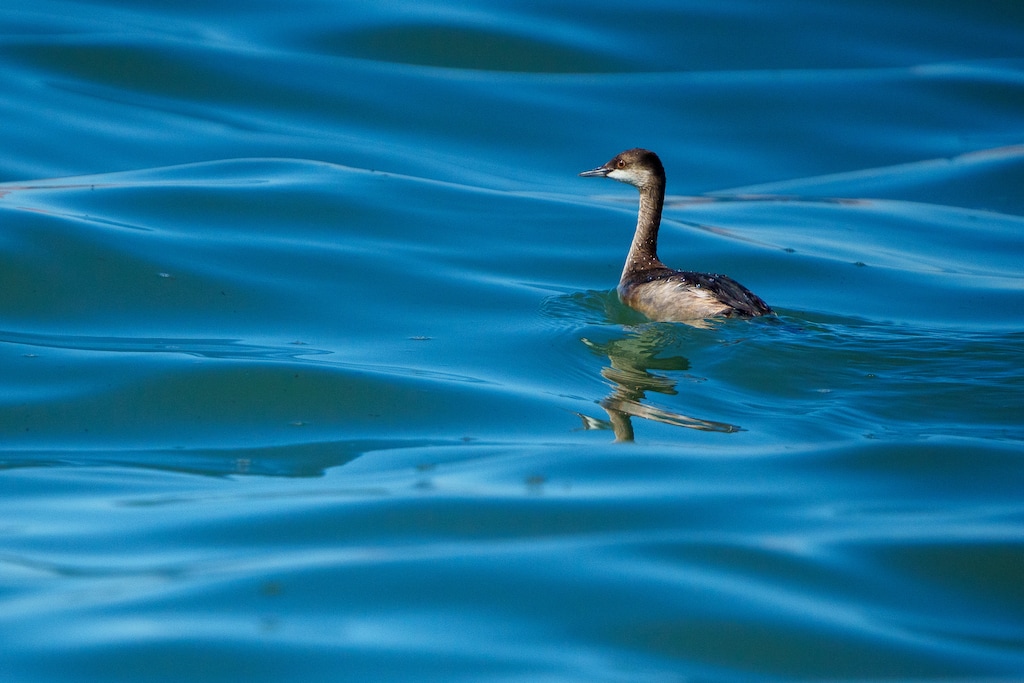
Last month, a group of citizens young and old gathered in 100-degree heat in a Salt Lake City garage to make hats out of cardboard and papier-mâché of a small, charismatic water bird. With its bright red eyes and splash of golden feathers resembling lightning set against jet black, the eared grebe makes for a striking headpiece.
Forty miles away, on Great Salt Lake, soon around four million eared grebes will be fattening themselves on brine shrimp and flies before a long migration south. Grebes are known as “hell-divers” because they are fearless and capable of inflating and deflating themselves as hunters and disappearing from danger.
One danger they can’t escape is the rapid shrinking of Great Salt Lake, and their food source with it. Each eared grebe eats 30,000 brine shrimp a day in the fall. If Great Salt Lake disappears, the eared grebes disappear with it. Habitat matters. That’s why citizens and scientists with the Center for Biological Diversity will request protection for the bird under the Endangered Species Act this winter. The grebe is one of Utah’s local heroes, revered and grieved as it nears the quicksand of extinction.
The Endangered Species Act is one of the few environmental laws formidable enough to hold developers accountable for the destruction of habitat — be it diverting water from a lake for agriculture, drilling for oil or building dams and golf courses. The law can shut down or force amendments on any project or operation that threatens the well-being of an endangered species.
For decades, the law’s critics have tried and mostly failed to dismantle its power and integrity. But this year, the Trump administration found a legally binding way to defang it. On Sept. 14, the Endangered Species Act will be revised under a new rule that says habitat destruction no longer falls within the definition of what constitutes harm. In other words, the Departments of the Interior and Commerce have said any stress an animal or plant may face over the loss of its habitat is irrelevant to its well-being.
Officials have justified the change by claiming that environmentalists have “weaponized” the law and that in any case it has fallen short of its goal to help populations of endangered species recover. In truth, this complaint shows just how effective the act has been. The Endangered Species Act has a 99 percent success rate: Almost every imperiled species listed is still with us. A study by the Center for Biological Diversity showed that without the law, an estimated 291 species would have most likely become extinct. Among the species that have made impressive recoveries are bald eagles, peregrine falcons, American alligators, brown pelicans and gray and humpback whales.
Hundreds of thousands of Americans submitted public comments on the proposed rule, and 99 percent of them opposed it, arguing you cannot protect an endangered species without protecting the environment that allows it to flourish. Environmental groups, 20 states and the District of Columbia have filed lawsuits arguing habitat destruction is within the definition of harm — anything that disrupts animals’ food, shelter or breeding — intended by Congress when it passed the law in 1973.
Some 53 years later, it seems that America’s leaders no longer appreciate that we live in a world of wonder. Their actions suggest we have become not just a threatening species, but a lost species. What if 50 years from now, having plundered America the Beautiful and destroyed the habitat for the creatures around us, we are plagued by an inconsolable loneliness because so many species have left us?
The act of protecting a tiny black bird that weighs roughly a pound reminds us that we are not the only species that lives and grieves on this planet. We are a companion species to grebes and all other forms of life on Earth.
We need the natural world — alive with birdsong, clear-running creeks and breathing forests. Octopodes camouflaged in tide pools will forever delight the child who reaches out to touch their flesh and is surprised by a swirl of purple ink, signaling the octopus has vanished. The rolling bugle of sandhill cranes at dusk on the tundra is the perfection of 2.5 million years of evolution. We live in an enchanted world if we can humble ourselves long enough to see it and slow down enough to feel it.
Those of us who find ourselves rapt in the soul of wildness recognize the Endangered Species Act as an act of reparation, a recognition of the harm humans have inflicted on other species and the landscapes they inhabit.
Where I live, Great Salt Lake is showing us in her retreat that we are intrinsically bound to winds and water. The diversion of water from entering the lake, especially for agriculture as it is currently practiced, could leave three million of us inhaling clouds of toxic dust from the exposed lake bed. Millions of shorebirds and waterfowl such as the eared grebe will be hovering above, looking for a place to land. Together, we will be among the displaced with nowhere to go.
Attaining threatened status for the eared grebe will not be easy with President Trump’s rule change. The process to get any threatened or endangered species on the federal list is always an act of faith, alongside science, long and arduous. It requires a comprehensive scientific review, and evidence that the species’ survival is imperiled.
Some Utah lawmakers call us foolish for making bird hats and puppets. Other lawmakers see 1,000 square miles of exposed lake bed, salt-encrusted and cracked, as “new land” around which to build data centers, detention centers and a national repository for nuclear waste. But there will be a tremendous cost in continuing to choose this form of economic gain over ecological health.
In the fall of 2022, Great Salt Lake was at its lowest recorded water level. Brine shrimp were suffering in high salinity, their population in danger of collapsing. Two months later, when I was walking with friends on the shores, we encountered hundreds of dead eared grebes, slapped down by a storm. The birds were thin and gaunt — they most likely had become too weak from lack of food to weather the blizzard. I bent down and placed my hand on a particular grebe’s stone still body — her vibrant red eye half-open — the streak of gold feathers still shimmering. I asked for forgiveness.
Terry Tempest Williams’s most recent book is “The Glorians: Visitations From the Holy Ordinary.” This article originally appeared in The New York Times.