Note to readers • This is part of a collaborative project between The Salt Lake Tribune and the Cougar Claw, Kearns High School’s student newspaper. Read more about these young Utahns’ experiences and perspectives here.
When I was younger my grandmother, Rosa, always told me: “Mijo, remember where you come from, and don’t let anyone disgrace our heritage.”
I grew up hearing this phrase from her my whole life.
She came from Sinaloa, Mexico, and my grandfather, Oskar, came from Copenhagen, Denmark. After World War II, Oskar was looking for a wife after his previous wife passed away. He went to Mexico and put an ad in a newspaper. Rosa, upset at her mother for bugging her about getting a husband, saw the ad and answered it. She married Oskar in Mexico. They had three children: Joe, Fernando and my mother, Carmen. All three were born in the U.S. and then moved back to Mexico. Then, when my mother was 7 years old, they moved to South Salt Lake, which is where I was born.
My mother was barely getting paid stocking shelves at Walmart, so while we were broke we lived with my grandmother until I was 10 years old. South Salt Lake was a welcoming place because it was filled with migrants that my family and I could relate to — like Mary, a friend of my grandmother, who came from Venezuela.
My uncle, Joe, has a car club building lowriders. I heard him and his brother talking about fixing up cars when they visited my grandmother’s house every week while I lived there. Pieces of that childhood never left me. When I was really young, I would watch the lowriders in the Sugar House area and car shows at Liberty Park.
I feel migrants are looked down upon in Utah, kind of like the lowrider culture. When I was around 3 years old, my mother told me she tried taking us to a Latter-day Saint church, but was told we needed to go to a refugee church due to our race.
When I tell people that I come from South Salt Lake, sometimes they say they don’t want to talk to me because of the crime rate.
When people hear the word “lowrider,” the first thing they might picture is a gang member in their Impala shooting rivals or innocent people on the streets, but that simply isn’t true. That’s an old stereotype based on racism.
People like Mel, a Kearns resident who belongs to a car club, pushes back against this stereotype. He says that, “There were individuals that might’ve been causing problems … and it just attached itself to, you know, stereotyping.”
“In today’s world,” he adds, “we have brought that to a different class, and I think lowriding today is very well recognized and respected by lots of people.”
Tony, who is in the same car club, agrees.
“A lot of those [gang members] were in the lowrider and stuff, but there’s a difference between that and the lowrider culture. The lowrider culture is a lot of good, genuine people that have put a lot of hard work into their cars and are family oriented.”
“The lowrider culture came a long way to be where they are now,” he adds.
Lowriding started after World War II by Mexican Americans as a way to show cultural pride. Modified cars with elaborate paint jobs would drive “low and slow” through towns. But drivers were harassed by police, according to Smithsonian Magazine, and California passed a law banning the practice in 1958. Just three years ago, California passed a law allowing cruising and lowriding.
For me, the lowrider culture is more personal.
When I was 14 years old, my mother was looking through old pictures and scrapbooking them. She stopped at a picture of my uncles, Joe and Fernando, in front of their Ford Mustang at a show. She gave that picture to me.
(Erik Dahlgreen) Erik Dahlgreen's uncles — and a friend — in front of their Ford Mustang.
I didn’t care about it until my grandmother passed away two years ago. I remembered what she told me when I was little, and I connected the pieces.
I wanted to inherit her car — a 1988 Nissan Stanza Sedan — and turn it into a lowrider.
(Erik Dahlgreen) Erik Dahlgreen's grandmother, Rosa.
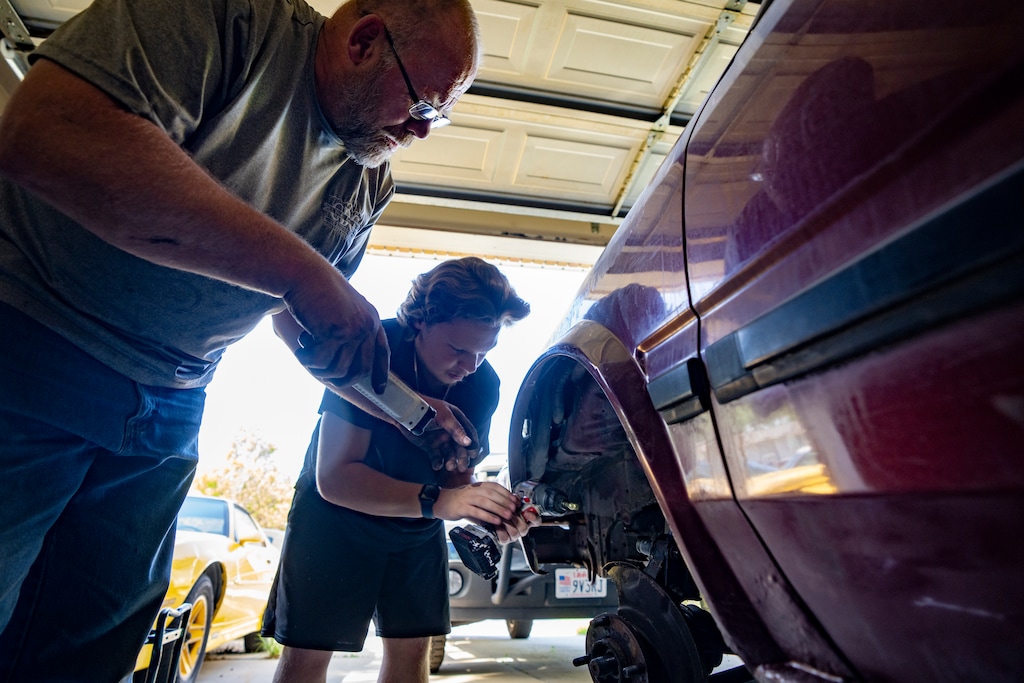
When I mentioned this to my stepfather, Michael, he was skeptical because the car hadn’t been driven in 10 years. He had helped us find a good home in West Jordan and find financial stability when I was about 10.
But the more we worked on it, the more he got into it.
There’s a common phrase in the lowrider culture: “If it’s not a Chevy, don’t lift it up.” It may not be a Chevy, but it gives my family and me value and strength. I feel that my grandmother is right by me, guiding me through this process.
In the lowrider culture, people honor their families, religion or culture with the art they put on their car. I’m honoring and remembering my grandmother with everything I do. I am choosing to paint Azteca art and roses on the top to represent my grandmother, Rosa. And I will install a portrait of her on the inside of the trunk.
I keep the picture of my uncles both wearing blue button-up shirts with their friend and their Ford Mustang with me at all times on my phone. It’s a reminder of where I come from and that I can do this, as well.
Doing this work has shown me where I come from. It’s how I found my true identity. But the true thing I’ve learned through this journey is this: Do not let your race be an embarrassment to you, use it to empower you to do things that you want to do. Embrace it.
(Rick Egan | The Salt Lake Tribune) Erik Dahlgreen is a member of the Kearns High journalism class, on Wednesday, May 13, 2026.
Erik Dahlgreen is a junior at Kearns High and writes for the Cougar Claw, the student newspaper.
The Salt Lake Tribune is committed to creating a space where Utahns can share ideas, perspectives and solutions that move our state forward. We rely on your insight to do this. Find out how to share your opinion here, and email us at voices@sltrib.com.