Note to readers • This is part of a collaborative project between The Salt Lake Tribune and the NS Times, North Sanpete High School’s student newspaper. Read more about these young Utahns’ experiences and perspectives here.
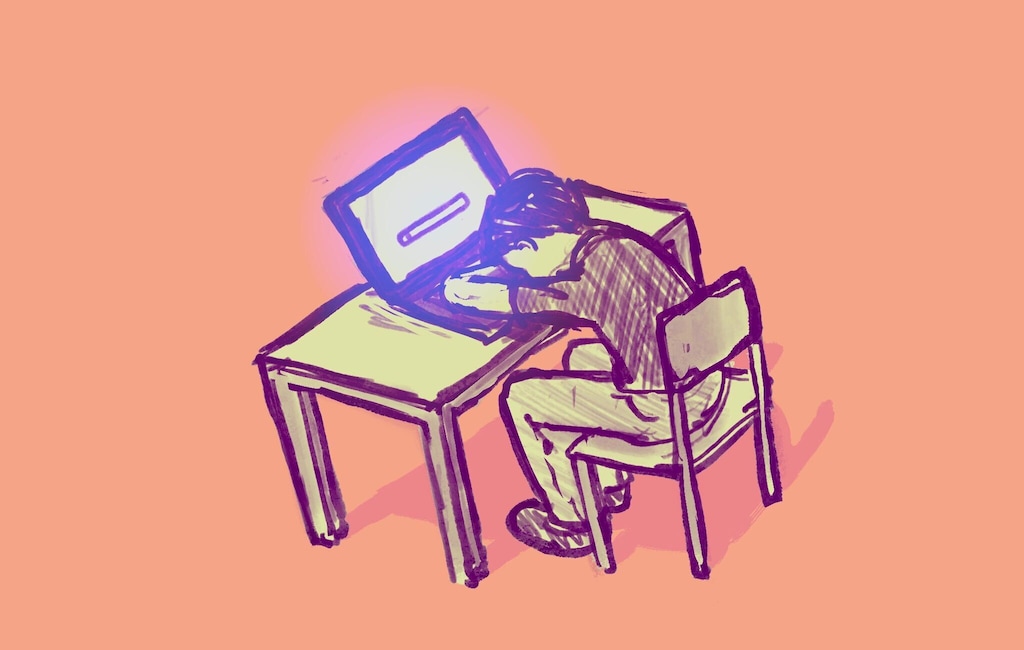
My computer screen remains unchanged. The assignment is due in half an hour, and I haven’t even started.
Looking around at my classmates, I see the majority of the class is finished. Most of my finished peers have one attribute in common: On each of their screens, a generative AI website is open.
Generative AI is problematic in schools. Recent studies show excessive use of AI can lead to less critical decision making skills and make it so people think for themselves less. Through AI, I’ve watched my peers become less creative and overall less personable.
I have seen others use AI on different assignments on a multitude of occasions. In addition to my own observations, data from a NS Times survey unveils experiences with AI. More than 14% of students who answered the survey say they feel AI has made them lazier. Additionally, 52.1% believe AI is making their peers lazier.
Looking at this data, we can see that some students recognize the negative effect AI has made on their lives. I believe that these two pieces of data highlight an underlying issue involving the use of AI: personal responsibility and laziness that results from the lack of personal responsibility.
What once was an environment that promoted learning is now filled with shortcuts. The value of figuring things out on your own is lost to time — and that makes me worried for the future of my peers. I am worried that my classmates are not taking personal responsibility. I am worried because I know firsthand how nice it is to use AI as an easy alternative to doing my work.
Every time I used AI in the past, it was to complete hard assignments that I did not understand. Through my choices, I feel that I have missed out on multiple learning opportunities.
I have since changed my mindset on AI and, in doing so, I feel that I became a better student.
Instead of relying on AI for my harder assignments, I try to focus on figuring things out for myself. If I can’t, I ask a friend or a teacher for advice. Sometimes, I use AI as a resource — but never to cheat.
However, I feel I am one of few who have shifted their view on AI. If students continue to use AI to do their work, I have severe worries for the future of my school. A student body that can’t think for themselves is a student body that won’t have success in the future.
The only way to fight AI in schools is for the students to take accountability. I want students to give up using AI on assignments.
Taking personal responsibility seems daunting for many, but if there was more support from the school for students to rely on, I believe that the negative usage of AI would dramatically decrease.
One possible solution would be to teach AI literacy within different classes, such as English. In this class, you could have multiple lessons on how to use AI sparingly and how to use it as research, not as cheating.
Through personal responsibility, I know that everyone at this school can set themselves up for a better future. I hope that my peers will discover the value in learning rather than relying on AI for all their questions.
(Andrew Madsen) Andrew Madsen is a managing editor of the NS Times, North Sanpete High School’s student newspaper. He also participates in speech and debate, where he will be the 2026-27 vice president.
Andrew Madsen is a managing editor of the NS Times, North Sanpete High School’s student newspaper. He also participates in speech and debate, where he will be the 2026-27 vice president.
The Salt Lake Tribune is committed to creating a space where Utahns can share ideas, perspectives and solutions that move our state forward. We rely on your insight to do this. Find out how to share your opinion here, and email us at voices@sltrib.com.