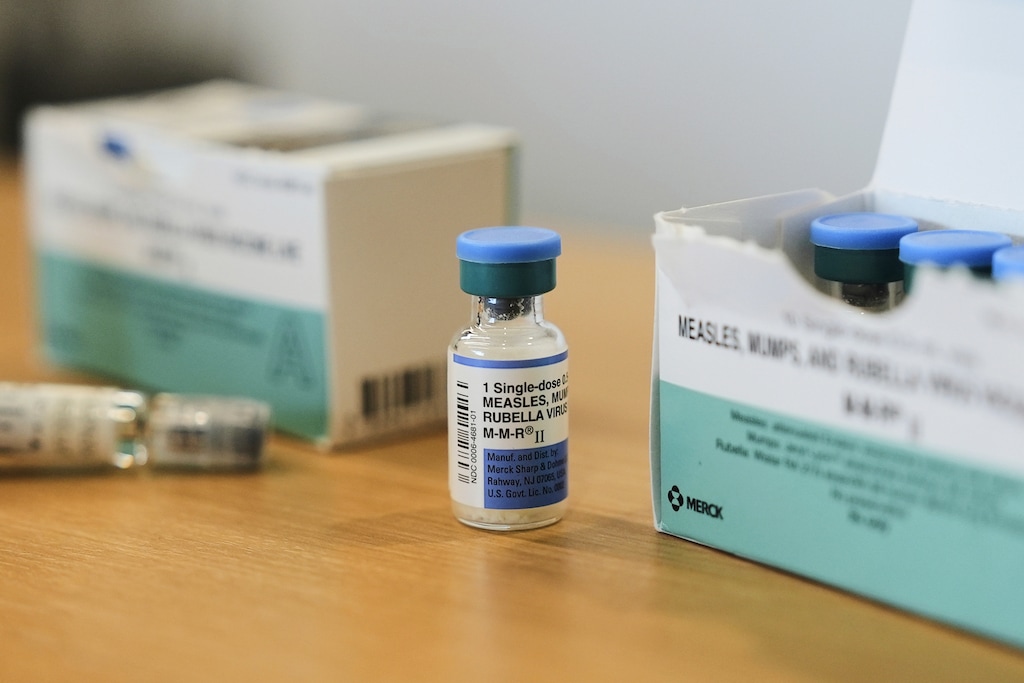
As a hospital-based pediatrician in Utah, I have seen children suffer from diseases preventable by vaccinations, and it is heart-breaking. I’ve cared for infants and children who have severe pneumonia from measles, respiratory failure from whooping cough and life-threatening dehydration due to rotavirus.
As measles resurfaces, the cost is borne most by those least able to bear it — Utah’s youngest and most vulnerable — making what we do next not just important, but imperative. Reversing our current trend will require a united effort, regardless of background, to rebuild medical trust, enhance public health messaging and pass legislation that protects our children’s health.
Vaccination rates are declining nationwide, and Utah is no exception. Utah has the 2nd highest exemption rate in the nation at 10.3%, double its 2021 rate. Utahns are seeing consequences of declining vaccination rates as it has accounted for one-third of the United States’ nearly 1,500 measles cases this year. We are having measles outbreaks first because it is the most contagious vaccine-preventable disease, requiring a community vaccination rate of 95% to protect communities.
Recent models have harrowing predictions for the future. If measles vaccination rates decrease just 1% yearly for five years, the U.S. can expect to see 85,000 measles cases by 2030, costing $8 billion dollars in cumulative national expenditures. If rates decline by 10%, that number increases to 11 million cases over 25 years.
The costs of this would be catastrophic. Early measles complications include hospitalization (around 1 in 10), pneumonia (1 in 20), encephalitis (1 in 1,000), and death (1 to 3 in 1,000).
Subacute sclerosing panencephalitis (SSPE), a degenerative inflammatory brain condition, also occurs years after a measles infection in 1 in 1,000 individuals. It is nearly always fatal and recently caused the death of a Los Angeles child.
As measles cases increase, these complications will cause many children to suffer unnecessarily.
Since the U.S. Vaccines for Children program was implemented in 1994, it has saved an estimated 1.1 million lives and $2.7 trillion dollars in societal costs. However, hospitalizations due to rotavirus have slowly increased over the past 10 years. Pertussis cases are recently higher than they’ve been in over a decade. Less than half of U.S. children received the flu shot, contributing to the U.S. having its most deadly flu season in 2024-2025 for children since 2010.
As vaccination rates decline further, we will incur costs from breakouts of other preventable diseases including diphtheria, rubella and polio, which paralyzes 1 in 200 children that contract it.
A tragic aspect of declining immunization rates is that the ones who are most affected are unable to be fully vaccinated themselves, specifically young infants, pregnant women, children with cancer and transplant patients.
Young infants with whooping cough often stop breathing without warning but cannot be vaccinated until they are 2 months old. Infants also have worse measles complications, but cannot be vaccinated until 6 months of age. One in 7 children who undergo organ transplant are hospitalized due to vaccine-preventable diseases. As rates decline, we fail to protect those who cannot protect themselves and rely on high community immunization rates.
The solution of improving vaccination rates is simple, but not easy. Parents who choose not to vaccinate love their children and are doing what they feel is best based on what they know and trust. At a time when trust is fragile, recent non-evidence-based changes to vaccine schedules have deepened uncertainty for families trying to do the right thing. Judging or guilting these parents drives a wedge between us and only worsens the problem.
Reversing the resurgence of measles in Utah will require rebuilding trust and understanding. Providers in clinics should listen without judgement and clearly explain disease risks and vaccination safety.
Public health messaging must also improve. Nationally, prominent voices from institutions, leaders and influencers have helped legitimize vaccine skepticism, making it harder for families to separate evidence from misinformation. Vaccine information campaigns can distribute accurate information by partnering with trusted community voices like faith leaders, educators and parent networks.
Policy must shift from lowering barriers to vaccination toward strengthening systems that protect children, including preserving school vaccination requirements and tightening — not expanding — non-medical exemptions. Policymakers should also bolster resources for immunization programs and prioritize equitable access to vaccinations. Examples of this include funding school-based vaccination programs and rural/after-hours clinics.
Preventable diseases like measles don’t return because we forgot how to prevent them — they return when we choose not to.
Utah stands at a crossroads of endemicity and elimination. The choices we make now are a matter of life and death for the children of Utah. The path forward is clear: If we want to protect our children, we must choose policies and a culture that improves immunization rates.
The question is, how bad will we let it get before we act?
(Nathan Money) Dr. Nathan Money is a board-certified, hospital-based pediatrician.
Dr. Nathan Money is a board-certified, hospital-based pediatrician in Utah and Fellow of the American Academy of Pediatrics.
The Salt Lake Tribune is committed to creating a space where Utahns can share ideas, perspectives and solutions that move our state forward. We rely on your insight to do this. Find out how to share your opinion here, and email us at voices@sltrib.com.