In 1986, as I investigated the mysterious death of my brother who worked for a federal contractor, I reached out to then-Rep. Norman Mineta of California for help.
At the time, I didn’t know that Norm, as I came to realize everyone called him, had been incarcerated with my parents as children in the Heart Mountain, Wyoming, prison camp for Japanese Americans forced from their homes after the attack on Pearl Harbor.
What I did know, and what most Japanese Americans knew, was that if you had a problem, Norman Y. Mineta was The Man to See.
Even before winning political office in his native San Jose, Norm built a life around community service. He served in the Korean War, helped thousands of Asian Americans find insurance, worked on community organizations, served as San Jose mayor, represented San Jose in Congress for 20 years and was a Cabinet official for two presidents, Democrat Bill Clinton and Republican George W. Bush.
After I became active with the Heart Mountain Wyoming Foundation and the larger Japanese American community, I learned even more about Norm’s commitment to his community and his country.
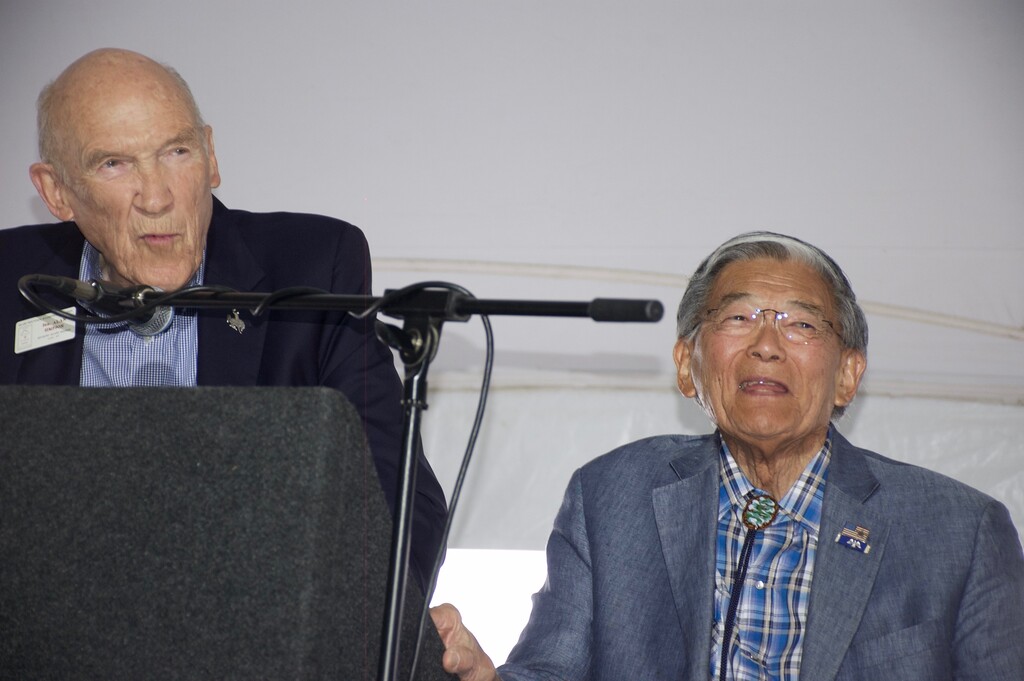
I learned of his astonishing friendship with Alan Simpson, the three-term Republican senator from Wyoming who first met Norm when they were both Boy Scouts at a jamboree inside the Heart Mountain camp’s barbed wire in 1943.
I learned of Norm’s everlasting commitment to bridging partisan divides to solve our biggest problems. That’s why the Heart Mountain Wyoming Foundation, which I now lead, is building the Mineta-Simpson Institute to honor both men’s commitment to building a better America.
Al Simpson calls Norm a Nelson Mandela or a Mahatma Gandhi-type figure who never gave in to bitterness after he and his family were treated so cruelly by their own country. Norm could have turned inward and declined to use his energies to help the thousands of others who sought his counsel, but he never did.
That’s what a leader does.
It was Norm’s experience as a child that led President Bush to reject punitive measures against Muslim Americans after the 9/11 terrorist attacks.
Bush said he was not going to do to Muslims what the U.S. government did to Norm, his family and 120,000 other Japanese Americans during World War II.
Norm never lobbied the president to make that decision. It was simply the power of his presence and example that carried the moment.
Knowing Norman Mineta has been an inspiration to me. When a documentary about his life premiered in Washington in 2018, I marveled at the presence of leaders of both parties who paid Norm tribute.
I also realized that I was not alone in knowing that I could call on Norm for help and guidance. Others did, too, even those whose rank in public affairs far exceeded mine.
That is why Norm’s passing on May 3 at age 90 will leave a huge hole in my heart and the world at large. He was truly that indispensable, and his instincts and advice were always on target.
The arc of his life showed that Norm learned from and honored his elders, brought others along as his career began to rise and continued to develop leaders long after he could have retired with his beloved wife Deni and family at his home on Maryland’s Eastern Shore.
Those are the lessons I take from the long and rich life of Norman Mineta, and I will strive to the end of my life to try to live up to his example.
(Photo by Brian Smyer) |Shirley Ann Higuchi
Shirley Ann Higuchi is a Washington, D.C., attorney and past president of the District of Columbia Bar. She chairs the Heart Mountain Wyoming Foundation (www.heartmountain.org), which runs an interpretive center at the site of the camp where her parents were imprisoned. She is the author of “Setsuko’s Secret: Heart Mountain and the Legacy of the Japanese American Incarceration,” released last fall by the University of Wisconsin Press. Follow her on Twitter at @HiguchiJD.