 Mark Eddington
Note to readers • This story is an excerpt from the Open Lands newsletter, delivered to inboxes every week. For a sneak peek from the environment team about what we’re working on and news we’re following, sign up to have Open Lands delivered to your inbox.
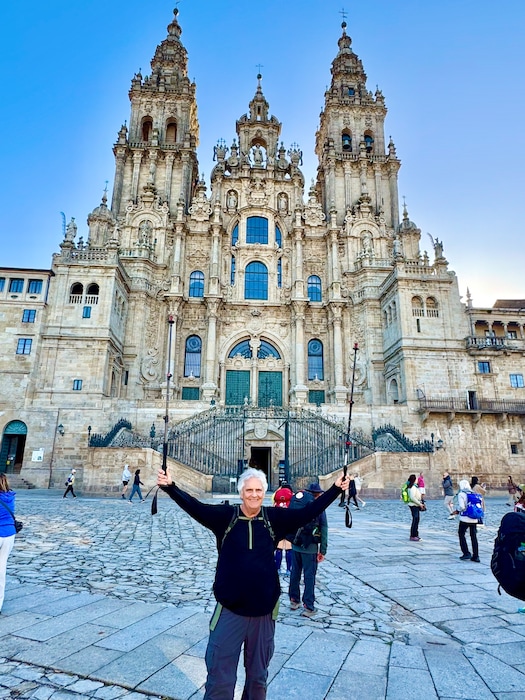
On Oct. 8, after five weeks and 500 miles of climbing, descending and occasionally questioning my life choices, I shuffled into Santiago de Compostela’s Praza do Obradoiro. The World Heritage square sits in front of the cathedral and marks the official end of Spain’s Camino de Santiago.
Before reaching the cathedral — where tradition says the bones of St. James rest — I had to hike the Camino del Norte, one of the most beautiful and challenging routes in the Camino network. I set out from Irun on Sept. 3 feeling ready. I’d trained with my backpack, walking before work and up to 15 miles on weekends. I had guidebooks, YouTube videos and expensive gear. I pictured myself as a bit of a conquering hero.
Alas, the Camino had other ideas.
On that first grueling stage, it didn’t take Sherlock Holmes to realize a much tougher game was afoot. As I climbed Mount Jaizkibel, an American couple I’d met online called out, “We’re right behind you, Mark!” I never saw or heard from them again.
The views of the Bay of Biscay were glorious, but I was busy sweating through my clothes and trying not to tumble down the stone-jutted trail. By the time I reached Pasajes de San Juan and ferried across the estuary, I was one trekking pole down and my shaky legs were doing an involuntary Elvis impersonation. Then came what I dubbed the “Stairway to Hell” — a climb so steep it made St. George’s Tech Ridge stairs and BYU’s Cardiac Hill look like a Sunday stroll.
(Mark Eddington |A beach on the Cantabrian coast in northern Spain.)
I’d imagined strolling on that first stage into San Sebastián, the food capital of Spain and celebrating at a Michelin-starred restaurant. Instead, I barely noticed the famous beach. I collapsed into the nearest café chair and called a cab to take me to my hostel. The Camino was already revising my itinerary.
The next beautiful, brutal stages nearly broke me. I was too wired to sleep and burning far more calories than I was eating. Then my pricey merino wool gear turned against me in the humidity, leaving me with painful rashes all over my body. My romantic vision of the journey was becoming less intrepid explorer and more man negotiating with his laundry.
A younger, dumber version of me might have pushed on until I ruined the trip. Instead, I swallowed my pride, skipped the grueling trek from Deba to Markina-Xemein and took a taxi to get medicine and new clothes.
Lacking Spanish, I relied on Google Translate, which inexplicably decided I needed ice cream instead of activewear. As the clerks at the sports store searched the racks, my phone live-translated one whispering to the other: “I couldn’t understand a damn thing he said.”
I mailed home the gear that wasn’t working, stopped to refuel whenever I could and learned to take better care of my feet. The trail didn’t get much easier, but I got better at accepting it as it was — not as I had imagined it.
That made the later stretches all the sweeter. Ocean views, green hills and eucalyptus forests fragrant after rain sometimes moved me to tears. I felt grateful to be there, and grateful for my life. The Camino helped me rediscover a childlike sense of wonder I hadn’t realized I’d lost.
(Mark Eddington | A sunrise at Finisterre served as a radiant benediction to my Camino.)
It also taught me about baggage. As I sent literal weight home, I thought about the old disappointments and resentments we carry around. If something isn’t helping us move forward, perhaps we don’t have to lug it along.
Unlike the apostle Paul, I never had a Road to Damascus moment. The closest thing I came to religious bliss was finding a public toilet, walking barefoot through the surf to soothe aching feet or being served a properly cooked burger. Some of the meat on my plate was so raw I half-expected it to run off before I could deliver the coup de grâce.
Above all, I learned that people are the real stars of the Camino. Pilgrims shared food, treated injuries and offered directions. Local people went out of their way to help when I got lost. And the journey brought out my better angels, too.
When Kate, a British pilgrim I walked a few stages with, realized she couldn’t find her phone, she urged me to keep going. I walked a short way, then turned back and retraced my steps for three miles. I found her just as she and two other pilgrims recovered the phone. I realized then that the Camino isn’t a race to the next bed. It’s a chance to look after one another along the way.
In Santiago, I attended the Pilgrim’s Mass and received my Compostela, the certificate awarded to pilgrims who complete the trek. Later, in Finisterre, I placed a stone on a cliffside in memory of Joshua Carter, my wife’s son who died in July 2025. The sunrise the next morning was one of the most beautiful I’ve ever seen — a peaceful benediction to my journey.
I wanted a Camino that would prove my stamina and courage. Instead, it gave me humility, gratitude, beauty and a renewed appreciation for how much we depend on one another. I didn’t finish as the conquering hero I’d imagined. I finished more grateful — and perhaps a little wiser — for having made it through.
It may not have been the Camino I wanted. It was the Camino I needed. And as the saying goes, the Camino does indeed provide.
Buen Camino!
(Mark Eddington | A stone lovingly placed on a Finisterre cliffside, overlooking the sea, to honor the memory of my wife Patti’s son, Joshua Carter, who died in July 2025)