 Robert Gehrke
It wasn’t long after Utah’s 2025 law barring pride flags and other unapproved banners from flying on government buildings took effect that the complaints started to unfurl.
It happened so fast that the state auditor, who was assigned to investigate and enforce the ban, hadn’t set up a system for tracking or probing the complaints.
The first recorded complaint came toward the end of May 2025, a resident upset about a “Thin Blue Line” flag — the flag showing support for law enforcement that resembles a black-and-white version of the Stars and Stripes but with one blue stripe.
The flag was allegedly displayed at the Academy for Math, Engineering & Science, a charter school in Murray. A representative of the auditor’s office visited the school, walked the campus and saw no banned flags.
That was how those initial complaints were investigated. A staffer would drive to the location and look for prohibited flags. That proved time consuming and was eventually abandoned not long after the office received a complaint of a prohibited flag displayed at the University of Utah’s satellite campus in Incheon, South Korea.
Now the inquiries typically consist of a letter or a phone call.
From Jack Sparrow to Donald Trump
In the 16 months since the law took hold, there have been 16 documented inquiries regarding banned flags on government buildings — plus a few more that came during the month before the auditor’s office had a tracking system in place.
The office’s correspondence, obtained through an open records request, ranges from standard complaints about pride flags, to an individual selling Confederate battle flags along Interstate 15, to a Donald Trump campaign flag hung in a state building, to a banner with an image of the Disney pirate Jack Sparrow.
The auditor’s office determined that the offending Jack Sparrow flag at the JL Sorenson Recreation Center in Herriman hadn’t been put there by the county, and it was unclear if it even met the standard for being “displayed” since it was “a small one visible only from the parking lot and partially obscured by trees.”
State Auditor Tina Cannon said in a statement that her office will continue to enforce compliance with the ban — even if she is less than thrilled with the assignment.
“I have also made no secret of my view that regulating flags is an unusual use of the state auditor’s financial expertise and statutory authority,” she said. “We will continue to administer the law as written, while encouraging the Legislature to consider whether oversight of matters that frequently implicate First Amendment considerations would be more appropriately placed elsewhere in state government.”
When Republican lawmakers passed HB77 in 2025, Utah became the first state in the nation to make it illegal for state and local governments, including schools, to “display” flags outside of an approved handful — the official flags of the nation, state, county or city; flags representing a military branch or prisoners of war; those representing tribes; a college or university flag; or an Olympic flag.
If a violation is found, the government entity has 30 days to take down the flag or the auditor can impose a fine of $500 per day.
No fines have been assessed.
Are universities exempt?
Officials at Utah Valley University, after receiving a complaint of prohibited flags on display at the Women’s Success Center (which was dissolved to comply with the Legislature’s anti-diversity law), said the banners may have been used in a video production but that the ban did not apply to the university.
While other Utah colleges and universities have issued policies to comply with the ban, UVU told the auditor that, as written, the law applied only to K-12 schools. Instead, based on consultation with the university’s attorney, the letter said, UVU abides by the neutrality policy guidance from the Utah commissioner of higher education that allows the display of flags in some circumstances.
In a statement, Commissioner Geoffrey Landward confirmed that it is the Utah System of Higher Education’s view that colleges and universities are not included in the flag ban but rather has its own systemwide “Institutional Neutrality Policy” that was in place before the law passed.
That policy bars institutions from taking positions on political or social issues as well as posting logos or symbols supporting a political or social movement on college buildings or websites.
When a flag isn’t a flag
(Office of Utah's state auditor) An image taken from a complaint shows a pride flag seen on a bulletin board in the Salt Lake County district attorney's office.
In several instances, the inquiries have boiled down to the question: What is an official flag?
In one example, a complaint was made against the Salt Lake County district attorney’s office over a rainbow-colored piece of paper that said “Happy Pride Month” and was posted on a bulletin board. It was deemed not to be a flag.
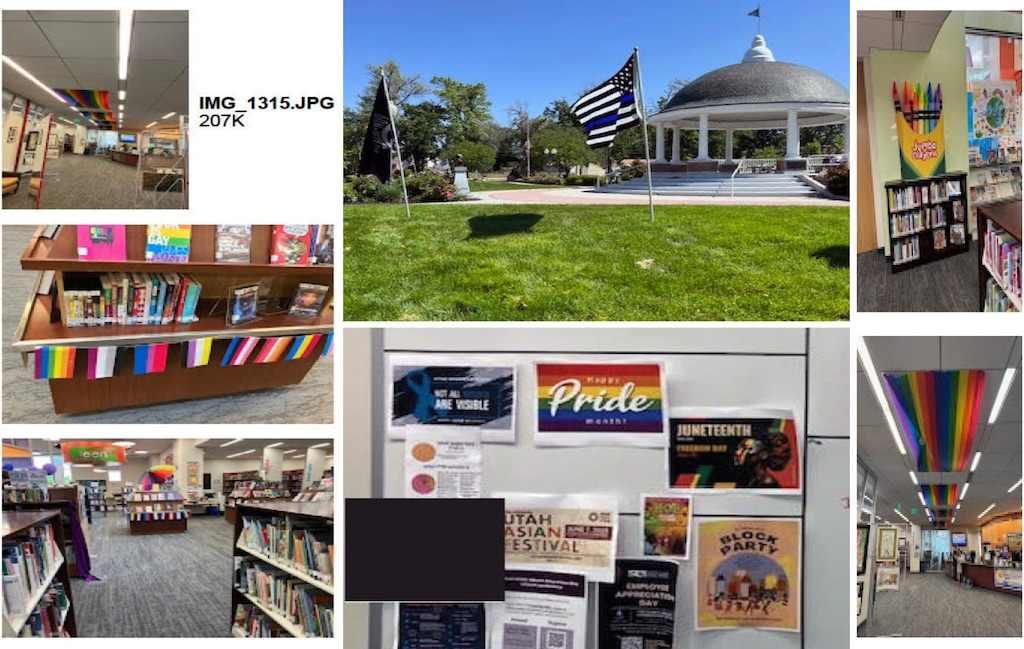
In another, a complaint was filed against Salt Lake County’s Millcreek Library because of several rainbow-colored displays, including balloons and crayons, as well as a long rainbow banner hung along the ceiling and small rainbow paper hung around a bookshelf.
(Office of Utah's state auditor) An image taken from a complaint shows rainbow-related displays in Millcreek.
The ceiling decoration was two rainbow tablecloths, library officials responded, and the paper rectangles did not constitute flags. They were all part of the reading theme for the month, “Color Our World,” which happened to coincide with Pride Month. Since they were removed at month’s end, the auditor’s office took no action.
And a Granger High teacher was reported to the auditor for having a pride flag on the instructor’s desk. The flag was one of three flags adopted by Salt Lake City with a sego lily over the LGBTQ+ flag, the teacher wrote. Again, no action was taken.
Rarely have government entities had to take down flags, either because they were not in violation or they were up temporarily and had been removed.
In Park City, for example, the city responded to the complaint after Pride Month ended, saying there had been banners, not flags, hung along Main Street, but they had been taken down at month’s end.
One exception came in August 2025, when a Trump campaign flag was reported to be on display at a Utah Department of Transportation maintenance station in eastern Utah’s Tabiona. UDOT Executive Director Carlos Braceras reported to the auditor that the employee who displayed the flag was told to remove it.
Resisting the flag ban
(Francisco Kjolseth | The Salt Lake Tribune) Outgoing Rep. Trevor Lee, shown in April, would like to see loopholes closed in his ban on pride flags at state, county and city buildings.
Rep. Trevor Lee, R-Layton, who sponsored the flag ban, said that the program “is working fairly well,” from what he has seen, but could use some tightening. He pointed to an issue that arose recently in Centerville.
Earlier this year, a complaint was made against Cheylynn Hayman, a Centerville City Council member, who began putting a small pride flag on the dais in front of her council seat after the flag ban passed — a protest against the law.
Hayman, who is an attorney, argued the law applies only to government entities and that stifling individual expressions, like hers, would violate her First Amendment right to speech. She said she would sue if the auditor attempted to fine her. The auditor concluded it was not a violation and closed the matter.
Lee said that loophole should be closed — although it will be up to other lawmakers to do that, if they choose. Lee lost his Republican primary race in June. He said at the time of the complaint that displays like Hayman’s are “exactly the kind of activity the bill was designed to prevent.”
He accused the council member of using “her official position to turn city meetings into a platform for a specific political and cultural agenda,” and said her action “undermines trust, divides communities and signals that only certain viewpoints are officially endorsed.”
(Cheylynn Hayman) A pride flag adorns council member Cheylynn Hayman's desk on the Centerville City Council — a protest, she said, against a Utah law that bans such flags from government entities and schools.
At a council meeting last week, Hayman said she had been asked if she had made her point and could get rid of her flag.
“I wish it wasn’t necessary that I display my flag,” she said. “I wish there wasn’t a law on the books that dictates right now what flag cities can and can’t put up in their own buildings. … But the law is on the books, and the Legislature has chosen to exercise its power to force cities like ours to bow to its demands. So as long as the flag ban statute is still law, I am going to tell you, respectfully, ‘No, I haven’t made my point, and I won’t take down my flag.’”
Hayman had filed a records request with the auditor seeking the complaints that led to the auditor’s inquiries into purported flag displays, including her own, but the actual complaints — including who filed them — were not provided to her or The Salt Lake Tribune.
Last week, she sued the auditor to force disclosure of the records.
The Centerville precedent appeared to protect a Salt Lake City police officer who hung a “Thin Blue Line” flag at the city’s police headquarters. City attorneys argued it was a personal statement by the officer, not an official government display, and was not in a public location.
“It is a representation and a reminder to me of my profession and sworn duty to protect and serve the citizens of this city, state and country,” the officer wrote in response to the complaint. “It represents the lives of my fellow officers lost in the line of duty who made the ultimate sacrifice in performance of their duties.”