 Addy Baird
U.S. Sen. John Curtis was a teenager during the Vietnam War and still remembers seeing neighbors, just a few years older than he was, drafted.
And once, Curtis said, he attended a Church of Jesus Christ of Latter-day Saints meeting where a group of seven young men drew straws to decide who would serve a church mission while the others were sent to Vietnam.
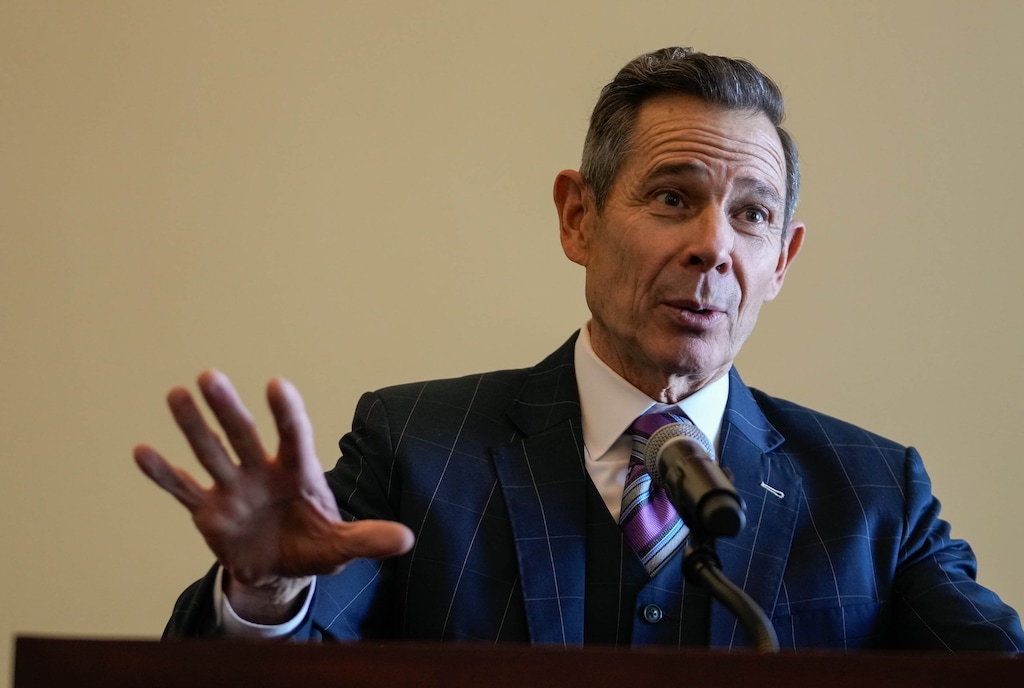
Now, nearly six months into an unauthorized military conflict in Iran, the senator told reporters Wednesday that he has been reflecting on the failings of that war — and that he hopes the U.S. will not repeat the same mistakes in Iran.
“[The Vietnam War] was as close to a constitutional crisis as this country has had, because we were at war, and Congress never declared war,” Curtis said during a news conference in his Salt Lake City office. “It wasn’t a little war. We lost way too many people, even those who came home came home very damaged.”
The absence of congressional authorization for the Iran conflict, the senator added, “is a big deal.”
According to the Department of Defense, 28 American troops have been killed since the Iran war began in late February, and more than 750 have been wounded in action. Those casualties include U.S. Army First Lt. Tyler James Feehan, a Southern Utah University graduate student who was killed during an Iranian attack on a military base in Jordan.
(Kenny Holston | The New York Times) The transfer case of a U.S. soldier is carried during a dignified transfer for soldiers killed amid the conflict with Iran at Dover Air Force Base in Delaware, on Wednesday, July 22, 2026.
Congress has so far failed to do its constitutional duty and define the terms of the Iran war, Curtis said, and President Donald Trump made a mistake by going to war without congressional approval.
“I can’t undo any of that — but I can insist that Congress step up and define the terms of the war,” he said.
Additionally, he said, the war in Iran has also contributed to rising costs for voters, which will “no doubt” have ramifications in the midterms.
But it isn’t just Republicans with whom voters are frustrated, Curtis argued.
“I don’t think it’s just aimed at a party,” he said. “I think people are very frustrated with politics. Everything from an AI facility to the war to gas, and I think people feel like, ‘You’re not listening. I can’t afford bread. You’re not listening. I can’t afford gas.’”
This sentiment has already manifested in Utah’s Republican primaries, Curtis noted, when a number of prominent incumbents, including state Senate President J. Stuart Adams, lost to challengers.
“Clearly, the data center was a big thing,” Curtis said, referring to the backlash against a proposed hyperscale data center in Box Elder County. “But I think deeper than the data center … it’s a lack of trust.”
Voters have always had some distrust of politicians in Washington, Curtis said, “but this feels bigger than that.”
That’s why he thinks it’s important that senators come home more often — even as Utah’s other senator, U.S. Sen. Mike Lee, argued that lawmakers should stay in session until they pass the SAVE America Act.
The bill, which Lee is sponsoring, would require people to provide proof of citizenship when registering to vote, while amendments to the legislation have also sought to limit vote-by-mail and ban transgender athletes from competing in federally funded women’s sports leagues.
Curtis said he supports the “clean” version of the bill without the amendments and wants the Senate to pass that first, but that, realistically, the bill wouldn’t be implemented before the November elections.
And, he said, there are only about 51 votes for it. Because of the filibuster, most bills the Senate passes require 60 votes in order to end debate, and although Lee has been pushing for the Senate to end the filibuster in order to pass the bill, Curtis said Wednesday he thinks that’s a bad idea.
“I will say very publicly that I’m not willing to break the filibuster,” he said. “We’ve heard what both parties would do with fifty-one votes.”
And keeping the practice, he argued, is vital for the country in a divided time: “It forces consensus.”