 Robert Gehrke
Tuesday night will be a make-or-break moment for Senate President J. Stuart Adams.
After more than two decades in the Legislature, the man some call the most powerful politician in Utah, is fighting for survival in a race marked by AI mudslinging and a contentious Box Elder data center looming large.
Adams has two challengers for the Republican nomination in Layton’s Senate District 7: Stephanie Hollist, the former general counsel at Weber State University, and Braden Hess, a former legislative attorney.
It is Hollist who poses the biggest threat to the incumbent lawmaker, who has rarely drawn a serious challenger throughout his political career.
But this year, late in the primary election cycle, Adams has been scrambling to tamp down the fury spawned by his key role approving a deal for celebrity investor Kevin O’Leary to develop the controversial hyperscale data center in Box Elder County, a process criticized across the state and in Adams’ district as rushed and secretive.
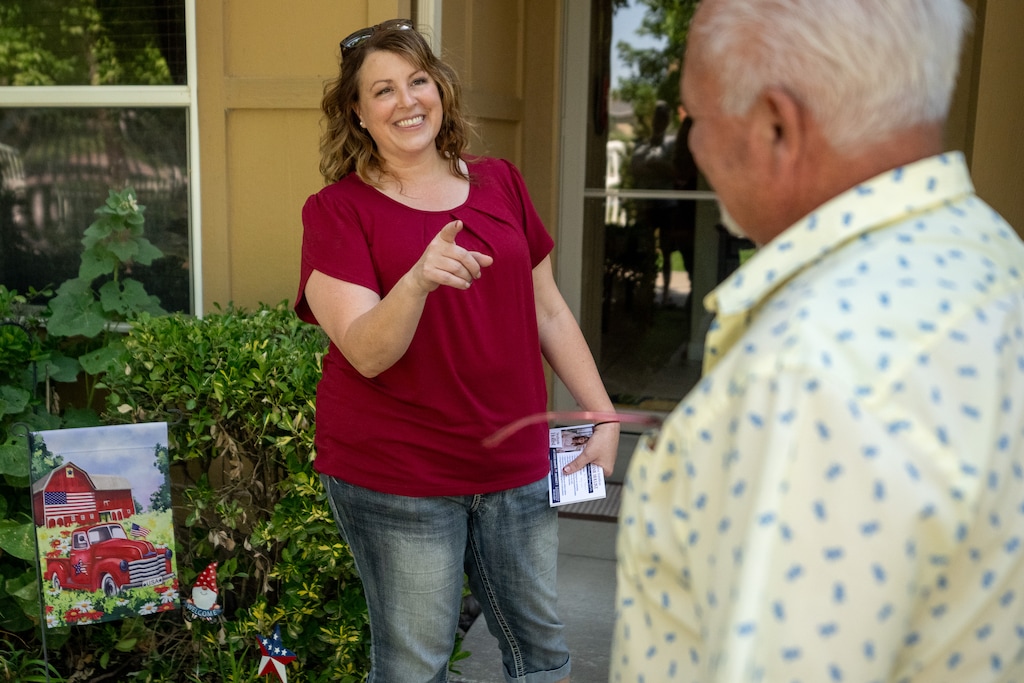
Saturday morning, about 20 volunteers joined Hollist to fan out across the Layton Senate district, knocking on doors in a last-minute drive to get voters to Tuesday’s primary polls — and the data center was a thread throughout the conversations on porches in the recently built subdivision.
“I’ve knocked on so many doors now and that is one that people are hyper-focused on right now, because people are really worried about it and they’re really mad about how it came to be,” Hollist said between door knocks.
(Bethany Baker | The Salt Lake Tribune) Senate President J. Stuart Adams, R-Layton, speaks during a Grow the Flow forum in Sunset on Tuesday, June 16, 2026.
But the massive data center project is part of a larger lack of transparency with the senator, Hollist added. “There have been lots of things that have been happening that are very similar,” she said, ”where there’s things happening behind the scenes that aren’t actually helping us”
Hess — who said he got into the race to try to repeal Proposition 4, the voter-backed Better Boundaries initiative that banned partisan gerrymandering — said voters he has talked to want transparency and someone who will listen, and the data center has brought those issues to a head.
“He’s very concerned and rightfully so,” Hess said of the incumbent. “When someone is in office, they’ve got to realize that people become less and less likely to vote for an incumbent the longer they’re in.”
Adams’ campaign manager did not respond to a request for an interview.
(Bethany Baker | The Salt Lake Tribune) Senate District 7 Republican candidate Braden Hess speaks during a Grow the Flow forum in Sunset on Tuesday, June 16, 2026.
Adams is the chair of the Military Installation Development Authority, a legislatively created commission designed to expedite and subsidize development projects it deems to have a benefit to the Defense Department. While chair, Adams has received significant campaign donations from companies doing business with MIDA.
In May, MIDA gave quick approval to the massive data center proposed by the Canadian billionaire “Shark Tank” star. The backlash was furious, as Utahns from across the political spectrum voiced their outrage over the water and power demands of the project.
Adams has tried to stanch the bleeding. He wrote a letter to O’Leary demanding he shrink the physical size of the data center and commit to diverting some water to the Great Salt Lake, additional transparency and measures to capture the heat that the project would emit.
While O’Leary initially blasted Adams’ maneuver, he eventually accepted the terms — although without a publicly available plan for the data center, the water and power demands of the re-envisioned project are unclear.
For Adams’ campaign, it was proof of the senator’s clout and ability to solve problems — even those he had a hand in creating — and have slapped it on campaign videos and direct mail ads to voters.
Those advertisements have added to the scores of mailers that have stuffed voters’ mailboxes.
Hollist had spent more than $181,000, as of the latest filings last week, a significant amount for a challenger in a state legislative race. But Adams has tapped into a prodigious fundraising network and spent nearly $429,000 from his campaign account and political action committee.
“I’m definitely going up two financial Goliaths, so I’m the David here. It’s had to be grassroots,” Hess said Monday as he was out knocking on doors. He has spent a comparatively paltry $6,000 during the race.
On top of that massive spending, organizations like Americans For Prosperity are shelling out tens of thousands of dollars in support of Adams, answered by groups ranging from the liberal-leaning Alliance For A Better Utah to Make Liberty Win, a conservative organization that targets entrenched incumbents, are pouring tens of thousands more into the race trying to knock out the senator.
Hess said Adams’ high profile and vulnerability have made him a target for outside groups — liberal and conservative — who want him out. But the volume and negativity of the ads is annoying voters he has talked to, Hess said, and he believes that could drive them to him on Tuesday.
The ads themselves have taken on a life of their own, as the outside organizations and Adams’ own campaign lean on AI-generated images and videos to throw haymakers back and forth.
One of the mail pieces shows Adams in clown makeup and says he is “Embarrassing Utah Again.”
Another video ad, produced by Join The Union, accuses Adams of having weakened penalties for child rape. The Salt Lake Tribune reported that in 2024 the Utah Senate president prompted a state law change that helped a teen relative of Adams charged with child rape. Adams denied that he ever intended to impact his relative’s case.
Adams’ campaign has produced its own attack ads against Hollist, accusing her of using money from George Soros, a liberal financier and conservative bogeyman, to attack Adams. The ads show an AI-generated image of Soros pulling Hollist’s strings and saying with a menacing voice that voters are too dumb to notice.
Adams campaign manager, Greg Powers, did not respond to an interview request, but told Utah News Dispatch that the connection to Soros stems from a post Hollist’s husband made on a left-leaning group’s site urging people to elect his wife and a postcard campaign against Adams by the progressive group Salt Lake Indivisible.
Hollist said Adams is trying to connect dots that don’t exist in order to smear her.
“And if he believes that? Wow. What does that say about him?” she said. “And if he doesn’t believe it, what does that say about him?”