 Addy Baird
Lee este artículo en español aquí.
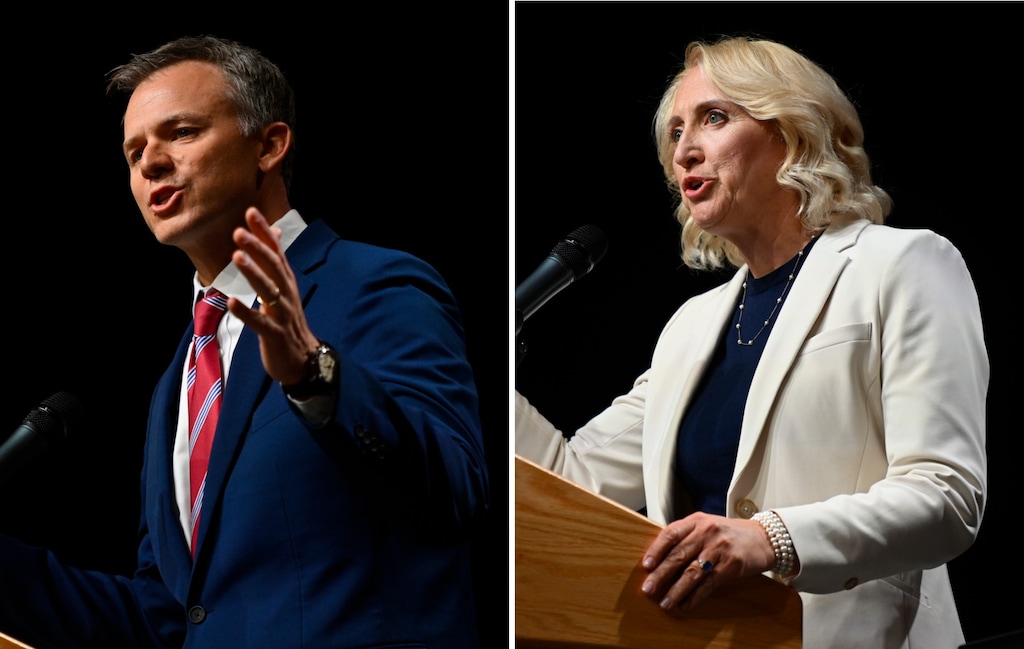
After a yearslong fight over Utah’s congressional maps came to a close earlier this year, incumbent U.S. Rep. Blake Moore is running for reelection in the newly drawn 2nd Congressional District, which includes a significant portion of his current district. He is facing a primary challenge from Utah House Rep. Karianne Lisonbee, who currently represents Clearfield in the Legislature.
Lisonbee has attacked Moore for his previous work with an anti-gerrymandering organization and for living outside the new district in which he is running. Moore is Utah’s only member of congressional leadership and has campaigned on his work on federal tax and budgetary policy.
The winner of the June 23 primary will face Peter Crosby, who won the Democratic nomination at the party’s convention in April.
The Salt Lake Tribune posed the following questions, based on a reader survey about the issues Utahns felt were most important this election season, to both Republican primary candidates. Their answers — listed in alphabetical order — may have been edited slightly for length, style or grammar.
A plurality of voters, more than 30%, said elected official corruption is the primary issue driving who they’ll vote for, with another 14% of voters saying it’s their second-highest issue. Why are so many Utah voters concerned about corruption in politics? How will you build trust with Utahns?
Lisonbee: There should be zero tolerance for waste, fraud, and abuse at the federal, state, and local levels of government. Whether it’s daycare fraud in Minnesota or Medicare fraud in California, Congress must take action to ensure that there is transparency and accountability over tax dollar expenditures. Too many members of Congress go to D.C. poor and come home rich. Serving in Congress was never supposed to be a career and it was never meant to create wealth for elected officials. I pledge to never trade individual stocks as a member of Congress.
Moore: Social media and coverage of institutions have made Utahns more aware of scandals relating to abuse of power, retribution, fraud and assault, but corruption isn’t new. There aren’t enough role models in politics demonstrating the type of character exhibited by George Washington and other great leaders, though the Ethics Committee has done good work lately holding representatives accountable for misconduct. Personally, I build trust through transparency, kindness, overcommunication and honesty about my votes and decisions.
(Alex Goodlett | Special to The Tribune) Second Congressional District GOP candidate Karianne Lisonbee speaks to a crowd during the 2026 GOP nominating convention at Utah Valley University on Saturday, April, 25 2026 in Orem.
After corruption, more than 16% of Utah voters said everyday affordability - like the cost of housing, groceries, gas, etc. - is the first thing on their minds as they vote this year. Another 15% said it is their second-highest issue. What will you do to help make life more affordable for Utahns?
Lisonbee: I have always been a proponent of small government and low taxes, and have a strong track record of cutting taxes here in Utah. Although inflation is down and stable, and the price of groceries has come down from their Biden-era high, Americans are still suffering from a high cost of living.
I support the framework of the Tax Cuts and Jobs Act as well as the One Big Beautiful Bill, but Congress should not cut taxes without also reining in out-of-control spending. In addition to controlling federal spending, Congress can make life more affordable by cutting red tape, deregulating, passing the REINS Act and ramping up domestic energy production.
Moore: With Utahns struggling with housing and gas costs, I’m laser focused on growing the economy, increasing wages, building more housing, slashing expensive regulations and creating jobs through my Ways and Means Committee position. I helped prevent the largest tax hike in history by passing the working families tax cuts, which made tax cuts permanent, put more money in Utahns’ pockets, doubled the child tax credit, ended tax on tips, car loan interest, Social Security benefits and overtime, increased wages by up to $7,200 per worker, created Trump Accounts and boosted the standard deduction.
Utah has experienced drought for much of the last two decades. The availability of water is the third-most pressing issue for voters this year. What can elected officials do to ensure Utahns have enough water for the future?
Lisonbee: This is a complex issue that requires collaboration across all levels of government. At the local level, municipalities can institute water conservation measures, via ordinance, which apply to new growth and incentivize smart behavior for existing residents. At the state level, I supported multiple pieces of legislation to conserve water. Federally, the government can support and fund large-scale projects. The Federal Government must also come to a favorable resolution regarding the Colorado River Compact to ensure that Utah receives its fair share of water from the Colorado River.
Moore: Updating our water infrastructure is paramount to ensuring Utah has the water to support our growing population. Many of the water projects in Utah are supported by federal programs and funding. I work to streamline these programs to increase access for communities and water districts. Since entering office, I secured tens of millions of dollars for local water infrastructure projects in northern Utah and my Saline Lakes bill was signed into law. A top priority for me right now is funding to restore and protect the Great Salt Lake and delivering on President Trump’s $1 billion commitment.
(Francisco Kjolseth | The Salt Lake Tribune) U.S. Rep. Blake Moore answers questions following a meeting with state, federal, philanthropic, scientific, business and conservation leaders on Friday, May 29, 2026, for a Great Salt Lake Roundtable focused on the next phase of coordinated action and partnership.
Should the state continue to pursue nuclear energy, yes or no? What can be done to address Utah’s growing energy needs?
Lisonbee: Yes. Utah has vast amounts of untapped energy potential right here within the borders of our own state. Utah has some of the cleanest coal and natural gas of any place in the world. With today’s innovative technologies, we can explore, extract, and refine energy that is clean and respectful of our beautiful environment. Red tape and regulation stand in the way of making progress in the energy space. It should not take years to permit a geothermal project, a new power line or a small-cell nuclear facility. I support an all-of-the-above energy policy without government subsidies.
Moore: Yes. As our technology advances, we need access to every type of energy production, including coal, geothermal, nuclear, solar and natural gas. Luckily, Utah is a hub for all of these. Energy security is national security, and at every level, we need to streamline our permitting system with clear timelines, stop frivolous litigation and prioritize projects that provide baseload, reliable power. I have voted to reform our permitting system and unleash domestic production, and I have introduced legislation to speed up and incentivize domestic mining of minerals critical to energy production.
In 2018, voters narrowly passed the Better Boundaries initiative, creating an independent redistricting commission and prohibiting partisan gerrymandering. The Legislature’s attempts to significantly weaken the Better Boundaries initiative spawned years of litigation, culminating in a court adopting new congressional boundaries. Who should be responsible for drawing Utah’s political boundaries? Why?
Lisonbee: The Legislature, following Utah’s Constitution, should be responsible for drawing Utah’s political boundaries. They conduct public hearings and provide an open and transparent process. Gerrymandering means many different things to different people, but as we’ve seen in Utah, independent commissions don’t prevent partisan gerrymandering. Utahns are intelligent and involved and should hold their legislators accountable if they gerrymander maps for their own benefit.
Moore: I believe Utahns deserve transparency and accountable representation. Adopting standards on how maps are drawn and having statewide public consultations gave Utahns a voice. I believe the Legislature has the authority to finalize maps under Prop 4 and the Utah Constitution, and I’m very disappointed in Judge Gibson’s decision. If she believed the legislature violated Prop 4 by submitting maps drawn using voter data, she should have gone back to the Legislature repeatedly until it submitted maps that met the standards. Choosing a plaintiff’s map was a violation of the separation of powers.
Is there an imbalance of power between the Legislature and the courts? If so, what should be done about it?
Lisonbee: Our government consists of three branches for a reason. Each branch should be a check on the others. When any of the three branches gets too powerful, the other two should step in to make a course correction. The courts are meant to interpret the laws passed by the Legislature and signed into law by the executive. The courts are not meant to act in a legislative capacity. I do feel that there are Utah judges legislating from the bench.
Moore: Our founders anticipated political differences and built a system to constructively facilitate disagreement and negotiate compromises. In an era of toxic social media, politicians fear negotiation and have fallen silent—legislatively. Congress has failed to act on key issues like immigration, AI, federal lands and healthcare. The executive branch has vastly overreached, leading the judicial system to decide cases that should never have been in front of them. Congress must step up and do its job, which is why my work focuses on the tough issues from budget reform to healthcare and immigration.
What do you believe is the most pressing issue before voters this year? What can be done to address it?
Lisonbee: As I’ve spoken with voters across the district, they are very concerned that members of Congress have lost sight of their role. Many voters feel like their representatives don’t listen, don’t take decisive action, don’t act as a check on the other branches of government and are serving themselves rather than the people they were elected to represent. The American people are growing tired of the status quo and the go-along-to-get-along mentality. It’s time for real leadership. It’s time for representatives who listen. It’s time for elected officials to take on the tough challenges to put our country on a better fiscal path.
Moore: Cost of living, economy and jobs, and tackling the debt and deficit are top issues facing voters. I led the charge for permanent tax reform to keep more of your money in your hands, increase the take-home pay for a family of four by $10,900, and cut wasteful spending. We made tax rates more competitive to achieve higher annual growth, and we decreased the deficit year over year in a historic win. I am fighting to pass my legislation to support families, slash regulations that hurt paychecks and increase housing costs, and tackle the fraud and spending that lead to inflation and high prices.