 Andrew Christiansen
Senate Bill 258, passed during the 2024 session of the Utah Legislature, has gained a lot of controversial traction in Grand County as many feel it’s tailor-made for the Kane Creek Preservation and Development project that faces widespread community opposition.
“It seems like it was specifically targeted to Grand County … it escaped our attention during the legislative session, more or less, even though, apparently it was more or less custom-designed for [the Kane Creek development],” said Commission Chair Jacques Hadler at the June 4 Grand County Commission meeting.
The bill, sponsored by Sen. Curtis Bramble and Rep. James Dunnigan, both Republicans, outlines a comprehensive process for creating a preliminary municipality and incorporating it into a fully functioning town – something the Kane Creek developers are actively in the process of doing.
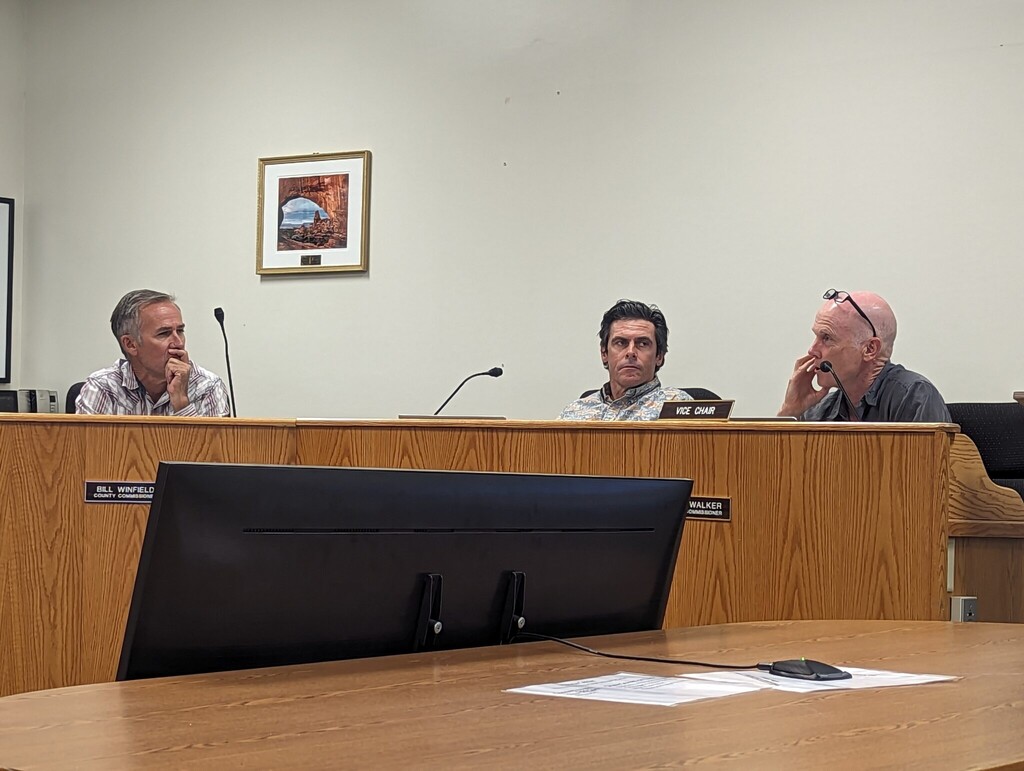
Although the commission may get into the legal details and implications of the bill at a later date, Commission Vice Chair Walker said he wanted to bring this up as a discussion item to talk about why they didn’t find out about this before May 1.
The process of becoming a preliminary municipality and town
Some of the major requirements, Grand County Attorney Stephen Stocks explained in the meeting, are that the area must be contiguous, not located in a first or second-class county, not within a quarter-mile from an existing municipality and at least 50% of the land area is undeveloped.
The developers have to reach out to the Grand County GES Specialist, James Murphy locally, so they can determine if “initially, the applicant meets the qualifications of the preliminary municipality,” according to Stocks. The Kane Creek developers have already contacted Murphy.
Only three proposed preliminary municipalities may apply per year in the state, according to the bill. On May 1, the day SB258 took effect, the Kane Creek developers officially applied to the Lt. Governor’s office to become a preliminary municipality, according to Stocks.
The process also includes a feasibility study under the Lt. Governor’s Office that evaluates the requirements, as well as the financial viability of the proposed municipality by analyzing tax revenue and fiscal impact.
This is also supposed to include an analysis of whether there is enough water available to support the municipality when the proposed development is complete, according to Kane Creek Development Watch, a group protesting the development.
Under SB258, if a preliminary municipality essentially has the same power as an ordinary municipality under Utah law, including zoning and land use control, as well as control over utilities, buildings, subdivision, events and law enforcement, according to Kane Creek Development Watch. The exceptions, until it is incorporated into a city, are taxation and eminent domain.
“To summarize, it’s a bill that seems designed to let the Kane Creek developers write their own zoning code – that’s the effect,” Walker said.
To incorporate the preliminary municipality into a town, the landowners, of which there can be a maximum of three, must first have at least 100 residents, but not more than 1,000, within six years. There are three landowners for Kane Creek.
At this point, a petition for transition to a town can be filed. If approved, an election would be held to elect a mayor and city council. The newly elected officials then replace the board members of the preliminary municipality.
Commissioner Trish Hedin said she thinks the bill is “definitely catering to a particular interest.”
“I don’t think that’s how the state Legislature should be writing bills to cater towards, in this case, developers,” Hedin said.
How did the commission miss it?
The job of Grand County’s lobbyist, Cody Stewart, is to track down legislation that is specifically aimed at the county, such as SB258, but he “flat-out said he missed it,” Hadler said.
“He read through the language of the bills as he reads through many, he said it was a technical bill and there was nothing that flagged it for him,” Hadler said. “I’m disappointed that he missed it – I think Cody does a great job for us, but in this case, I think he failed us at the county.”
The Utah Association of Counties (UAC), which advocates for all 29 Utah counties in many ways, helps local governments keep track of legislative bills that may impact the county or cities they govern.
Commissioner Mary McGann, who participated in the UAC meeting where they mentioned the bill, watched the committee meeting for the bill and when it was on the floor, said “they never got into the details.”
“It was really undercover,” McGann said. “… I’m still disappointed in UAC – when they heard it was for Grand County, it should’ve spoken [to us].”
At the UAC meeting, Stocks recollected that they had a rapid-fire session of all the bills where they came in and explained the bills in a minute.
“And they say, ‘Ready? Everybody’s going to vote and you either vote that the UAC is going to support it, seek more information or oppose it and it goes super quick,” he said.
McGann suggested that the commission set up a meeting with the bill sponsors to ask what the purpose of SB258 was and if this was targeted at Grand County. Additionally, she said the county could potentially work with different senators and representatives to take the bill back to the floor to tweak it.
Earlier this year, the SB258 passed out of the House on its third reading 71-1.
“Why was this so popular with the entirety of our Republicans and Democrats? I never once heard of this at UAC,” said Commissioner Bill Winfield.
Walker said it’s pretty concerning that it sounds like UAC lobbyists knew about this bill but didn’t tell the commission.
“UAC has some good lobbyists and Grand County can benefit from that … but if [they] can’t even be bothered to inform us that there’s a bill targeted at us, I think it’s something we need to think about,” Walker said.
Winfield made a point of crediting UAC in the past helping him “bring money back to this county.”
“Maybe somebody dropped the ball on this bill and they didn’t think to notify Grand County, but I would be real careful at total alienating [UAC],” he said.
Walker concluded that going forward, he thinks it would be good for the commission to speak with Stewart about looking out for bills that affect Grand County and reach out to UAC to remind them to notify them of relevant bills.
“I think that’s a simple step to take — we could do more lobbying,” Walker said. “I think this whole other topic about legal status about this bill and constitutional challenges is for a discussion for another day and also understanding, if the bill isn’t struck down, what’s the timeframe and the mechanics of doing it?”
Editor’s note • This story is available to Salt Lake Tribune subscribers only. Thank you for supporting local journalism.