 Courtney Tanner
Utah State University has a new agreement with the tribe whose ancestral homelands the school’s main campus was built upon.
And for the first time, that will now include a provision for USU, a land-grant institution, to support and provide resources for research “in areas of importance” to the Northwestern Band of the Shoshone Nation.
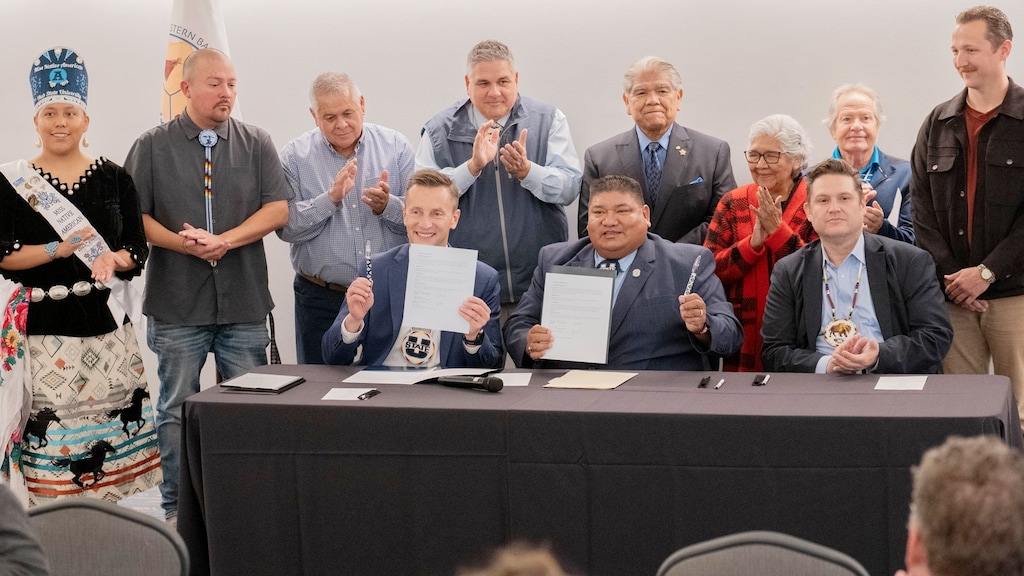
It’s a pivotal addition to the latest version of the more than decade-long memorandum of understanding, or MOU, between the university and tribal leaders. The new agreement was signed in a November ceremony in Logan.
The document “reaffirms our mutual commitment to expanding opportunities for Northwestern Band of the Shoshone Nation students and strengthening collaborative research efforts that benefit both our tribe and the broader community,” said the nation’s chairman, Jason Walker, in a statement.
The research component includes both scientific and technical projects, with particular emphasis on continuing to help the tribe restore the native plants and historic environment features at the site of the Bear River Massacre; the Shoshone Nation purchased the land in January 2018.
Through that purchase, the Wuda Ogwa Cultural and Land Restoration Project is meant to commemorate the place where an estimated 250 to 500 Shoshone people were killed in January 1863, when volunteer soldiers from Utah’s Fort Douglas raided the tribe’s winter camp.
It’s since been recognized by historians as one of the deadliest massacres of American Indians in U.S. history.
(Francisco Kjolseth | The Salt Lake Tribune) The Bear River, pictured on Thursday, Oct. 6, 2022, twists and turns near Preston, Idaho, where a hot spring empties into the river at the site of the Bear River massacre of 1863.
The tribe hopes its efforts to replant native willows and other greenery on the 350 acres there, near Preston, Idaho, will also help reduce water waste sucked up by invasive species and allow it to gift shares to the Great Salt Lake, to help the lake rebound from significant degradation.
The tribe is still envisioning what it might do outside of that project with the now-formal support of USU researchers.
The new MOU promises: “USU will encourage and support tribally approved research conducted by university faculty, staff, and students that advances economic, ecological, environmental, health, educational, and other priorities identified by the Tribe.”
Kristian J. Olsen, USU’s deputy vice president for residential campuses, met with Chairman Walker and the Shoshone’s governing council over the summer to see what the tribe wanted in an updated agreement. Olsen’s role oversees the 28 satellites and centers the university operates across the state.
While USU already supported certain research, he said, there was a push to formalize that and ensure any data collected is ultimately shared with the tribe.
“We had a good conversation about research and collaboration,” Olsen said. “Whatever we research, come up with, figure out, we won’t keep that data to ourselves.”
The MOU will also continue the school’s original effort to support Shoshone students who intend to attend USU and earn a degree or certificate there — under a full scholarship.
“Education is one of the most powerful tools we can provide for future generations,” Walker added in his statement.
(Jared Gereau | Utah State University) Northwestern Band of the Shoshone Nation Chairman Jason Walker pictured at USU on Tuesday, Nov. 3, 2026, during a signing of a new memorandum between the tribe and school.
‘Supported academically, culturally, socially and financially’
At Utah State, scholarships for Shoshone students started under the first formal agreement, signed between the university and the Shoshone Nation in 2015.
That covered tuition for any enrolled member of the Shoshone Nation (up to eight semesters for a student starting their freshman year at USU, or up to four for a transfer student).
That doesn’t include fees, but there’s an additional housing waiver for Shoshone students who live in campus dorms in a double-occupancy room at either the Logan or Price campuses.
Since that 2015 deal, USU spokesperson Amanda DeRito said, 27 Shoshone students have had their tuition covered. And four have also chosen to live on campus, with housing support.
The Northwestern Band of the Shoshone Nation is a smaller tribe, with about 400 total enrolled members. That means there’s not as many eligible students as there may be in other tribes, but USU is required to recruit and encourage Shoshone students to pursue higher education there under the MOU.
In total at USU, there are 460 Indigenous students enrolled this fall out of 32,286. That’s 1.4% of the student body.
(Jared Gereau | Utah State University) Members of the Northwestern Band of the Shoshone drum at a memorandum of understanding signing ceremony on Tuesday, Nov. 3, 2026, on USU's Logan campus.
DeRito said Diné students from the Navajo Nation tend to have more representation. That particularly includes at USU’s campuses in southeastern Utah. At the school’s Blanding campus, for instance, about 70% of students are Native. USU this year also opened an education building in Monument Valley.
Since 2023, USU has also offered a Native American Student Scholarship that covers members of other tribes.
The Shoshone agreement says both the school and the tribe will work together to create education opportunities for Shoshone tribal members, including both technical and traditional paths. USU offers both.
The tribe will also encourage its youth to participate in pre-college activities, according to the new agreement, including concurrent enrollment classes and 4-H development programs.
At the same time, Utah State will ensure that “Shoshone students, staff and faculty are supported academically, culturally, socially and financially in ways that foster a strong sense of belonging at the university,” according to the MOU.
Giving back as a land-grant university
The University of Utah has a similar longstanding MOU with the Ute Indian Tribe of Utah, so the university can continue to use the tribe’s name in exchange for supporting Ute students.
And several schools across the nation have research-specific memorandums. That includes the University of Nevada, Reno, with the Summit Lake Paiute Tribe; Northwestern State University with the Tunica-Biloxi Tribe of Louisiana; and Idaho State University with the Shoshone-Bannock Tribes — a band connected to the Northwestern Band of the Shoshone Nation.
But USU acknowledged that it has a specific obligation to give back as a land-grant institution. The designation means the school earns federal benefits in exchange for a commitment to increase education access on the site of previously tribal-owned lands.
(Francisco Kjolseth | The Salt Lake Tribune) The Old Main building at Utah State University in Logan on Monday, Nov. 17, 2025.
The MOU mentions the school’s land-grant status and notes because of that, it has a charge to “cultivate diversity of thought and culture.” USU President Brad Mortensen also mentioned it in his statement on the updated agreement.
The Salt Lake Tribune reported in 2024 that USU is one of 14 land-grant universities across the country (with publicly available data) that has kept and is still earning income from land taken from Indigenous nations — often without compensation for tribes.
USU retains rights to about 31,000 acres of formerly Native land, acquired under the federal Morrill Act and other land-grant laws.
It also holds the rights to roughly 75,000 acres of subsurface areas, which applies to oil, gas, minerals and other resources underground. That includes some areas tied to the Shoshone tribe.
In 2024, the university’s acreage had generated more than $15 million in revenue for the school over the previous five years. A small portion of that revenue is distributed annually to the university; the rest is held in a permanent fund.
USU has said that it tries to pay that forward with scholarships and other efforts to support Native students. It also has land acknowledgements for its main campus and satellites, recognizing where those sit on ancestral homelands.
Shoshone tribal leaders have said they appreciate how the university has conducted itself with respect to Indigenous partnerships and ancestral territories.
Brad Parry, vice chairman for the Northwestern Shoshone Nation, has called the school a good partner in working on state-owned property that was previously Shoshone land. USU has supported restoration, water preservation and Indigenous hunting rights, in accordance with the tribe’s wishes.
The research addition to the MOU, Chairman Walker noted in his statement, is a continuation of that valued partnership.
Walker has so appreciated USU’s leadership that he gifted a beaded medallion to President Mortensen at his inauguration in January, months before the new agreement.
Mortensen again wore that medallion earlier this month at the MOU renewal ceremony.
(Rick Egan | The Salt Lake Tribune) Utah State University President Brad Mortensen receives a necklace from Chairman Jason Walker, of the Northwestern Band of the Shoshone Nation, during Mortensen's inauguration ceremony at the Russell/Wanlass Performance Hall in Logan on Friday, Jan 16, 2026.