Democrats notched a series of early victories and strong showings in states and districts where Republicans have won by large margins for years as the midterms offered voters the chance to deliver their first national mandate on President Donald Trump’s second term.
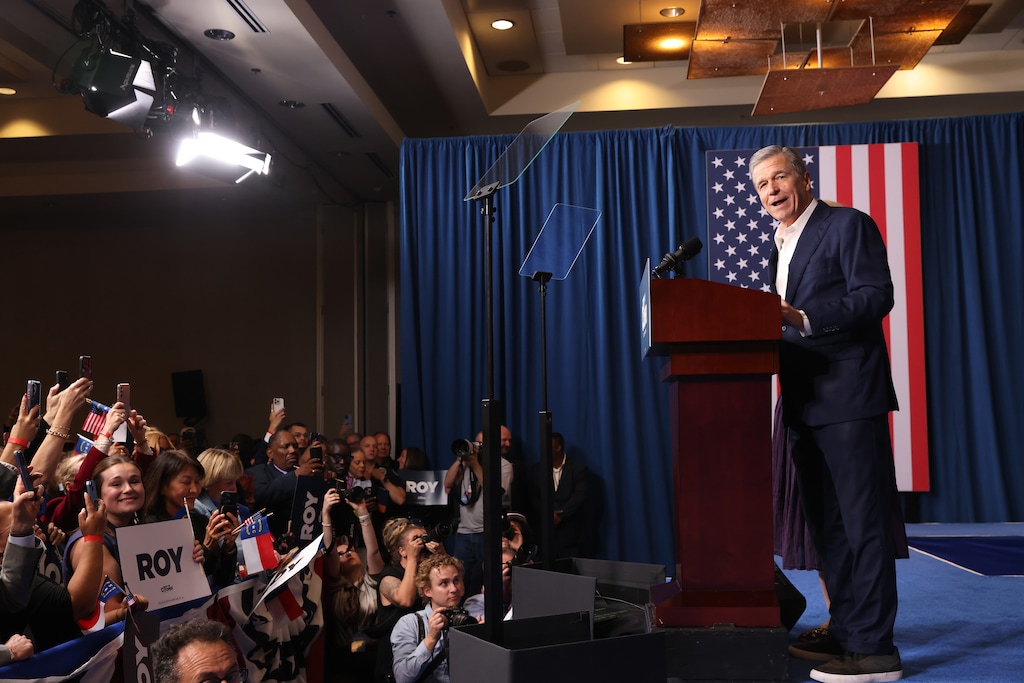
Democrats flipped the Senate seat in North Carolina and maintained control of seats in Georgia and New Hampshire, according to The Associated Press. And they flipped their first House seat of the night in western North Carolina.
Races have yet to be called in South Carolina and Texas, where Democrats fielded strong and well-funded Senate candidates against Republicans considered their party’s weakest nominees. In each, the Democratic candidates are posting margins unthinkable for their party in counties that have reported the vast majorities of their votes.
Republicans’ redistricting effort appears to have failed to yield the sweeping victories in House races that they intended. Democrats have already won three districts in Florida that Republicans redrew to be favorable for themselves, and the North Carolina seat Democrats flipped was also part of the Republican redistricting effort.
(Victor J. Blue | The New York Times) Voters cast their ballots in the midterm elections as polls open at the Berwyn Senior Center in Dearborn Heights, Mich., on Tuesday, Nov. 3, 2026.
In Georgia, Keisha Lance Bottoms, the former Atlanta mayor, became the first Black woman to be elected governor in the country’s history. She is the first Democrat elected to lead the state since 1998.
In Washington, Trump is watching the election results from the White House and posting criticism of the Fox News coverage on his social media site. He celebrated a Republican victory in Guam but has yet to speak at length about results in the 50 states.
Democratic candidates have blamed Trump, and the war he started this year in Iran, for the economic hardships that have driven a current of frustration across the nation. Republicans have focused on portraying their Democratic opponents as extreme on social issues and the economy as they played defense in reliably red states.
Republicans fended off a significant challenge in a Senate race in Florida: Sen. Ashley Moody defeated Angie Nixon, a progressive Democrat, in a tight contest to complete the term of Secretary of State Marco Rubio.
But Democrats were mounting strong challenges all over the map. In Texas, James Talarico, a state lawmaker, is trying to flip a seat in a race against Ken Paxton, the state attorney general. In South Carolina, Sen. Darline Graham has been filling the seat long occupied by her late brother, Lindsey, and Democrats have hoped that Annie Andrews, a pediatrician, could flip the seat. In Ohio — which also features an acrimonious race for governor — former Sen. Sherrod Brown, a Democrat, is vying for a comeback as he tries to oust Sen. Jon Husted, a Republican.
The last polling places will not close until 1 a.m. Eastern on Wednesday, in Alaska. Full results may not be known for days, particularly if many of the races are close — but it was clear that voters were eager to have their say. Turnout appeared strong across the country, as millions of people cast votes that will deliver a verdict on an unpopular president who has implored the country to act as if he were on the ballot.
In each of the major Senate battlegrounds, early turnout eclipsed that of the last midterm cycle. In Texas, overall turnout could exceed 10 million votes, which would top the total from each of the last two midterms. In Georgia, Election Day turnout was on track to beat that of the 2024 presidential election, the Georgia secretary of state said.
Here’s what else we’re covering:
— A complicated landscape: More than 400 New York Times reporters, editors, data analysts, video journalists and photographers are covering the midterms, seeking to understand a large country with voters who are complicated — and sometimes contradictory.
— The counting process: Control of the Senate will hinge on the outcomes in the battleground states of Alaska, Iowa, Kansas, Maine, Michigan, Minnesota, Nebraska, New Hampshire, Ohio, South Carolina and Texas.
— Big spending: This is the most expensive midterm election, as measured in spending on political advertising, since at least 2018, according to data from AdImpact. Elon Musk, the world’s richest person, alone contributed $474 million to Republican groups, candidates and their allies, more than any donor has ever spent in a single election cycle.
— Minor disruptions: A technical problem with voting machines in Westchester County, New York, outside New York City, led officials there to collect ballots by hand in a competitive House race. In Florida, flooding forced more than 20 polling stations across eight counties to be relocated. In North Carolina, technical problems at several precincts caused minor delays; state election officials said they would delay the release of election results to at least 8:15 p.m. from 7:30 p.m.
— Election integrity: Many election officials and Democrats have said they fear that Trump’s attacks on the integrity of U.S. elections could lead to tensions during voting and baseless challenges to the outcome. The administration has sought to prove that many noncitizens have cast ballots, but few people have been charged with offenses related to voting fraud. Local and state officials say they are well prepared to run a secure election.
— Court rulings: A federal judge has turned down a request by Democratic lawmakers and party organizations to prohibit the Trump administration from coercing states into screening incoming ballots. And the Supreme Court issued what appeared to be an extraordinary rebuke to Trump, signaling that it was not interested in assisting his efforts to interfere with how states administer elections.
This article originally appeared in The New York Times.