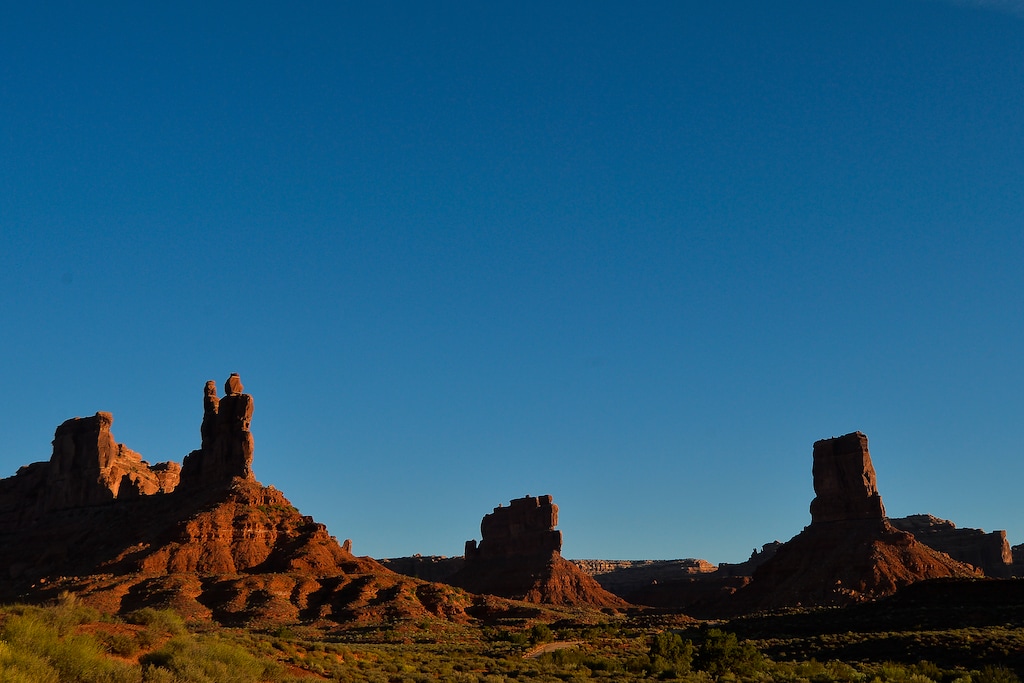
About a month after President Donald Trump sharply reduced the size of two national monuments in Utah, at least nine mining claims have been staked on land that is no longer protected from development, public records show.
The claims suggest that some companies are racing to dig up minerals within the former boundaries of the Bears Ears and Grand Staircase-Escalante national monuments, which are rich in wildlife habitat and archaeological treasures but also sit atop vast reserves of uranium and other precious metals.
On July 13, Trump signed proclamations that shrunk both sites by more than 90%, opening nearly 3 million acres to mining, oil and gas drilling and other commercial activities. The proclamations said that new mining claims would be allowed within the monuments’ former boundaries starting Sept. 11.
But the next day, Utah-based company Kimmerle Mining filed seven mining claims in areas that were removed from Bears Ears, according to records from the San Juan County Recorder’s Office in Utah. Kyle Kimmerle, an executive at the company, has challenged the monument’s previous boundaries in court, claiming they “locked up” valuable minerals.
On Aug. 6, Craig Rosequist filed two mining claims in areas that were cut from Grand Staircase, according to records from the Kane County Recorder’s Office. Rosequist’s LinkedIn profile lists him as an “owner at MMT Mine.”
The total acreage of the new claims is unclear. The Bureau of Land Management, which oversees the monuments, is likely to reject the claims before Sept. 11.
Kimmerle and Rosequist did not immediately respond to requests for comment.
National monuments are public lands that are legally protected from development. They have similar protections as national parks, but while national parks are created by Congress, national monuments can be created by presidents through the Antiquities Act of 1906.
Filing a mining claim is just an initial step toward pulling minerals from the ground. Prospective miners must also pay fees and obtain permits from state and federal agencies, a process that can take years.
During his first term, Trump similarly shrank Bears Ears and Grand Staircase at the urging of top Republicans from Utah. But Native American tribes and environmental groups challenged the move in court, and President Joe Biden subsequently restored protections to both sites before a court could issue a final decision.
After Trump’s first reduction of Bears Ears, Kimmerle Mining built a mine called Easy Peasy on land that had been part of the monument. In 2018, the company dug up 30 tons of ore in search of uranium, which is used to fuel nuclear power plants, and vanadium, which is used to strengthen steel.
Soon after, the mine ceased operations because low uranium prices made it uneconomical. Then in 2021, Kimmerle became a plaintiff in a lawsuit over Biden’s restoration of the monument’s boundaries.
Before Trump signed the proclamation to shrink Bears Ears last month, he claimed that the move was necessary because recreation was virtually impossible inside the monument’s boundaries.
“You can’t go hunting, you can’t go fishing, you can’t do anything, you can virtually not even walk on it,” Trump said during a ceremony in the Oval Office.
But recreation has been allowed in Bears Ears since President Barack Obama designated the monument in 2016. And the Trump administration was briefed on opportunities for hiking and off-road vehicle driving within the monument about a month before the Oval Office event, The New York Times previously reported.
In the proclamation, Trump suggested a different motivation: accessing “critical minerals such as silver, copper, molybdenum, lead, uranium, vanadium and zinc.” He called these minerals “vital to energy and resource independence.”
Steve Bloch, legal director at the Southern Utah Wilderness Alliance, a nonprofit environmental group that first noticed the nine new claims, said he worried that mining would damage the fragile desert landscape.
“The fact that companies and individuals are already trying to locate mining claims — weeks before even the Trump proclamations allow it — only underscores our concern about what might be coming while we work to see the monuments fully restored and protected,” Bloch said.
But Brian Somers, president of the Utah Mining Association, said that “responsible mineral development and protection of sensitive landscapes can coexist.” He added that political whiplash could prevent companies from staking additional mining claims in the area.
“The ping-ponging back and forth between administrations is challenging,” Somers said. “For industry to really feel comfortable in making investments in these areas, you’ve got to have some resolution to the status of these lands.”
Courts may have the final say over the fate of the mining claims. In the coming weeks, tribes and environmentalists plan to lead another legal challenge to Trump’s latest effort to shrink Bears Ears and Grand Staircase.
They are expected to argue that the Antiquities Act authorizes presidents to designate monuments but not to abolish or cut them. The litigation could eventually reach the Supreme Court, where Chief Justice John Roberts has suggested that the century-old law is ripe for review.
This article originally appeared in The New York Times.