 Leia Larsen
Note to readers • This story is made possible through a partnership between The Salt Lake Tribune and Grist, a nonprofit environmental media organization.
A state-run ferry on Lake Powell will likely become a casualty of historically low water levels at the nation’s second-largest reservoir.
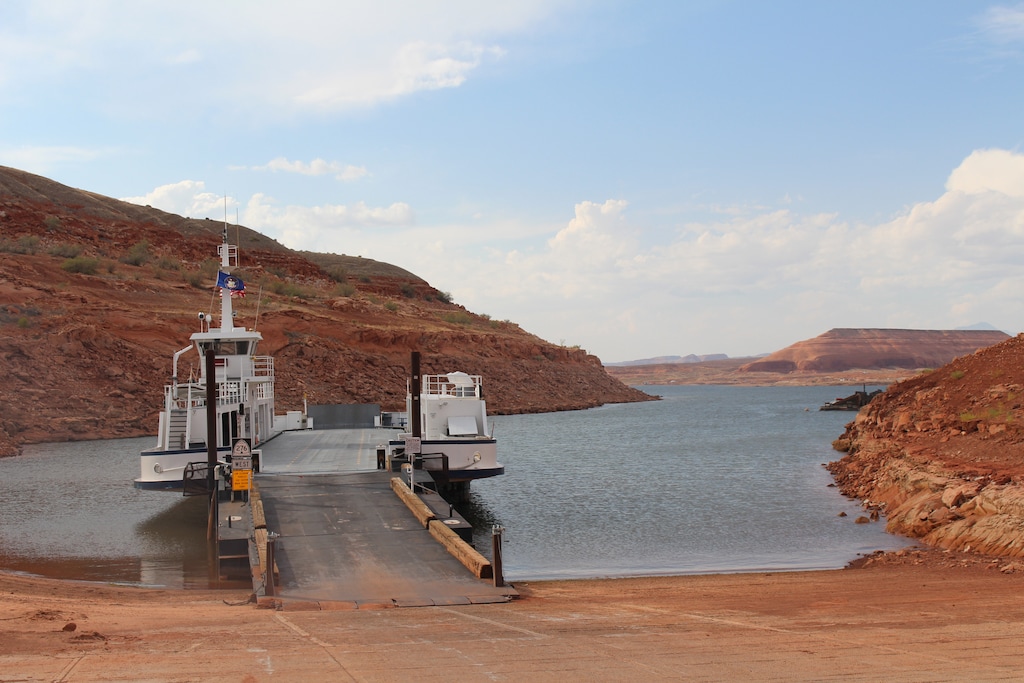
The Charles Hall Ferry has shuttled motorists and tourists between Bullfrog and Halls Crossing since the Utah Department of Transportation commissioned it in 2001. But the ferry has faced a bumpy ride in recent years due to a combination of mechanical issues and Colorado River water shortages that have shriveled Lake Powell. Now state lawmakers are ready to permanently bid the ferry farewell.
“I don’t support this ferry at all,” said Sen. Kathleen Riebe, D-Cottonwood Heights, during a legislative interim hearing Wednesday. “I wish it were more successful.”
The Charles Hall Ferry could hold up to 25 standard passenger vehicles and make up to eight crossings each day. Tickets cost $25 for cars, $15 for motorcycles and $10 for pedestrians and cyclists. The journey took around 25 minutes and covered about 4 miles.
The ferry saved motorists a significant amount of driving. Travel between Bullfrog and Halls Crossing takes 2.5 hours via 143 miles of remote roads.
Tourism, according to UDOT, was the primary traffic driver for the ferry.
“It’s a very scenic drive,” Jared Beard, deputy director of UDOT’s Region 4, told the transportation committee. “It’s unbelievably beautiful down there.”
The boat made 11,500 crossings in 2008, but the numbers steadily declined in the years that followed. Mechanical issues caused the first drop, but repairs allowed the ferry to bounce back starting in 2015. Around 2020, though, the boat literally and figuratively hit some snags.
“We actually replaced the entire drive system of the ferry in 2020,” Beard said. “In 2021, that’s when we really started having the major challenges with water elevations in the lake.”
(Utah Department of Transportation) Charles Hall Ferry vehicle crossings since 2008.
UDOT has dedicated ramps at both docking points that can operate at reservoir elevations of 3,585 feet above sea level or higher. When the water drops below that, the ferry uses public ramps, allowing it to launch at water levels as low as 3,565 feet — the absolute minimum for the boat to remain operational.
The reservoir sat at roughly 3,519 feet as of Wednesday.
The ferry did not operate at all in 2022 or 2023 due to the low water levels. It started running again in July 2024, but the service only lasted seven months before the ferry’s captain went off course and hit a rock, causing major damage.
Even the most optimistic projections from the U.S. Bureau of Reclamation show the reservoir won’t reach an elevation at which the ferry can operate until April 2028.
The ferry is also a major money sink for the state.
In fiscal year 2025, UDOT had an annual budget of $487,000 for the ferry. It hauled in just $30,000 in revenue.
“We know the ferry is never meant to be a money-making operation,” Beard said. “It’s a service. But it certainly doesn’t come close to breaking even either.”
(Francisco Kjolseth | The Salt Lake Tribune) House boats are pictured at Halls Crossing on Lake Powell on Sunday, April 26, 2026.
UDOT presented lawmakers with three options as they deliberated over the ferry’s future.
The first is to decommission the ferry entirely, selling it off to a new home. It will still need to reach a ramp to get it out of Lake Powell, but existing federal funds cover the $200,000 in ongoing maintenance and insurance costs while it’s stuck.
Transportation officials also floated the idea of a four-year plan to restore the ferry service. The National Park Service is finalizing plans to extend its ramp at Bullfrog, but it would be up to the state to pay for a ramp at Halls Crossing that remains functional at low water levels.
It would cost at least $20 million to make the ramp accessible again, according to UDOT estimates. The ferry also needs a hull rehabilitation, which will cost around $1.5 million.
The third option is to build a bridge between Bullfrog and Halls Crossing, with a projected price tag of $650 million.
Lawmakers pressed UDOT on what their preferred route forward might be.
“There’s never a bad day on the lake,” Beard said. “But, from a logistics standpoint … my personal opinion is we should seriously consider selling and discontinuing that service.”
The committee also questioned where UDOT might dredge up the funds to build a bridge instead.
“I don’t know,” said Lisa Wilson, the department’s deputy director of engineering and operations.
Counties surrounding Lake Powell are facing their biggest economic hit from an overall lack of access to the water for launching boats, not moving cars across its water for a scenic drive, Beard said.
Lawmakers questioned whether it would make more sense to invest in marina infrastructure for those communities rather than continuing to dump state dollars into keeping the ferry afloat.
The committee voted unanimously to recommend that UDOT discontinue the ferry service. Any funds recovered from selling the boat will need to be applied to federally supported projects, since the boat was purchased using federal funds, UDOT officials said.
Leia Larsen is a sixth generation Utahn and a water and land use reporter reporter for The Salt Lake Tribune. She has covered environment, energy and political issues throughout the West. When she’s not chasing the news, Leia can be found exploring the Wasatch Mountains, sleeping in the desert or rooting around her garden.