 Brooke Larsen
Beaver • The Beaver River flowed dark brown, almost black, as it wove alongside a destroyed road, burned trees, rock piles and ashen gray earth on Thursday.
Crews were busy clearing out sediment, fallen branches and logs from the river and closed canyon road outside Beaver as the community and forest continue to recover from the destructive Cottonwood Fire and subsequent flash floods.
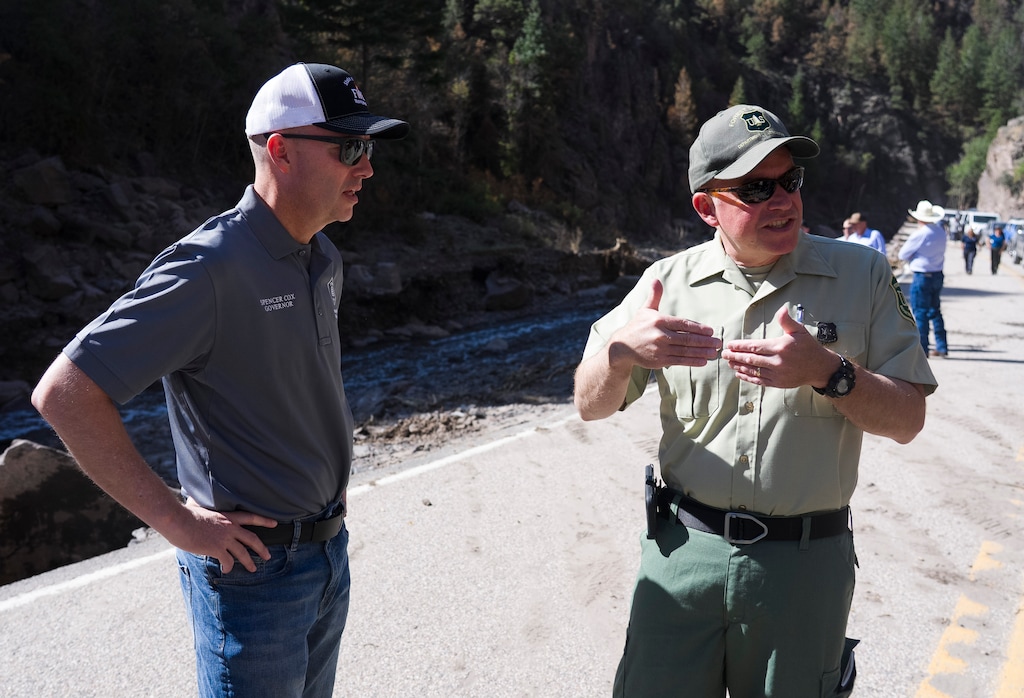
“It’s terrible,” said U.S. Forest Service Chief Tom Schultz on Thursday while looking at the river filled with ash and sediment. “You see the impact to the community, to the watershed, to the ranchers.”
“That’s why we stepped up on this fire,” he continued. “There’s a lot of needs for funding, and this was prioritized right now.”
The Cottonwood burned roughly 150 structures and scorched over 97,000 acres, making it one of the state’s most destructive fires this summer.
Schultz and Gov. Spencer Cox on Thursday signed an $18 million funding agreement to support the recovery needs in the Fishlake National Forest and surrounding communities affected by the fire. Those funds will go toward immediately stabilizing soils, preventing erosion and flooding, restoring recreation access and preventing invasive species from encroaching, among other projects.
The agreement is unique because the state is matching the federal government “dollar for dollar,” Schultz said.
(Bethany Baker | The Salt Lake Tribune) Heavy machinery is seen in the burn scar of the Cottonwood Fire near Beaver on Thursday, Aug. 6, 2026.
“We are a resilient, tight-knit community,” Beaver County Commissioner Tammy Pearson said. “Our roots are deep here, and we’re not leaving. Rebuilding and restoring this land will take time, but working alongside our state, our federal, and local partners, we’ll see this mountain green again.”
The Cottonwood Fire was just one of several destructive fires that have ripped through Utah this summer. As Beaver recovers, the Widemouth 2 Fire continues to rage across another stretch of the Fishlake National Forest near the communities of Kanosh, Fillmore, Meadow and the Kanosh Band of the Paiute Indian Tribe of Utah.
The entire band initially was instructed to evacuate last weekend as the fire spread. The tribe is grateful that the immediate threat to band members’ homes has passed but they remain vigilant as the fire is still not contained, Kanosh Band Chairwoman Gari Lafferty said.
Smoke continues to billow from the mountains outside Kanosh and Fillmore as extreme fire behavior creates challenges for firefighters tackling the blaze that has grown to over 99,000 acres.
(Bethany Baker | The Salt Lake Tribune) The Widemouth 2 Fire burns near Fillmore on Thursday, Aug. 6, 2026.
“We saw it jump and grow several tens of thousands of acres in a very, very short time,” said Tony DeMasters, incident commander with the Great Basin Complex Incident Management team tackling the blaze. “We’re still hot, dry and things are still not getting any better.”
The air was thick with smoke on Thursday afternoon. It has seeped into people’s homes, including longtime Fillmore resident Joyce Goddard.
“The smoke’s been really, really bad in the house,” Goddard said, as she looked at the smoke and flames rising from the mountains east of her. Goddard has closed windows and doors, but smoke still creeps in, especially at night. “[I’m] just trying to survive it until it’s over,” she said.
Goddard has a suitcase packed and ready by the front door in case she has to evacuate. She told The Tribune she has started sleeping in a guest bedroom near the front door in case someone knocks to alert her it’s time to leave.
“It’s been scary since I’m by myself,” she said. She remembers a fire burning nearby three years ago, but her husband was still alive then, so she wasn’t alone.
Goddard isn’t the only resident near the blaze with a suitcase packed and looming anxiety.
Meadow Town Mayor Gary Bishop told The Tribune that he and his family have been “stumbling over” bags by the front door this week. “People are anxious. They’re worried,” he said. “This came through about 3 o’clock Sunday morning, and there are people who have not slept well since.”
(Bethany Baker | The Salt Lake Tribune) Gov. Spencer Cox speaks with various local mayors during a media tour in Kanosh on Thursday, Aug. 6, 2026.
Standing in front of smoke clouds and flames rising in the distance outside Fillmore, Cox said that “if there’s any good news,” it is that firefighters have “done a great job securing the west side of the fire, which is protecting the cities … and the tribal lands.”
The blaze isn’t the only thing on local leaders’ minds, though. They saw the damage from flash floods in Beaver following the Cottonwood Fire and want to prepare their community as much as possible as the fire burns.
“We’ve learned lessons from Beaver,” Fillmore Mayor Curt Hare said. “For us right now, there’s still a lot of unknown because it’s still burning, and how much of that drainage is going to dump into town with the next big rain is where we’re still trying to evaluate.”
(Bethany Baker | The Salt Lake Tribune) A helicopter works the Widemouth 2 Fire near Fillmore on Thursday, Aug. 6, 2026.
Bishop said his town of 300 people could use modeling and engineering assistance to make sure the community is as prepared for floods as possible.
Cox told reporters that he heard the mayors’ calls for engineering help and the need to begin work before the floods come. The “catastrophic fires” Utah has experienced this year have been different from others the state has fought, he added.
“We’ve had fires before, but these burn so hot that the runoff is even worse, and it just decimates everything,” he said.
The state is trying to figure out “where to put the money and where to put the resources in a way that will actually make a difference,” he continued. They tried to do that in Beaver, he said, including with thousands of sandbags. “Those sandbags are all gone because Mother Nature is so much more powerful.”
While the state and Forest Service have committed $18 million to help the recovery of the Cottonwood Fire, the forest and communities affected by the Widemouth 2 Fire may not get the same funds.
“We don’t have unlimited funding for post-fire recovery, and right now we prioritized Cottonwood given those tremendous funding impacts,” Schultz said. The Forest Service also has to evaluate firefighting and recovery costs across the nation as blazes scorch Oregon and Washington, pushing the U.S. to the highest level of preparedness.