 Brooke Larsen
Lake Powell and Lake Mead hit a grim milestone this week.
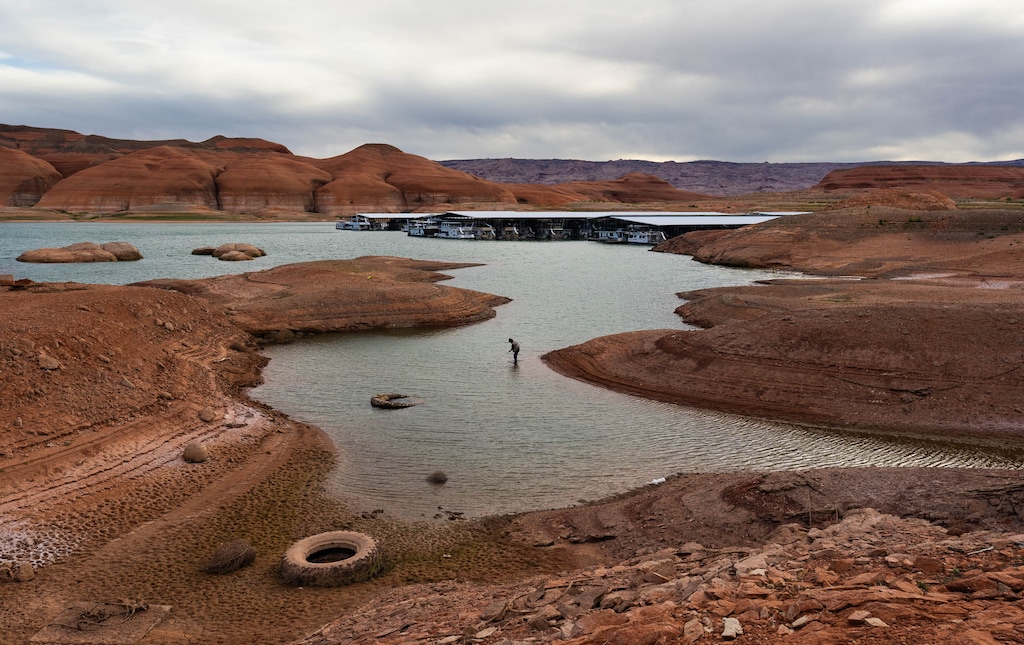
The combined storage in the nation’s two largest reservoirs has dropped to a level not seen since 1956, when Glen Canyon Dam was still under construction, according to a new paper from Jack Schmidt, Anne Castle and other Colorado River scholars.
“It is humbling and potentially disturbing to think about the fact that … we haven’t had that little water in the bank account since before Lake Powell even existed,” said Schmidt, the director of the Center for Colorado River Studies at Utah State University.
The two reservoirs hold almost 60% of the water stored in the Colorado River system. As of July 12, Mead was 27% full and Powell was 24% full, according to the Bureau of Reclamation.
“Powell is downstream of all of the significant Upper Basin uses and Mead is upstream of all the significant Lower Basin uses,” Schmidt said, “so essentially it’s one gigantic reservoir divided into two parts by the length of Grand Canyon National Park.”
The Upper Basin includes Utah, Colorado, New Mexico and Wyoming; the Lower Basin consists of Arizona, California and Nevada.
The record low levels may open up questions about which reservoirs are needed, Schmidt said. However, he added he doubts current water managers, who currently can’t reach consensus about how to share the river, are ready for those conversations.
“The big questions that are implied by where we’re at are ones that absolutely need to be addressed, but they’re not going to be addressed now,” he said. “I mean, we can’t even have functional conversations about how to reduce consumptive use.”
(Francisco Kjolseth | The Salt Lake Tribune) A Lake Powell rental pontoon boat motors down the main channel of the reservoir on Saturday, April 25, 2026, as bathtub rings are indicative of how far the waters levels have fallen since being at full capacity in the early 1980s.
The seven states that share the Colorado River still can’t agree on how to manage the river system after current guidelines expire at the end of this year.
But states met yesterday and more meetings are anticipated next week, Gene Shawcroft, Utah’s Colorado River negotiator, told The Tribune. The two basins have agreed to exchange previously unshared draft agreements that they have been separately working on with the federal government, Shawcroft added.
Reclamation must have operating plans before the water year starts at Lake Powell on Oct. 1. The agency is expected to release a final environmental impact statement this month.
How Powell levels affect storage at other reservoirs
After a record dry and warm winter, Reclamation has been reducing flows out of Glen Canyon Dam and increasing releases out of Flaming Gorge to keep water at Lake Powell above what the agency has called “critical elevation levels.”
Below 3,500 feet, the agency has documented damage to the infrastructure at the dam. Below 3,490 feet, the dam can no longer generate hydropower and Reclamation must send water through lower outlets that weren’t “intended to be operated” for long-term use, Katrina Grantz, Reclamation’s deputy director for the Upper Colorado Region, told The Tribune in June.
“We’re effectively sacrificing Lake Mead and Flaming Gorge to prop up Lake Powell Reservoir,” said Eric Balken, executive director of Glen Canyon Institute.
“We’re just getting to a point with Powell and Mead where we have these two mega reservoirs that are going to be both 80% empty soon,” he added, “and I think a lot of people are scratching their heads and they’re saying, at what point should we consider saving one of them?”
(Francisco Kjolseth | The Salt Lake Tribune) Eric Balken, Glen Canyon Institute executive director, talks about the changes he has seen in a canyon that has surfaced from Lake Powell as the reservoir drops on Saturday, April 25, 2026.
Balken told The Tribune it’s time for decision makers to “start thinking outside of the box,” including reengineering infrastructure at Glen Canyon Dam.
The Tribune asked Grantz about Glen Canyon Institute’s proposal to “Fill Mead First” in June, and she said she “can’t speculate decades down into the future.”
Powell, and all the reservoirs in the Colorado River system, have been “a very important resource,” she added. “Without them we would have had this crisis years ago.”
Reclamation is studying how to operate the dam in a way that would minimize the risk of damage to infrastructure at low water levels, Grantz said in June. The agency is also conducting an initial appraisal study to assess costs of dam modifications. Whether those are pursued is ultimately up to Congress, though, she said.
Shawcroft said he’s not ready to “throw in the towel” and say one reservoir will be enough. Modifying the dam also won’t solve the “the math problem,” he said, which is that water consumption is exceeding supply in the basin.
“It doesn’t generate one drop of additional water, and I don’t know what the cost will be, and I don’t even want to guess,” he added.
The bigger picture, Balken said, is that the basin needs to figure out how consume less water. “Every basin state should have a curtailment plan,” he said. “It should be mandated by by the federal government.”
The latest most-probable reservoir elevation forecast from Reclamation shows Powell dropping below 3,500 feet by the end of February 2027. The July study was more optimistic than forecasts in recent months, though, and doesn’t show Powell dropping below minimum power pool, 3,490 feet, in the next year.
The July minimum probable study, which has been more accurate in recent years, shows Powell dropping below 3,490 by the end of February 2027.
Releases from Flaming Gorge gave Powell a boost in May. But it began dropping again after June 1, and Flaming Gorge releases now are only slowing Powell’s recession, not increasing storage, Schmidt said in an email.
“We are in uncharted territory,” Balken said.
This article is published through the Colorado River Collaborative, a solutions journalism initiative supported by the Janet Quinney Lawson Institute for Land, Water, and Air at Utah State University. See all of our stories about how Utahns are impacted by the Colorado River at greatsaltlakenews.org/coloradoriver.