 Brooke Larsen
As hot temperatures sweep across Utah and water supplies continue to drop, states and the federal government are launching a new effort to better measure how much water evaporates from major reservoirs upstream of Lake Powell.
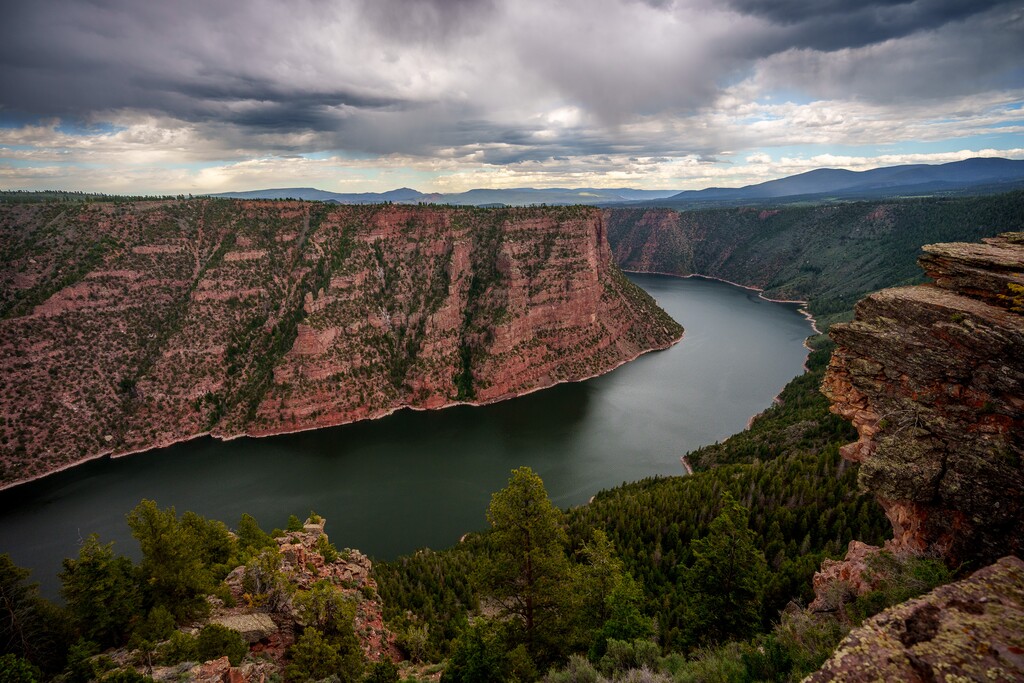
The Bureau of Reclamation partnered with scientists and Upper Basin states, including Utah, Colorado, New Mexico and Wyoming, to launch a new evaporation study at Flaming Gorge, Blue Mesa and Navajo reservoirs — key water storage projects in the Upper Colorado River Basin.
“We’re deploying some state-of-the-art instrumentation to monitor evaporation and weather conditions over the reservoirs,” said Chris Pearson, a research scientist at the Desert Research Institute who was busy installing equipment on floating platforms at Navajo Reservoir, which straddles the Colorado and New Mexico border, last week.
Platforms were launched at Flaming Gorge, which spans Utah and Wyoming, in April and Colorado’s Blue Mesa reservoir in May.
The project was funded through a $50 million grant from the Infrastructure Investment and Jobs Act, which was passed during the Biden administration. The funding is meant to improve reporting, measuring and monitoring of water use in the Upper Basin states, Chuck Cullom, director of the Upper Colorado River Commission, told The Tribune.
(Upper Colorado River Commission) Wyoming Colorado River Commissioner Brandon Gebhart, Utah Colorado River Commissioner Gene Shawcroft, Bureau of Reclamation Upper Colorado Regional Director Wayne Pullan and Desert Research Institute scientist Chris Pearson, visit the floating evaporation monitoring platform at Flaming Gorge Reservoir on Wednesday, April 15, 2026.
“Reservoir evaporation is about 15% of the Upper Basin depletions every year, and so if we can improve our understanding of evaporation losses, it’ll help water managers in a year like this make the best decisions on when and how much water to release and how to operate those reservoirs,” Cullom said.
The Colorado River Basin received its worst snowpack and some of its warmest winter and spring temperatures on record this year. Reclamation is sending up to 1 million acre-feet of water from Flaming Gorge to prop up Lake Powell, which forecast models show will reach levels that threaten hydropower production and could damage dam infrastructure by early next year.
This new evaporation study is a “piece of a big puzzle” states are trying to solve, said Gene Shawcroft, Utah’s Colorado River commissioner. “We are trying to make sure we understand as much as we can about every drop of water and where it goes and how it’s used.”
Evaporation counts against each state’s water allocation and consumptive use, Shawcroft added.
How the study will help
Reclamation and the states have modeled the new study in part after the long-term evaporation monitoring program at Lake Powell. The agency and states hope it will provide more data to improve future decision-making.
(Upper Colorado River Commission) A new evaporation monitoring station at Flaming Gorge on Wednesday, April 15, 2026.
“This study helps strengthen the technical foundation needed for future reservoir operations, forecasting and accounting efforts,” said Wayne Pullan, Reclamation’s regional director for the Upper Colorado Basin, in a statement on Thursday.
Historically, most evaporation studies in the Upper Basin were done with equipment that was on land next to a reservoir. By installing instruments in the middle of the reservoir, researchers can better understand what’s happening across the water body, Pearson said.
The new instruments will capture real-time data on air temperature, relative humidity, wind speed, water temperature at different elevations and more to give a full picture of evaporation and the factors that affect it. “It’s basically a super weather station,” Cullom said.
So far, the new evaporation monitoring technology appears to be improving the accuracy of data collected, Cullom said.
“That’s really important this year because the storage in those reservoirs is changing dramatically at Flaming Gorge and Blue Mesa,” Cullom continued, “and having these instruments actually on the water surface is telling us how evaporation changes when the amount of water in those reservoirs changes.”
Data is showing that the temperature of the lake changes more rapidly than they thought when there’s less water in the reservoir, Cullom explained. “It’s like a giant refrigerator when it’s full, and then it’s more like an igloo cooler.”
With more accurate data, water managers will be able to operate reservoirs more precisely, Cullom said. “That’s increasingly important as our water supplies are getting tighter every year,” he added.
This article is published through the Colorado River Collaborative, a solutions journalism initiative supported by the Janet Quinney Lawson Institute for Land, Water, and Air at Utah State University. See all of our stories about how Utahns are impacted by the Colorado River at greatsaltlakenews.org/coloradoriver.