 Leia Larsen
Note to readers •This story is made possible through a partnership between The Salt Lake Tribune and Grist, a nonprofit environmental media organization.
A billion-dollar cleanup at one of Utah’s most popular recreation destinations is almost complete, and a new report hints at what might be in store.
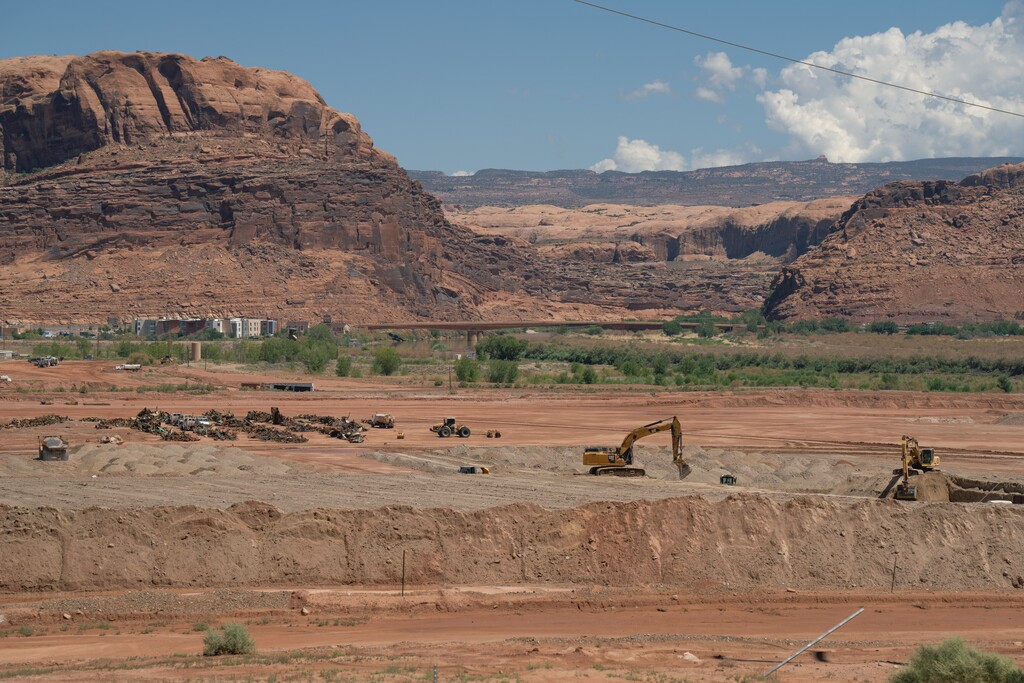
The U.S. Government Accountability Office spent a year auditing the Moab Mill Site, a Cold War-era uranium processing facility sandwiched between the Moab, the Colorado River and Arches National Park. The mill site could become a public asset for Grand County residents — possibly with a boat ramp, events center or hiking trails — although federal agencies have not made a formal decision.
A private company removed uranium from rock in the Moab area and sold it to the U.S. Atomic Energy Commission — now the Department of Energy — between 1956 and 1970. The Moab Mill Site operator dumped processed rocks in an unlined tailings pond, which contaminated the surrounding groundwater with uranium and ammonia, threatening the nearby Colorado River, according to the federal government.
The company ended operations in 1984 and went bankrupt. The federal government realized it had an environmental mess to address by 2000 and no one to sue for cleanup. It stepped in to cover all the costs and began work in 2009.
As of this year, according to a report released Wednesday, the government has removed 16 million tons of tailings, loading them on rail cars at the Moab site and shipping them 30 miles away to a landfill near Crescent Junction specifically designed to house the tailings.
(Christopher Cherrington | The Salt Lake Tribune)
The Department of Energy also removed 1 million pounds of ammonia and more than 5,000 pounds of uranium from groundwater at the 480-acre mill property.
Cleanup costs reached $970 million as of the 2025 fiscal year. The project will likely complete work in 2029, with a total expected price tag of $1.16 billion.
The federal government will retain ownership and management of the disposal site near Crescent Junction. It intends to transfer the cleaned Moab Mill Site to Grand County, although the report notes the Department of Energy has not made a final decision on the project’s future.
Plans to transfer the property to the county are still in the works. A steering committee of local officials and public outreach efforts have floated ideas like turning the old mill into an event center, a non-motorized boat ramp or hiking trails with viewpoints, according to the report. Much of the land includes rights-of-way for utilities, roads and railroads, along with steep hills, floodplains and a conservation easement.
But the Department of Energy does not have authority to transfer ownership of the Moab Mill Site, the report notes. Sen. John Curtis and Sen. Mike Lee introduced a bill last year to donate the site to Grand County, but it has not been approved in either chamber of Congress.
The Government Accountability Office’s audit found the feds had adequately followed or mostly followed its eight leading practices for engaging with the National Park Service, the Utah Department of Natural Resources, local governments and other area stakeholders for the cleanup and future use of the Moab Mill Site. The only category where the federal government fell short was causing confusion over the property’s future use and transfer process, the report said.