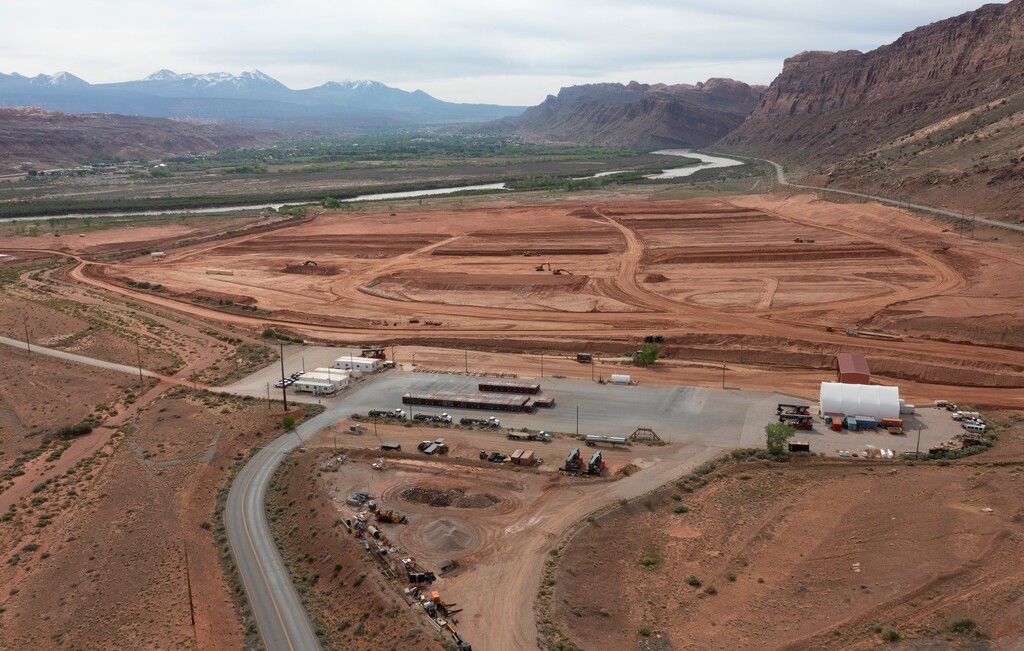
Just over a week after celebrating a major cleanup milestone at the former uranium mill site north of Moab, local officials are turning more directly to the next phase of the project: what the land should become — and how to begin preparing for that transition.
At a joint meeting April 17, the Moab City Council and Grand County Commission discussed the site’s long-term future and reviewed years of community planning. Officials also outlined key decisions that will need to be made in the coming months and years as cleanup continues.
Early concepts for the site — shaped through multiple rounds of public input over the past decade — include resident-focused uses such as trails, river access, event space and transit connections.
Those discussions come as the Moab Uranium Mill Tailings Remedial Action project — a decades-long federal effort to remove radioactive waste from along the Colorado River — moves closer to completion. More than 16 million tons of tailings have been relocated, officials said, though some contaminated material remains and groundwater treatment and long-term monitoring will continue, with full completion expected around 2029.
Until then, the site remains under federal management, and its long-term ownership has not yet been finalized. Federal legislation that would transfer the property to Grand County has advanced out of committee but has not yet been approved.
In the near term, Grand County faces a June 1 deadline to identify which infrastructure it may want to request for transfer from the U.S. Department of Energy — essentially a preliminary “wish list” of assets the county could take on, said Grand County Commission Chair Melodie McCandless. The decision could influence how the site is accessed, maintained and developed if it is eventually transferred to local control.
The infrastructure under consideration includes roads, rail access, water systems, utilities and buildings constructed during the cleanup process. Some of those assets could support early public access or development, while others may come with significant long-term maintenance costs and responsibility.
“It really comes down to Grand County,” Moab Mayor Joette Langianese said. “It’s going to be your property. What liabilities you want, what liabilities you don’t.”
(The Times-Independent) Moab Mayor Joette Langianese speaks at the Moab City Council and Grand County Commission joint meeting on April 17, where officials discussed, among other topics, the future use of the former uranium mill site and next steps as cleanup continues.
Officials discussed how some infrastructure could be costly or difficult for the county to maintain, including systems such as a cliff stability monitoring system, while other assets could be important for making the site usable in the near term.
The discussion also included a pipeline used during cleanup that could potentially be transferred to the Grand County Water Conservancy District, offering a potential water source for northern Grand County communities but adding responsibility for maintenance.
“That’s a resource,” Commissioner Brian Martinez said, noting both the opportunity and the associated liability.
Several officials emphasized that the site should not be viewed simply as an opportunity.
“I don’t think that it’s an asset yet,” Martinez said. “I think that we all need to understand what we’re actually taking on as a liability.”
Langianese echoed that point.
“We all get high in the sky and think, look at this, we’ve got this 500 acres of land,” she said. “But it is going to be a liability.”
Presentation materials and discussion at the meeting highlighted significant constraints on development. About 74% of the site is considered undevelopable due to floodplain, steep terrain, rights-of-way and conservation areas, leaving a smaller portion suitable for more intensive use.
Additional limitations include potential subsurface contamination, the lack of culinary groundwater and continued federal oversight of groundwater conditions. Officials also said liability concerns tied to long-term monitoring could limit certain uses, including overnight stays.
“Legacy Management has very much discouraged any overnight,” Commissioner Mary McGann said.
Langianese said the Department of Energy has indicated that deed restrictions would be placed on the property, though those restrictions have not yet been provided to local officials.
The April 17 discussion builds on more than a decade of planning led by the Moab Tailings Project Site Futures Committee, which was established in 2012 to guide a public process for determining future use of the site.
That process has included community visioning efforts in 2013, 2018 and 2023, each informed by public workshops, surveys and stakeholder input and resulting in conceptual plans for how the site could be developed. The most recent plan includes a conceptual layout identifying areas for potential parks, event space, river access and trail connections across the site.
“We’ve come a really long way,” said Saxon Sharpe, vice chair of the committee, adding that the project is “finally rounding the corner to actually implementing something on this property.”
(Andrew Christiansen | The Times-Independent) Saxon Sharpe, vice chair of the Moab Tailings Project Site Futures Committee, and Grand County Commissioner Mary McGann present during a joint meeting of the Moab City Council and Grand County Commission on April 17 in Moab.
Officials said another round of community visioning is expected in 2027, but in the meantime, existing plans are guiding early discussions about how the site could be implemented in phases.
Langianese pointed to Las Colonias Park in Grand Junction, Colorado — a former uranium mill site that took decades to redevelop — and said Moab hopes to move more quickly.
“I don’t think we want to wait 20 years,” she said, noting that some uses, such as trails or day-use amenities, could potentially be developed earlier.
Langianese also said the site’s existing rail infrastructure could create opportunities for future passenger rail access, including the possibility of connections to the Canyon Spirit luxury train, though no plans have been finalized.
She also said local officials should consider asking the Department of Energy to complete certain improvements before transferring the land, while federal resources are still available.
“I really feel strongly that we should be asking the Department of Energy to do things to that site while they have the capability to do them,” she said.
Questions about how exactly that work will be coordinated and funded remain unresolved.
Officials discussed the possibility of a shared city–county staff position focused on coordinating the site’s transition, pursuing funding and managing long-term planning, though no decisions have been made.
They also discussed revisiting an existing agreement between the city and county that was previously approved to guide joint planning efforts. The agreement had supported a federal grant application for site planning, which was not awarded because it was too early, though Moab City Manager Michael Black said the proposal received a generally positive response.
Until the land is formally transferred, McGann said securing funding for development may remain difficult, though officials noted that having federal legislation now advancing could improve those prospects compared to earlier efforts.
In the coming weeks, a smaller working group is expected to refine the county’s infrastructure wish list ahead of the June 1 deadline, with final decisions brought back to the commission.
In the coming weeks, a smaller working group is expected to refine the county’s infrastructure wish list ahead of the June 1 deadline, with final decisions brought back to the commission.
“We start working together now, so that when we get to 2029, we have something that we can actually use,” Langianese said, a point that drew agreement from officials in the room.
This story was first published by The Times-Independent.