 Brooke Larsen
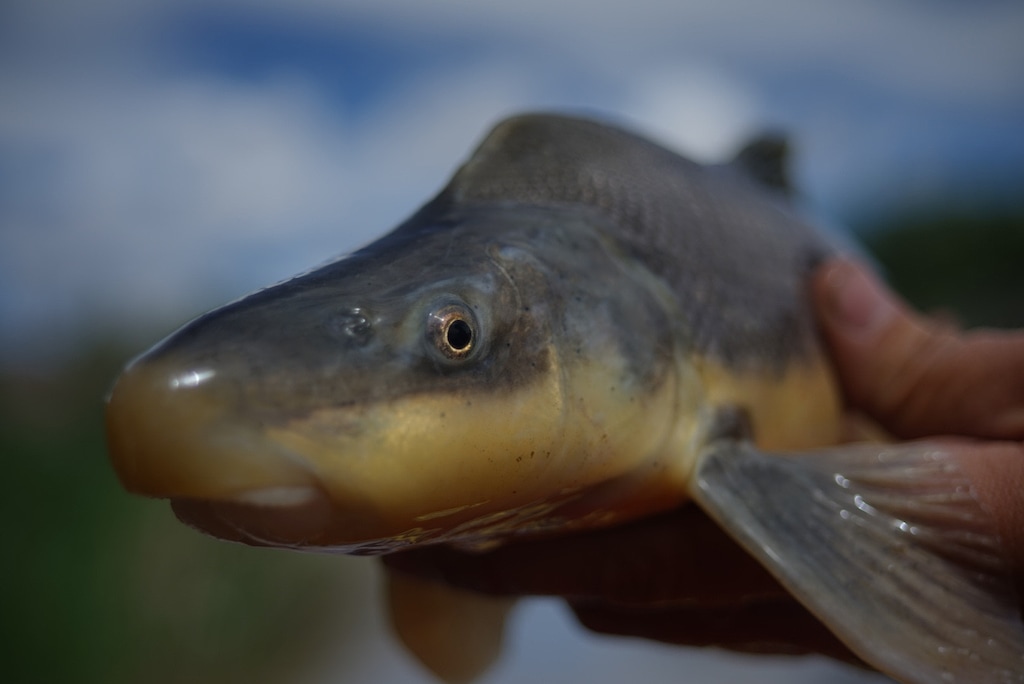
Tiny razorback sucker fish have begun spawning in the Green River. Just a few millimeters long now, these larvae will eventually grow up to three-feet long with a sharp hump across their back — if they survive, that is.
The razorback sucker is one of four endangered fish in the Green River and larger Colorado River Basin. Dams have changed their home, while invasive smallmouth bass prey on the young fish before they can reach adulthood.
Now, a surge of water released from Flaming Gorge into the Green River intended to boost levels at the shrinking Lake Powell may also improve the endangered fish’s odds of survival.
“It’s actually kind of a silver lining to this awful year,” said John Berggren, regional policy manager with Western Resource Advocates. “Because Reclamation is going to be moving so much water from Flaming Gorge down to Lake Powell, if you time that water in a way that benefits the four endangered fish of the Green River, you can actually have significant benefit for them.”
The Bureau of Reclamation plans to release between 660,000 to 1 million acre-feet of water from Flaming Gorge Dam this year to prevent Lake Powell from reaching minimum power pool — the level at which Glen Canyon Dam can no longer generate hydroelectricity or sustain long-term releases of water downstream.
Flows out of the dam in early May reached up to 8,600 cubic feet per second. The agency tapered those flows down to 1,100 cfs last week and will ramp up at other strategic moments to help endangered fish later in the year.
(Shaney Slaugh | U.S. Bureau of Reclamation) Water rushes out of Flaming Gorge Dam during the Larval Trigger Study Plan release in early May 2026.
The bureau times spring peak releases according to when scientists with the Upper Colorado River Endangered Species Recovery Program first find razorback sucker fish in the Green River, said Valerie Deppe, the bureau’s projects, operations and modeling division manager for the region.
Members of the program — known as “night hawks” — place light traps in the river that attract the fish, explained Kevin Bestgen, a scientist with the program and professor at Colorado State University. Those “night hawks,” Bestgen added, trudge through the insect-filled, mucky wetlands at night to place the traps then collect them in the morning.
Researchers first captured razorback suckers in late April, about a month earlier than average, Bestgten said, and nine days sooner than the previous earliest observation, according to Deppe.
Scientists and federal agencies then made a plan to start what’s called Larval Trigger Study Plan releases to boost the river and flood razorback sucker wetland habitat. Since the plan was put in place in 2012, Reclamation has waited to start spring peak releases from Flaming Gorge until scientists detect razorback sucker larvae so those flows can best benefit the fish.
Without the additional releases to boost Powell, the bureau would have only done one day of releases for the razorback sucker at 4,600 cfs, according to the bureau’s water management team. The additional flows from Flaming Gorge this year, though, allowed the agency to magnify and extend that to seven days at 8,600 cfs.
How the high flows will help endangered fish
When the bureau last released extra water from Flaming Gorge to prop up Powell in 2022, the recovery program collected 4,577 juvenile razorback sucker fish from four wetlands managed as nursery habitat. That’s nearly the same amount biologists collected over the entire prior decade.
“The habitat would not have existed without those releases,” a U.S. Fish and Wildlife Service spokesperson said over email. “Without the high flows those wetlands don’t get filled.”
Prior to those additional releases, land and water managers also created more ideal habitat conditions for the razorback sucker, Bestgen said, including reducing cattails that had taken over a wetland and reducing nonnative fish populations.
The high flows allowed the river to connect with floodplain wetlands and sweep the young razorback suckers into those warmer, mellower waters.
“Those fish hatch when they’re only about nine millimeters in total length,” Bestgen said. “So they’re pretty weak at swimming. They’re out there in the coldest flows in kind of a food poor environment in the main channel. But these floodplain wetlands are actually warm, low velocity and very rich in food.”
(U.S. Fish and Wildlife Service) Razorback sucker larvae photographed at the Grand Valley Propagation Facility in Colorado on May 22, 2019.
That environment allows for the razorback sucker to grow relatively rapidly, Bestgen added. His team has watched the juveniles grow from nine millimeters to 150 millimeters, or about 6 inches, in just one summer.
“That’s a substantial growth rate. And with fish, size matters,” Bestgen said. “The bigger the fish is, the higher survival rate.”
The invasive smallmouth bass grows much faster than the endangered native fish of the Green River, Bestgen added. That’s why the recovery program is trying to stop smallmouth bass from hatching in the first place.
The bureau will time a 72-hour flow spike from Flaming Gorge later this year, likely in June, to try to disrupt smallmouth bass spawning and wash away the fish’s nests.
The drought response releases from Flaming Gorge will also allow the agency to maintain higher base flows throughout the summer and fall, which could potentially benefit the endangered Colorado pikeminnow, according to the drought response operation plan.
Since the plan was implemented in late April, the bureau has sent over 18,000 acre-feet of additional water out of Flaming Gorge, Amy Haas, executive director of the Colorado River Authority of Utah, said during an authority board meeting last week. That water just arrived at Powell on May 11, she added.
While the main purpose of those flows is to prop up Powell, timing the releases to benefit fish is the “perfect example” of finding “environmental benefits” in this drought year, Western Resources Advocates’ Berggren said.
“In an era of climate change, in an era of an over-appropriated Colorado River, there’s not excess water to go around,” he continued, “and so you have to be really strategic, really intentional and find opportunities for win-wins.”
This article is published through the Colorado River Collaborative, a solutions journalism initiative supported by the Janet Quinney Lawson Institute for Land, Water, and Air at Utah State University. See all of our stories about how Utahns are impacted by the Colorado River at greatsaltlakenews.org/coloradoriver.