 Brooke Larsen
Utah Sen. Mike Lee and fellow Republicans added a repeal of the controversial roadless rule to a previously bipartisan wildfire bill on Wednesday.
The amended Wildfire Prevention Act passed out of the U.S. Senate Energy and Natural Resources Committee on an 11-9 vote split along party lines and now heads to the full Senate. The act would nullify the 2001 roadless rule, which prevents logging and roadbuilding on nearly 59 million acres of national forest land, including roughly 4 million acres in Utah.
“The roadless rule was a bad idea in 2001 and it remains a bad idea today, a quarter of a century later,” Lee, who chairs the committee, said during the meeting. “The rule has wreaked havoc on a lot of western communities, including a lot of communities in my state.”
This move comes nearly a year after the U.S. Department of Agriculture began an effort to rescind the roadless rule through an administrative process. The environmental review is currently underway and a decision is expected later this year.
More than 99% of comments submitted during the public comment period oppose the Trump administration’s efforts to rescind the roadless rule, according to an analysis by the Center for Western Priorities.
“In a time of drought, wildfire, and overuse, these lands need more resources, not fewer,” said Jack Stauss, director of Save Our Canyons, in a statement. “While I’m not surprised by Senator Mike Lee’s partisan public land grab, I am deeply saddened by it. It is bad for the Wasatch, and bad for Utah.”
Democratic senators introduced a second amendment early in the meeting on Wednesday in an attempt to strike the repeal of the roadless rule from the bill.
(Tim Peterson) A roadless area in the Ashley National Forest in the High Uintas.
“For decades the roadless rule has protected some of America’s most iconic outdoor recreation areas,” said Sen. Ron Wyden, D-Ore.
Senators in both parties initially supported the Wildfire Prevention Act, introduced by Sen. John Barrasso, R-Wyo., which instructs federal land agencies to set targets and report on prescribed fire and forest thinning to reduce wildfire risk.
“I’m just really disappointed,” Sen. Martin Heinrich (D-N.M.), the committee’s ranking member, said during the Wednesday meeting. “I want to commend Senator Barrasso for working in a very bipartisan way on dealing with the wildfire threats that we’re all struggling with, and I think putting the roadless rule repeal into this legislation just blows that up.”
Sen. Alex Padilla, D-Calif., said Republicans are pushing a “poison pill in what is a tremendous bipartisan opportunity.”
After voting in support of the amended bill, Sen. Steve Daines, R-Mont., said he didn’t “want to spoil the broth” or the “bipartisan progress” the committee had made on forest management.
“I do hope we can continue the spirit of dialogue and cooperation,” he added.
Wildfires and the roadless rule
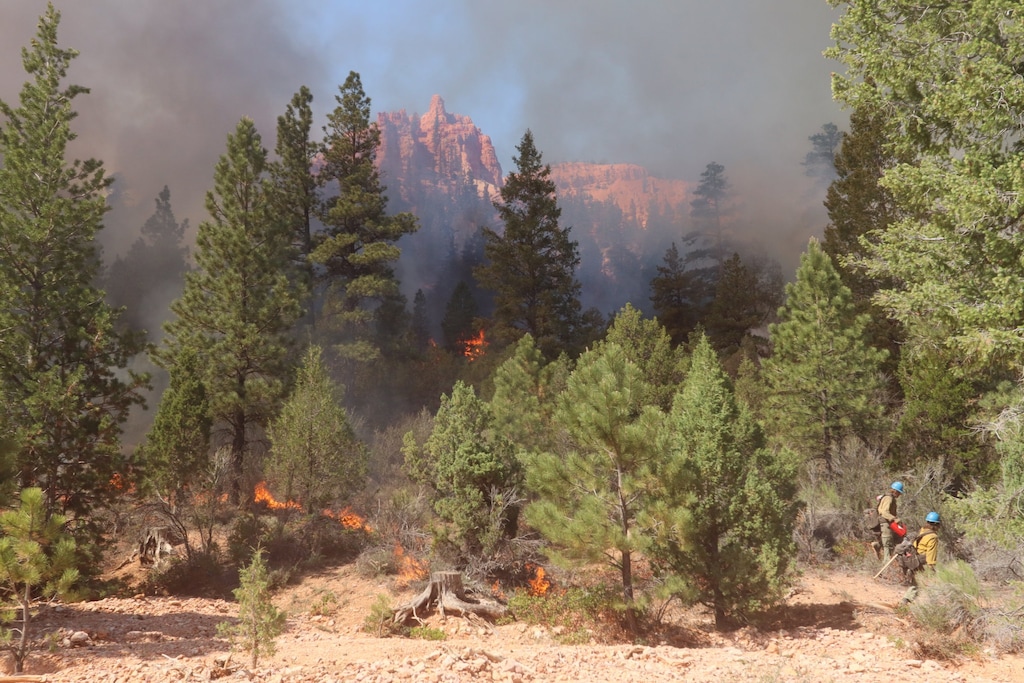
Wildfire threats have become a central part of the debate over the roadless rule.
The West faces significant wildfire risk this year after an abnormally hot and dry winter, according to the National Interagency Fire Center. All of Utah faces an above-normal wildland fire potential for June and July.
(National Interagency Fire Center) Outlook for wildfires across the U.S. in June 2026.
Adding on to climate and weather factors, federal agencies, such as the Forest Service, are facing a diminished workforce to conduct wildfire prevention activities, according to Andrea Delgado, former deputy regional forester with the Forest Service’s Rocky Mountain region.
Leading up to this fire season, the Forest Service treated roughly 35% fewer acres of hazardous fuels in 2025 compared to 2024, according to an analysis by the Center for Western Priorities. However, Utah was among three states in the West that did see an increase in acres treated in 2025.
Opponents of the roadless rule argue it makes wildfire prevention and treatment more challenging.
“The rule restricts access for multiple use in nearly 59 million acres of Forest Service lands in ways that … have a tendency to increase wildfire risk, endanger communities and limit economic activity,” Lee said.
Supporters of Lee’s amendment echoed his sentiments. “Blocking responsible management access doesn’t protect these forests — it leaves them more vulnerable to catastrophic fire, insect infestations, and long-term ecosystem damage,” Ben Burr, executive director of the Blue Ribbon Coalition, said in a statement.
Democrats argued, though, that roads increase wildfire risk and that the roadless rule doesn’t stop prevention activities.
“Republicans have claimed that the roadless rule has hindered wildfire mitigation efforts, and it’s simply false,” Padilla said. “In fact, more than 240,000 acres of roadless land in California have undergone vegetation maintenance and treatments to reduce wildfire risk and protect those nearby communities.”
“In a number of instances, more roads mean more wildfires,” Wyden said, “and repealing the roadless rule is an open invitation to destroy these recreation areas and to spark catastrophic wildfires.”
Leading forest and wildfire scientists have said that the relationship between roads and fires is complicated.
(Rick Egan | The Salt Lake Tribune) The Pine Valley Recreation Area after the Forsyth Fire on Wednesday, August 13, 2025.
Humans cause the majority of wildfires. Roads can increase wildfire risk directly through chain dragging and parking on dry grass, as well as by bringing more humans into more forest lands where they may light campfires or set off fireworks.
“Speculation that eliminating road prohibitions would improve forest health is not supported by nearly twenty years of monitoring data,” a 2020 study from the Forest Service said.
That study also found that the roadless rule had not stopped wildfire prevention activities in roadless areas.
Another 2021 study found no difference in wildfire severity across roadless and roaded national forest areas in the West, but fires did reach a greater extent in roadless areas because it’s more difficult to contain fires in remote areas.
There was an exception, though: in Utah, particularly the Wasatch and Uinta Mountains, fire extent was similar in areas with and without roads.