 Leia Larsen
Note to readers • This story is made possible through a partnership between The Salt Lake Tribune and Grist, a nonprofit environmental media organization.
Utahns just witnessed one of the state’s worst snowpacks on record. An unseasonably hot start to spring may tempt some to turn on the sprinklers to keep plants happy, but water managers are urging them — wait at least another month.
Spring runoff typically peaks around June. This year, though, what little snow did fall has mostly melted off thanks to record-warm temperatures in March. Despite cooler temperatures and some moisture in recent days, water providers say they are stressed about the irrigation season ahead.
“This was the worst winter of my career, by far, for lots and lots of reasons,” said Jared Hansen, director of water policy for Central Utah Water Conservancy District.
Hansen’s district supplies water to Utah, Wasatch, Juab, Uintah and Duchesne counties, along with parts of Salt Lake and Summit counties. Central Utah has large reservoirs like Strawberry and Jordanelle that can store up to seven years’ worth of water needs with supplies sourced from the Colorado and Provo rivers.
“It’s a little more drought resilient,” Hansen said.
That’s not the case farther north, where the Weber Basin Water Conservancy District can only store two years’ worth of water. The Weber River’s reservoirs currently sit about 60% full, according to district manager Scott Paxman.
“We never saw any runoff,” Paxman said. “It’s weird, so weird.”
That means the district’s customers in Weber, Box Elder and Morgan — which have one of the largest secondary water systems in the nation — won’t see their outdoor irrigation water turn on until May 15, a month later than normal. And water will shut off on September 15, one month ahead of the usual schedule. Paxman expects 20% cuts across his service area.
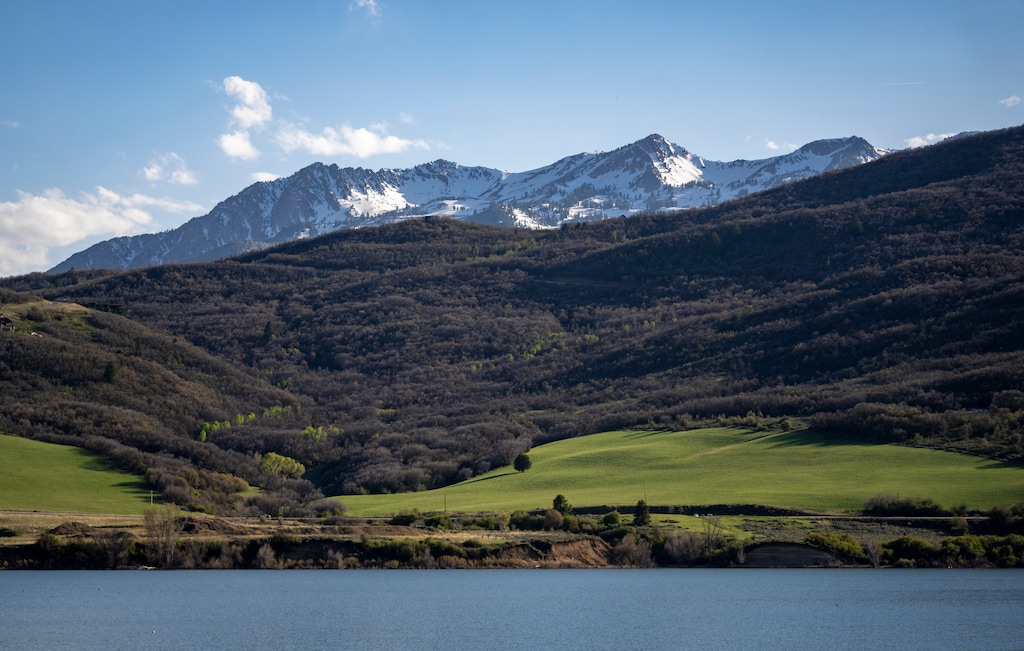
(Rick Egan | The Salt Lake Tribune) Willard Bay State Park, on Monday, April 20, 2026.
That May 15 date to begin outdoor watering has been embraced by resource managers across the northern part of the state, regardless of how much storage they have in reservoirs. Central Utah plans to deliver full water allocations to customers this year, but they still urge residents to reel in their use.
“We’re trying to get people to use their water wisely,” said Amanda Strack, the district’s conservation manager. “We want everyone to feel they’re empowered and they can do something.”
Jordan Valley Water Conservancy District, which serves much of Salt Lake County, is calling on water users to reduce irrigation by 10% this year. Wholesale customers — which are typically the cities buying water from the district for their residents’ use — could face fines if they exceed their contracts. Like Weber Basin, Jordan Valley’s reservoirs only hold about two years’ worth of storage.
“We’ll really be dipping into that insurance policy this year,” said spokesperson Kelly Good. “If we have another really bad winter, we’ll be feeling it next summer.”
Salt Lake City Public Utilities is aiming to cut 10 million gallons per day this spring and summer from all sectors, according to director Laura Briefer. But her department has noticed customers already turning on their outdoor spigots.
“It’s not time to start watering outside yet,” Briefer said. “We’re asking for people to wait until mid-May.”
She encouraged residents to use the next few weeks to check their irrigation systems for leaks instead. The city has a partnership with Utah State University customers can tap to identify ways to reduce water use as well.
The city has declared “Stage 2″ watering restrictions, which requires government-owned properties to make cuts and calls on other water users to voluntarily reduce use.
“There’s a potential that we would move into more restrictive stages as the summer progresses,” Briefer said. “It would be unusual for us to do that, because typically our community has risen to the challenge in drought years and conserved quite a lot of water.”
Briefer added that she’s concerned that the Great Salt Lake is set to hit yet another record low this season. The lake sunk to its first modern low in 2021, then hit another in 2022. An unprecedented amount of snowpack in 2023 briefly reversed its downward trend, but the gains in lake elevation have since been erased.
While climate change is bringing warmer temperatures and drier conditions to Utah, the Great Salt Lake’s decline is almost entirely human-caused as farmers, water districts and cities divert water away from its tributary streams, which include the Bear, Weber and Jordan rivers, according to research from the Great Salt Lake Strike Team.
“Every drop we can conserve,” Briefer said, “especially with outdoor water usage, can help the Great Salt Lake.”
(Rick Egan | The Salt Lake Tribune) Pine view Reservoir, on Monday, April 20, 2026.
The lake’s fresher, more ecologically productive southern arm — where abundant brine flies and brine shrimp feed millions of migrating birds each year — currently sits at 4,192 feet above sea level, or about 3.5 feet higher than the historic low it set in 2022. Joel Ferry, director of the Utah Department of Natural Resources, said he doesn’t expect it to rise much more this spring, and the lake typically loses around three feet to evaporation during the warm summer and fall months.
“We’re back hitting on all cylinders and really pushing both the drought messaging and conservation messaging,” Ferry said. “It’s going to be a rough year.”
His department previously used a rock-filled railroad causeway bisecting the lake to manage salinity levels and prevent ecosystem collapse by filling in a breach that allows water exchange between north and south. State resource managers are currently evaluating when and whether to do the same this summer.
But Ferry said he is hopeful that a “super El Niño” forecasted by agencies like the National Oceanic and Atmospheric Administration will provide relief next winter, bringing with it significant snowfall and potentially some summer monsoons.
“Our snowpack is so abysmal this year, though, that we can’t let our foot off the gas, even if this El Niño does form,” Ferry said.
The National Weather is already seeing a dry La Niña cycle shifting toward a more “neutral” weather phase, said Brittany Whitlam, a forecaster with the Salt Lake City office. She expects that to bring wetter conditions to southern Utah starting in the fall, but in the Great Salt Lake Basin, the forecast remains up in the air.
“In northern Utah, there’s not too much of a signal,” Whitlam said. “We’re kind of between where that jet stream would impact the area.”
Leia Larsen is a sixth generation Utahn and a water and land use reporter reporter for The Salt Lake Tribune. She has covered environment, energy and political issues throughout the West. When she’s not chasing the news, Leia can be found exploring the Wasatch Mountains, sleeping in the desert or rooting around her garden.