The number of married students enrolled at Brigham Young University’s campuses in Provo and Rexburg, Idaho, seem to be dropping.
At the flagship college campus of The Church of Jesus Christ of Latter-day Saints, in the heart of Utah County, 25% of all enrolled students in fall 2021 were married, The Daily Universe previously reported.
By fall 2025, that figure fell to about 17%, according to university enrollment figures, though the marital status of 20% of the students was reported to be unknown.
To the north, in Rexburg, about 22% of students enrolled at BYU-Idaho were married in fall 2021, the school reported. That percentage dipped to 20% by fall 2025, university enrollment data indicates.
Tallies on married students at BYU-Hawaii were not immediately available, and the school did not respond to a request for more information.
Despite the apparent decline in Utah and Idaho, the predominantly Latter-day Saint student body at both schools is still marrying at a higher rate than other campuses across the country.
In the 2019-2020 academic year, only about 4% of U.S. college students ages 19 to 23 were married, on average, according to the most recent data available from the National Center for Education Statistics.
Still, the decline at these two BYU campuses falls at a time when it has become more common for young people to skip marriage altogether, The New York Times reported.
“The drop in marriage rates among Latter-day Saints just tracks with the broader culture, as with almost all trends,” said marriage and family researcher Jenet Erickson, who teaches at BYU’s Provo campus.
But for church leaders, BYU administrators and professors, the emerging trend seems to have triggered alarms.
Engineered ‘date nights’
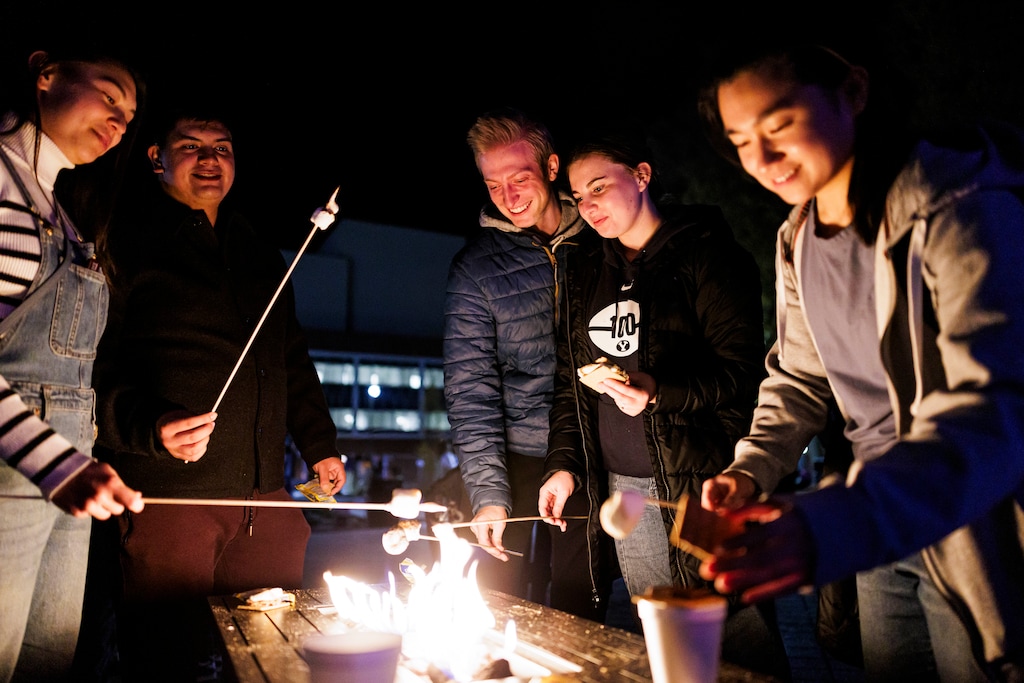
(Ellie Alder | BYU Photo) BYU students participate in the Night of Light Date Night in 2025.
Church authorities want more members to marry, and it’s hardly a new message. In 2023, apostle Dallin H. Oaks, now the faith’s president, shared in a worldwide devotional that “marriage is central to the purpose of mortal life and what follows.”
Earlier this year, Oaks said he hoped lowering the minimum missionary age to 18 for young women would lead to Latter-day Saints marrying sooner.
That is “part of the Lord’s plan to overcome the tendency of waiting until the late 20s” to marry, he said. “I think we will see a reduction in the age of marriages for Latter-day Saints.”
(The Church of Jesus Christ of Latter-day Saints) Dallin H. Oaks and his wife, Kristen, tout marriage in a worldwide devotional in 2023.
Enter university-organized “date nights,” one of several singles-centered social events at the faith’s educational institutions.
The relatively new “date night” events, introduced since at least 2024, the Church News reported, typically include free food and activities, like break-the-ice games.
The Provo rendition takes place each fall. BYU-Idaho hosts one every semester. And each time, students at both schools say, thousands attend.
(Francisco Kjolseth | The Salt Lake Tribune) Students walk between classes at BYU in 2022. The number of married students appears to be declining on the Provo campus.
Mae Evans, a rising senior studying computer science at BYU-Provo, said she attended her first school-hosted date night without a date in mind.
“I was asked on a date, but it was by someone I wasn’t interested in,” she said, “so I just went with my roommates.”
Even so, she came away a fan, thanks to the free food and karaoke. “I enjoyed it, I thought it was a fun activity.” And she credited the format with lowering the barrier to socializing.
BYU-Provo junior Logan Bishop, an electrical engineering major, said the events offer a welcome break from a dating routine he believes has grown stale.
“A lot of college students have just lost creativity,” he said, in terms of date ideas in general. “... Maybe it was just an opportunity to create something new, so you’re not going to play pickleball on a first date.”
Some versions of BYU’s institutional matchmaking, though, are more conspicuous, Bishop said. He pointed to the “EE Ball,” an event hosted by the school’s McKay School of Education and its College of Engineering, according to a copy of an emailed invite Bishop shared with The Salt Lake Tribune.
The March 6 dance was catered to engineering and education majors as a means to introduce students from more traditionally male-dominated and female-dominated programs, Bishop said, though the invite also noted, “all majors welcome.”
It called for “formal attire” and included games and refreshments.
It was “kind of crazy in my mind,” Bishop said, but he attended. The vibe, he added, “felt very 15-year-old youth dance.”
‘It’s on everyone’s mind’
(Francisco Kjolseth | The Salt Lake Tribune) Students cross BYU's campus, where the school is offering more activities to bring men and women together in social settings.
For Evans, dating so far in Provo has felt more defined by pressure than encouragement.
“Encouragement is positive,” she said, “but I don’t think pressure is.”
She tries to avoid what seems like a cultural fixation, she said, but it can be hard.
“It’s not that I feel like I need to be married,” she said, “but it’s on everyone’s mind, and it’s on my mind far more often than I like.”
Neither Evans nor Bishop sees the schools’ falling marriage rates as a rejection of marriage, though. Both feel it’s a matter of timing.
For Evans, she is unmarried not because she isn’t ready but because she hasn’t found the right person, she said. She believes socializing more may help. But she also is focused on her studies, her friends and the rest of her life.
For Bishop, he and his friends all “have the intention of getting married.”
“We all have that goal,” he said, “it’s just not an immediate priority right now.”