facebook-pixel

Trump administration fast-tracks oil transport expansion in eastern Utah

The Bureau of Land Management approved the expansion of the Wildcat Loadout Facility after an expedited review.
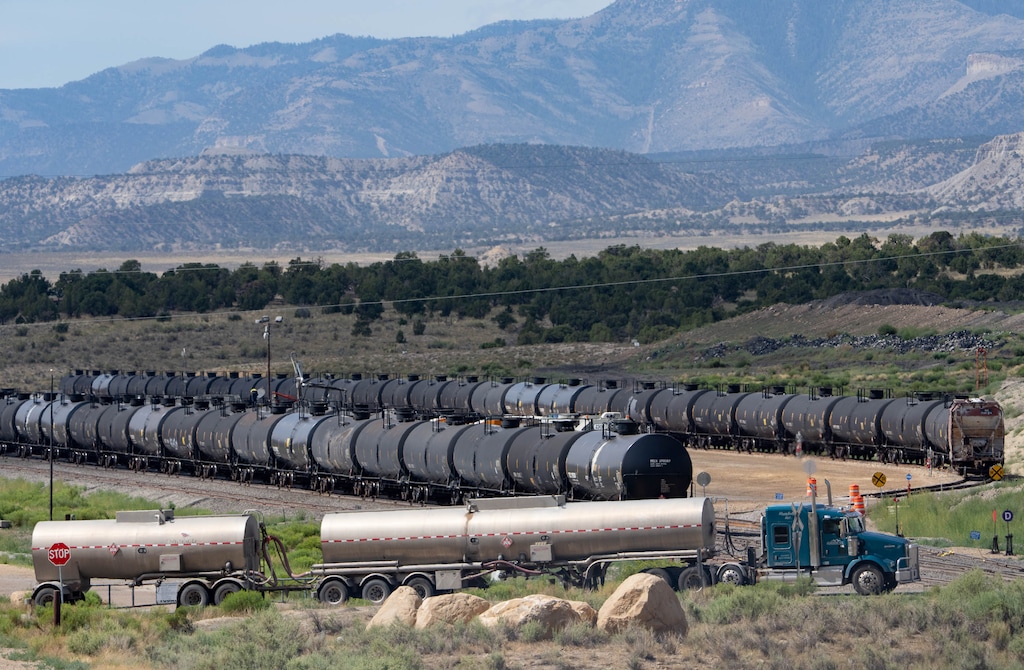
(Francisco Kjolseth | The Salt Lake Tribune) Crude oil is transferred from tanker trucks to rail cars parked at the Wildcat Loadout, now controlled by Finley Resources, a Texas-based oil producer. The old coal-handling facility outside Helper, Utah has been repurposed for transloading oil that is trucked from the Uinta Basin and ultimately shipped to Gulf Coast refineries. The Bureau of Land Management approved an expansion of the facility on Thursday, July 3, 2025.

The Bureau of Land Management approved the expansion of an oil transloading facility in Carbon County after an expedited review under President Trump’s “national energy emergency” declaration.

The expansion of the Wildcat Loadout Facility, which was approved Thursday, will ramp up the amount of waxy crude oil that producers can transport out of the Uinta Basin by 80,000 barrels per day.

Currently, oil tanker trucks haul 20,000 barrels of oil from the Uinta Basin down the remote, windy U.S. Highway 191 to Wildcat’s facility daily. There, the oil is transferred from trucks to rail cars that travel adjacent to the Colorado River for over 100 miles.

With the expansion, the facility will load 100,000 barrels of oil onto trains heading for the Gulf Coast each day, according to the BLM’s environmental analysis. The oil trains consist of 104 rail cars, the largest train length possible on the Union Pacific route.

This increase will also require roughly 345 oil tanker truck deliveries through Indian Canyon daily, according to BLM’s review.

(Francisco Kjolseth | The Salt Lake Tribune) Tanker trucks carry oil through Utah’s Indian Canyon on U.S. Highway 191 on Aug. 5, 2022 from the Uinta Basin to the Wildcat Loadout, now controlled by Finley Resources, a Texas-based oil producer. The old coal-handling facility outside Helper has been repurposed for transloading oil that is ultimately shipped to Gulf Coast refineries. The Bureau of Land Management approved an expansion of the facility on Thursday, July 3, 2025.

“Responsible energy development plays a key role in supporting local communities and national priorities,” said BLM Green River District Manager Elijah Waters in a press release. “This project reflects our commitment to advancing critical infrastructure while ensuring careful stewardship of Utah’s public lands.”

The BLM gave Coal Energy Group 2 LLC, the owner of the loadout facility, the go ahead to expand after a 16-day review with no public input process.

Environmental groups and Colorado leaders sent letters to the BLM and the Interior Secretary expressing concerns.

“Greatly increased oil train traffic next to the Colorado River and its tributaries for over a hundred miles risks contamination of the water source for tens of millions of people and the economic lifeblood of the region’s businesses, ranches, and farms,” said lawyers representing Eagle County in a letter.

Sen. Michael Bennet and Rep. Joe Neguse of Colorado also released a statement, saying, “There is no credible energy emergency to justify bypassing public involvement and environmental safeguards.”

Environmental analyses typically take months to complete and allow for public input. That changed earlier this year when Trump declared a “national energy emergency” and opened doors to fast-track the procedures normally required under the National Environmental Policy Act and other federal legislation.

“The integrity and expansion of our Nation’s energy infrastructure — from coast to coast — is an immediate and pressing priority for the protection of the United States’ national and economic security," the executive order said.

Fifteen states have filed a lawsuit against Trump’s energy emergency, arguing both the declaration and agencies’ actions on it are unlawfully bypassing “critical ecological, historical, and cultural resource review.”

Oil production has hit record levels in recent years. In March 2024, the U.S. Energy Information Administration found that the U.S. had produced more crude oil than any nation ever for the previous six years in a row. The U.S. has been a net exporter of oil since 2020 and hit record exports in 2024.

Utah also saw record production last year, with 93% of the 65 million barrels produced coming from the Uinta Basin.

(Francisco Kjolseth | The Salt Lake Tribune) Crude oil is transferred from tanker trucks to rail cars parked at the Wildcat Loadout, now controlled by Finley Resources, a Texas-based oil producer. The old coal-handling facility outside Helper, Utah has been repurposed for transloading oil that is trucked from the Uinta Basin and ultimately shipped to Gulf Coast refineries. The Bureau of Land Management approved an expansion of the facility on Thursday, July 3, 2025.

The BLM considered an expansion of Wildcat in 2023, but the company failed to provide BLM with needed information for the environmental analysis, so the agency terminated the review process.

The company then submitted a request in writing to the BLM on May 1 to use the alternative arrangements for review under Trump’s energy emergency.

Environmental groups question the company’s sudden urgency since it previously stopped participating in the environmental review process.

“This project, which was slow walked for years by the company itself up until last year, has now magically transitioned into an energy emergency,” said Landon Newell, attorney at the Southern Utah Wilderness Alliance.

Finley Resource and the BLM did not respond to The Tribune’s requests for comment.

The Wildcat Loadout Facility is a key piece in the expansion of oil drilling in the Uinta Basin. Jim Finley, Texas oilman and prominent player in the Uinta Basin oil fields, bought a 50% stake in the Wildcat Loadout five years ago.

“That story is the most important story in the basin right now,” Brent Talbot, president of Finley Resources, said at a Utah Division of Oil, Gas and Mining meeting in 2022.

Finley Resources has allowed Uinta Basin oil drillers to use the Wildcat facility at cost to help increase production from the region and build up producers’ bargaining power, according to minutes from a 2021 meeting of the Seven County Infrastructure Coalition, which includes Carbon and Uintah Counties.

(Francisco Kjolseth | The Salt Lake Tribune) Crude oil is transferred from tanker trucks to rail cars parked at the Wildcat Loadout, now controlled by Finley Resources, a Texas-based oil producer. The old coal-handling facility outside Helper, Utah has been repurposed for transloading oil that is trucked from the Uinta Basin and ultimately shipped to Gulf Coast refineries. The Bureau of Land Management approved an expansion of the facility on Thursday, July 3, 2025.

As oil refining capacity maxes out in Salt Lake City, Uinta Basin oil drillers have been pushing for infrastructure, such as the Uinta Basin Railway, that will increase transportation capacity.

While the Uinta Basin Railway faces additional hurdles, the Wildcat expansion serves as another pathway to ramp up transport of oil from the Uinta Basin.