 Carmen Nesbitt
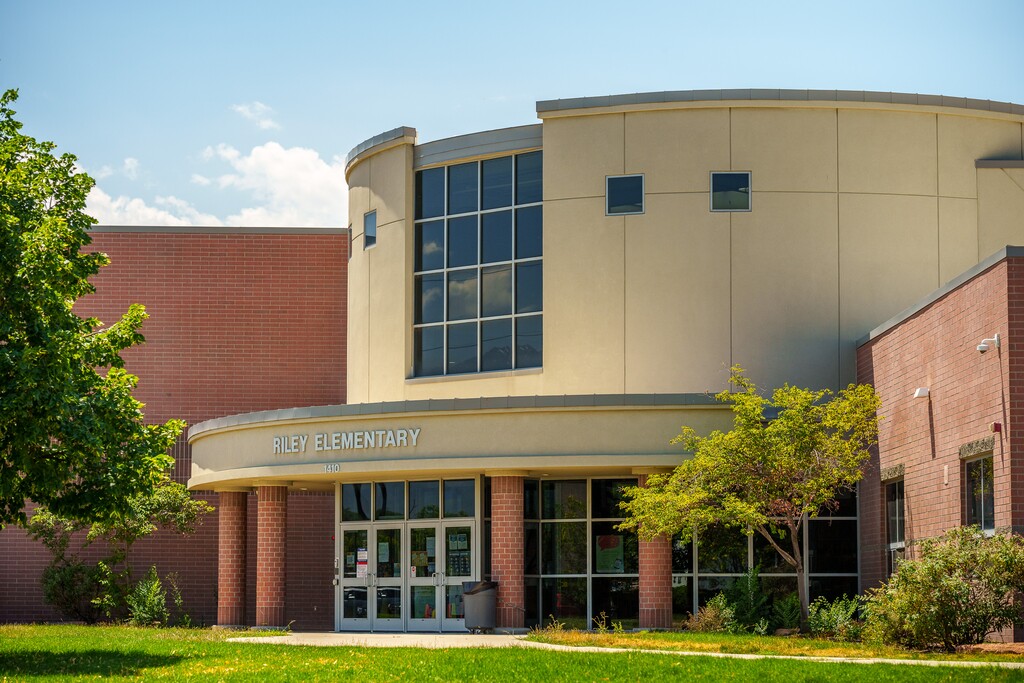
It’s been more than a year since the Salt Lake City School Board approved a multi-million-dollar plan to turn the shuttered Riley Elementary School into a new Career and Technical Center — but some officials now want to hit pause on the plan, citing the district’s $17 million deficit and falling enrollment.
With the possibility looming of more schools closing next year in the face of that enrollment nosedive, “we are not at a place to commit to a project of this size,” board member Annie Romano said at a board meeting in September.
Romano was speaking against approving a roughly $2 million contract with VCBO Architects to design the new center. The motion passed 4-3 with Romano, Ashley Anderson and Bryce Williams voting against.
The board approved the center in May 2025, which carries an estimated budget of $34 million. That vote was 5-1, with Anderson voting no and Nate Salazar, the board president, abstaining, according to meeting documents.
Most of the costs for the rebuild – some $30 million – come from the state, through Utah’s APEX Grant Program, district spokesperson Yándary Chatwin said in a statement. Another $2.11 million has been raised by the nonprofit Salt Lake Education Foundation, which is working on securing the remaining roughly $2 million, Chatwin said.
She added that the district cannot spend general or capital funds — the money used to pay for everyday operations and other building needs — on the center, unless the board specifically approves. Additionally, the center’s ongoing maintenance costs are already accounted for in the district’s 50-year capital plan, Chatwin said.
(Bethany Baker | The Salt Lake Tribune) Salt Lake City School Board member Ashley Anderson, seen here in a 2024 meeting, is one of three board members who issued a statement urging the district to pause plans for a Career and Technical Center.
Long-term expenses
The Salt Lake District has already projected a $17 million deficit for this school year, according to board documents. The shortage is largely due to “declining enrollment, inflationary cost increases and reduced state and federal funding,” a May board report stated.
That’s why board members Anderson, Romano and Williams — the three who voted against the architect contract — signed a joint statement in which they said they remain “concerned about the long-term operational expenses required to successfully run a new CTC.”
“When the Superintendent recommends a school closure study in 2027, our neighbors will certainly ask why we chose to rebuild a currently central and robust CTC rather than investing in their elementary schools,” the statement said.
Both Anderson and Romano are up for reelection in one week.
District enrollment took another massive hit this year, according to a new report by the Utah State Board of Education. Since last October, its student count has dropped almost 1,000 for the second year in a row. The district’s total student population now sits at 16,679 compared to 17,649 in October 2025.
The new Career and Technical Center, if completed, will bring the district’s Career and Technical Education (CTE) offerings, now spread across several high schools and facilities, under one roof at 1410 S. 800 West in Salt Lake City.
It also will replace the district’s current training facility , at Salt Lake Community College’s South Campus. Demand for CTE programs has exceeded what the SLCC space in the old South High School can accommodate, Chatwin said.
CTE programs provide hands-on training in fields ranging from welding to construction to healthcare. Depending on the program, students can earn college credit or complete the training hours needed to take a state licensing exam and enter the workforce immediately after graduation.
‘Very different situations’
Chatwin said that future school closures and the center’s rebuild are “two separate district processes” and “reflect very different situations.”
“When the Board closed schools a few years ago, it was in part because some of our elementary schools had dropped in enrollment,” Chatwin said. “Our CTE program is experiencing the opposite: waitlists for CTE courses are significant.”
But the three board members who expressed concerns about the center said in their statement that the district’s response “siloes a number of complex topics.”
“At the end of the day, we all know that you can only spend a dollar once,” they wrote.
(Rick Egan | The Salt Lake Tribune) Salt Lake City School Board Member Amanda Longwell, seen here at a groundbreaking in April 2026, recently defended the district's plans to build a new Career and Technical Center.
The three went on to argue that operating a new CTC is “a commitment that will culminate in difficult financial tradeoffs for the schools we serve. … Until we have sufficient answers for those tradeoffs, we continue to oppose this decision.”
Anderson has separately raised concerns that the consolidation may lead to job cuts, though Chatwin said that “there are no anticipated staff changes at this time.”
But not all board members agree with the trio’s opposition.
“The rebuild is not being paid with district funds,” board member Amanda Longwell argued during the September meeting. “The CTE program is an existing program in the district, not a new one starting from scratch. It already has been and continues to be sustainable.”
(Salt Lake City School District) Annie Romano, member of the Salt Lake School Board, argued in a September 2026 meeting that declining enrollment in the city's schools may ultimately mean fewer students in a proposed Career and Technical Center.
Romano argued that while CTE enrollment may be increasing now, projected declines in Utah’s K-12 enrollment would naturally result in fewer CTE students – and the district would have to make up those costs out-of-pocket.
“That loss of student enrollment will come with a loss of funds, and will come with a loss of enrollment in CTE,” Romano said in September. “I don’t think the demand, in terms of our student enrollment, is there. So, I remain at a point where I don’t think we have enough information or enough financial stability.”
Chatwin said the state grant money has an expiration date. If the district doesn’t spend it by June 2030, the funds must be returned to the state “in full,” she said.