 Carmen Nesbitt
Davis School District leaders honored the first rule of “Fight Club” — and now, they could be in trouble.
That’s because, when school board members there decided April 7 to support banning Chuck Palahniuk’s 1996 novel from all Davis schools, they didn’t talk about it.
More specifically, the board didn’t state its “rationale” for removing the book, which Utah law requires districts to do.
Now, a small subsect of the Utah State Board of Education says that decision violated state procedure. The full 15-member state board will have final say, but if they agree, the Davis school board will have to go back to the drawing board and recast votes on the book.
What happened?
On the day that Davis school board members decided to ban “Fight Club,” they placed the book’s removal vote on what’s called a consent agenda.
Consent agendas bundle certain meeting actions into one item, usually to save time. But according to Utah standards, consent-agenda items must be routine business and shouldn’t be controversial.
“This is certainly controversial,” Assistant Attorney General Lora Cooper told members of the state school board’s Standards and Assessment Committee on Aug. 7.
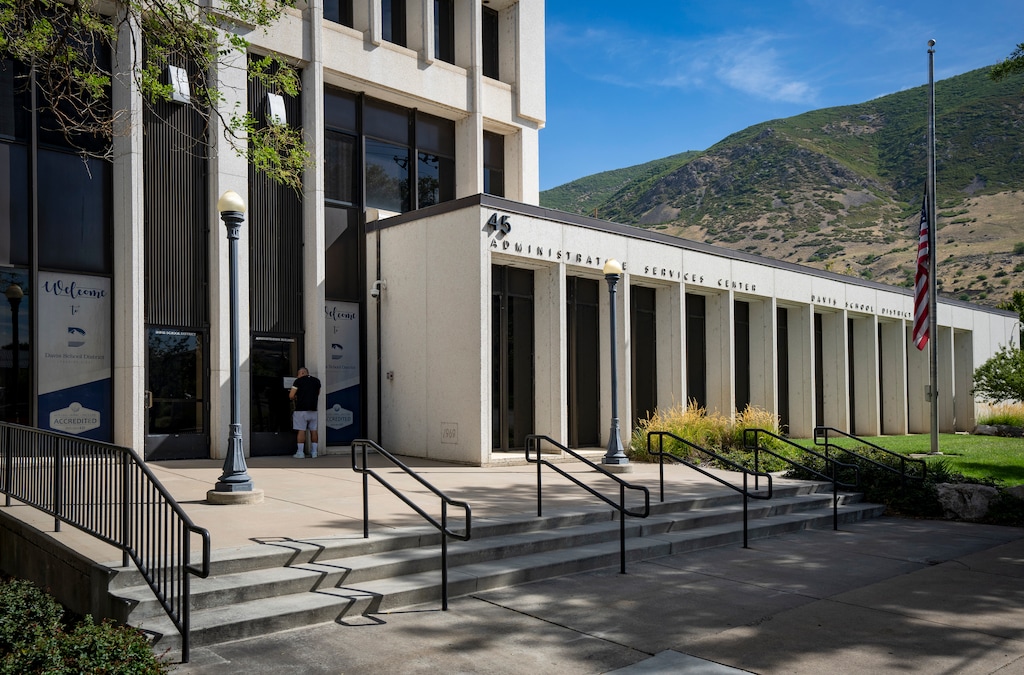
(Rick Egan | The Salt Lake Tribune) The Davis School District offices in Farmington.
When a book is challenged at the local level, school district committees are tasked with reviewing the book, determining if it meets Utah’s definition of sensitive materials and deciding whether or not to remove it.
If a district parent, student or employee disagrees with the committee’s decision, they have a right to appeal it — and that’s what happened with “Fight Club.”
In an appeal, the decision over whether or not to remove or retain the book gets bumped to the entire school board.
During that broader school board vote, Utah law requires board members to ”clearly” identify their rationale, along with “each component” of state law and other policy standards they used to reach their conclusion.
Davis School District’s own guidance also cites that requirement.
“Davis policies on the sensitive materials review require it to be brought up in the open meeting,” Cooper noted.
Davis defends the move
This is the first time since Utah’s sensitive materials law took effect in 2024 that state school board members have addressed a procedural appeal.
Davis parent Jessica Horton first raised the appeal with USBE. Horton runs an advocacy group called Let Davis Read, which aims to preserve student book access in a district that often spearheads statewide book bans. The district has removed 36 of the 37 books banned from all Utah public schools.
“I respectfully request that you overturn [Davis School District’s] decision and require them to comply with applicable law and policies,” Horton told USBE’s Standards and Assessment Committee earlier this month.
Horton didn’t file the initial district-level “Fight Club” appeal, she told The Salt Lake Tribune. She went to USBE after the Davis school board’s quiet April 7 vote.
Davis School District Assistant Superintendent Logan Toone defended the district to the state committee.
He said the district’s review committee provided its “Fight Club” determination — “as well as a statement of their rationale” — to the school board, both before the Davis meeting and “as an attachment to the public meeting agenda,” he told USBE members.
According to that attachment, their rationale stated only that the book “contains subjective sensitive materials as defined by Utah law.” No further detail was cited.
The school board had the opportunity to request a discussion, Toone added, but chose not to. He asked state board members to dismiss the matter and “consider the consent item as a business item in an open public meeting.”
Cooper acknowledged that consent agendas are part of public meetings, but she said discussing “the rationale for the removal” is a key component of state and Davis School District procedure.
When asked for comment, a Davis spokesperson declined, adding that the district didn’t plan to comment until the entire state school board addresses the matter.
Why was ‘Fight Club’ actually banned?
(Rick Egan | The Salt Lake Tribune) The Davis School District offices in Farmington.
The Davis review committee’s decision to remove “Fight Club” from schools hinged on its interpretation that the book contained “subjective” sensitive material.
A ban of that nature wouldn’t have contributed to a statewide book ban. That’s because statewide bans are only triggered if three school districts — or two districts and five charter schools — decide to remove the same book for containing “objective” sensitive material (pornographic or indecent content, as defined by state law).
“Subjective” decisions stay local, and only affect the district they were made in. In these cases, books that don’t meet the state definition of pornographic or indecent content can be considered otherwise “harmful” to youth.
That’s what happened in Davis: The district’s review committee in December found “Fight Club” contained no “serious literary, artistic, political or scientific value,” according to documents cited during the USBE appeal process.
“There were some sections of the book that weren’t described enough in detail to be considered against the law, however, the violence and overall attitude towards violence is something that is concerning to expose teenagers to,” one review committee member wrote.
“There also isn’t much redeeming qualities in the characters,” the member continued, “and I feel that teenagers aren’t quite mature enough to handle the content of the book.”
Horton flagged that decision to the state committee Aug. 7, arguing that violence doesn’t fall under “objective” or “subjective” removal standards.
“If [the Davis School District] wishes to remove this book based on their concerns with its violent content, they should evaluate it under their library collection policies,” she said. “Books that do not have sensitive materials should not be removed under the guise of Utah’s sensitive materials law.”
Cooper noted that it’s not the committee’s role to determine whether or not district officials “properly determined something to be sensitive.”
“We don’t substitute our judgment for theirs,” she said. “It’s just whether or not they followed their process.”
The 1996 novel led to the 1999 “Fight Club” film that reportedly inspired some fight clubs across the country, including here in Utah.
In 2002, a teenage son of Utah’s then-Gov. Mike Leavitt was arrested in connection with a teen-run fight club organized inside the gym of a Latter-day Saint church, the Los Angeles Times reported. He was sentenced to 40 hours of community service after he pleaded guilty to trespassing and disturbing the peace.
Palahniuk mentioned the Utah example in a 2003 interview on “Late Night with Conan O’Brien,” as well as in the afterword of a 2005 run of the book.