 Carmen Nesbitt
“The Bluest Eye” by Toni Morrison is bound for the shredder.
Three copies of the novel sit in the librarian’s office at West High School, out of reach from students.
The book was banned April 17, about two weeks prior. When the notice came, Kara Budge, the school’s librarian, said she alerted teachers and staff, reminding them that they can no longer keep copies in their classrooms.
“Students can’t use it for a report or class project,” Budge said. Students can still carry personal copies, she explained, but any assignments were now off limits.
But West High didn’t ban it. Neither did the Salt Lake City School District, where the school sits.
Three other Utah school districts did. Each found “The Bluest Eye” amounted to pornographic or indecent content, or as Utah code calls it, “objective sensitive material.”
Under Utah law, once three school districts (or two districts and five charters) remove the same book for containing “objective sensitive material,” all public schools in the state must also pull — and destroy — the title.
“Regardless of our own feelings about any of the books that are removed, the fact is, the job that we have means that we have to follow the process,” said Tiffany Hall, the district’s executive director of teaching and learning. “It is state law.”
(Trent Nelson | The Salt Lake Tribune) A stack of books banned in 2026 at West High School in Salt Lake City on Wednesday, April 29, 2026.
Since the law took effect in July 2024, 34 titles have met the statewide removal threshold — none at the behest of the Salt Lake City School District, or the majority of Utah school districts.
In actuality, a small handful are driving the statewide bans and, in most cases, the same three or four districts, according to the Utah State Board of Education’s online list of “titles to be removed from Utah public schools.”
Two districts appear most often on that list: the Davis and Washington County school districts.
(Christopher Cherrington | The Salt Lake Tribune)
A historically ‘conservative community’
Every single book ban so far has originated from at least one of nine school districts in the state, which is comprised of 41 districts.
That’s about 21% of districts driving challenges. No charters have helped trigger a statewide ban.
Davis School District has removed 33 of the 34 titles currently banned from all public schools. Washington County has banned 29. They are followed by the Jordan School District with 14 removals and Tooele School District with 11.
Those are just the titles that have met the statewide removal threshold. This school year, 47 titles have been challenged at Davis School District alone, according to the district’s website.
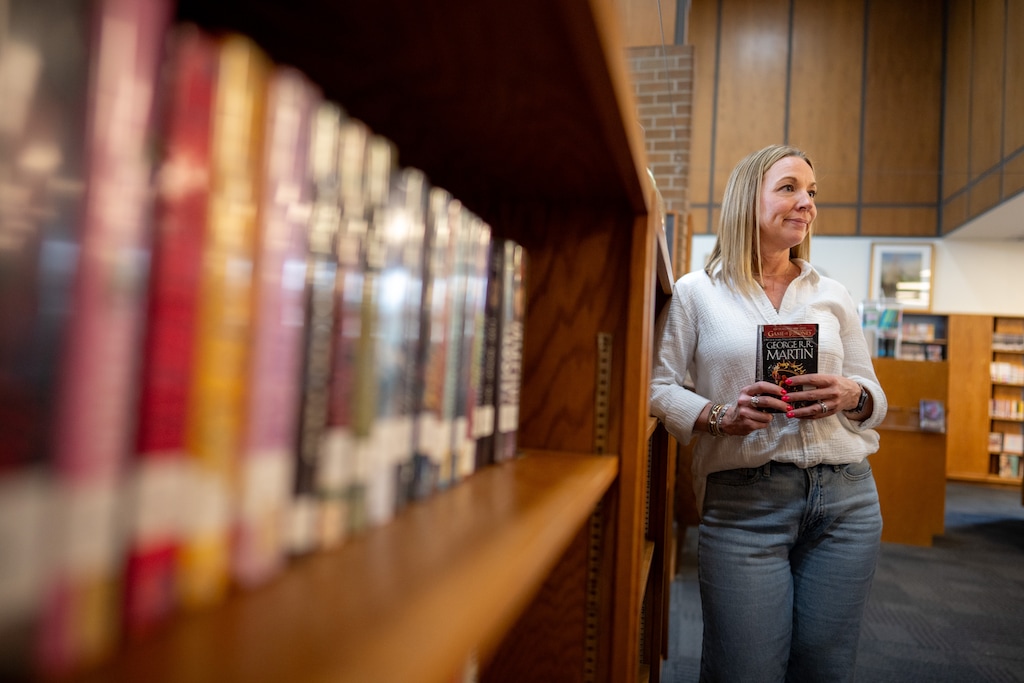
(Trent Nelson | The Salt Lake Tribune) The library at West High School in Salt Lake City on Wednesday, April 29, 2026.
“The Davis School District remains committed to following state law with regard to the use of books within its schools and will continue to judge each request to review a book on its own merits,” spokesperson Christopher Williams said.
“Those decisions are made solely by district book review committees and the Davis School District Board of Education,” Williams said, “and are independent of any other educational entity.”
A Washington County School District spokesperson similarly said the district is “simply trying to be in compliance” with Utah law.
“It is important to note that Washington County has historically been a conservative community,” said Steven Dunham. “Washington County School District is not seeking to influence other districts, rather we are respecting and responding to our own parent requests, and following the law.”
Who can challenge books?
(Trent Nelson | The Salt Lake Tribune) Librarian Kara Budge removes banned books from West High School's circulation database in Salt Lake City on Wednesday, April 29, 2026.
At the local level, a book can only be formally challenged by a student, parent, school board member or district employee, according to Utah law. Many districts provide online forms where challenges can be submitted.
For instance, Davis School District’s form asks the challenger to list their name, address and contact information. It also asks if the person has read the book in its entirety.
One section requires the challenger to cite the “specific passages” they find objectionable and instructs them to refrain from linking to social media posts. However, another section invites “supporting evidence,” including links.
The form ends with an acknowledgement that the challenger must agree to:
“I have reviewed Parental Restriction of Individual Student Access and understand that I may restrict my student’s access but restricting other’s rights requires a formal process and is limited to considering the specific concern regarding the sensitivity of the material submitted with this request.”
(Trent Nelson | The Salt Lake Tribune) Librarian Kara Budge removes banned books from West High School's circulation database in Salt Lake City on Wednesday, April 29, 2026.
From there, members of a district’s book review committee read the challenged title. While this process looks a bit different from district to district, the goal at this stage is to determine whether the book contains “objective” or “subjective” sensitive material.
Under state law, “subjective” sensitive material is content that may not meet the state’s definition of pornography or “indecent public displays,” but could otherwise be considered “harmful” to youth.
In that case, a book can still be removed from district shelves. But triggering a statewide ban only applies to “objective” sensitive material.
Once a district determination is made, appeals are possible; local school board members have the final say.
If a title ultimately meets the statewide ban threshold, USBE has 10 school days to notify all public schools in the state, which must then remove the title from student access.
The state board can also overturn a statewide ban, in which case districts can choose whether or not to return a book to shelves; USBE has not yet attempted to reverse a ban since the law went into effect.
‘I trust them and their school librarians’
(Trent Nelson | The Salt Lake Tribune) Librarian Kara Budge removes banned books from West High School's circulation database in Salt Lake City on Wednesday, April 29, 2026.
One Davis parent, Jessica Horton, has four children in the district. She calls book bans “a distraction.”
“I feel like all the resources, the time and the money — and the employee expertise being dedicated to book bans — is taking away from the district’s ability to actually educate our kids and to focus on helping them to learn to love reading,” Horton said.
She and a group of other Davis parents and community members have pushed back. In 2023, they formed a group called Let Davis Read, an unofficial branch of the nonpartisan coalition Let Utah Read.
“[We’re] just a bunch of parents trying to do what we can to put the brakes on this,” Horton said.
Together, they’ve appealed removal decisions made by the Davis School District, she said, but their success record has been spotty.
“That’s a big challenge, because the law itself favors book-banners,” she said. “It’s very, very hard to save books, because they have the upper hand in this situation.”
(Trent Nelson | The Salt Lake Tribune) The library at West High School in Salt Lake City on Wednesday, April 29, 2026.
She pointed to one win: reversing the decision to remove “The Hate U Give,” by Angie Thomas. The 2017 young adult novel follows 16-year-old Starr Carter, who witnesses a white police officer fatally shoot her unarmed Black best friend.
Initially, the district’s review committee determined the book contained “fondling or other erotic touching of human genitals” and did not have “serious” educational value.
But the district’s appeal committee instead determined the book did not contain “objective” sensitive material. That committee makes a recommendation to the school board, which informs the board’s vote on any appeal.
“The Hate U Give” was then sent to the “subjective” book review committee. That group ultimately decided the book has “significant literary merit” despite mild references to sexual activity.
“The perspectives given in this book are important in literary value,” one committee member wrote. “The reader gets the perspective of a young Black woman who is faced with many societal issues with which our students can identify.”
Horton said her involvement comes down to the idea that she doesn’t want other parents or challengers to decide what her kids can and can’t read at school.
“I trust them and their school librarians to help them find the books that will excite them and interest them,” Horton said of her children.
Libraries are the ‘heart’ of a school
(Trent Nelson | The Salt Lake Tribune) Tiffany Hall at West High School in Salt Lake City on Wednesday, April 29, 2026.
At the Salt Lake City School District, Hall said she’s holding off on shredding “The Bluest Eye” until the state school board’s window to overturn the ban passes.
That’s allowed by law, so long as students don’t have access to it.
“After that date has passed, then the legislation now says that we dispose of the books,” Hall said. “And so we will do that. We have a secure shredder, and that’s where we put the books.”
That’s because school dumpsters and garbage cans aren’t considered acceptable means of legal disposal, according to the Utah State Board of Education. Donating, reselling or distributing sensitive materials is not allowed under state law.
Hall added that “The Bluest Eye” is often assigned on Advanced Placement (AP) reading lists. AP courses are college-level classes developed by the College Board and offered to high school students. At the end of the course, students can take AP exams for a chance to receive college credit.
When a book that’s banned in Utah appears on an AP reading list, teachers can’t assign it, Hall said.
“We can say to students, ‘This is a list of books that they would suggest that you’ve read before you take the test, but this is a book that we don’t have,’” Hall said.
She noted that when other districts decide what books all students in the state can read, it can limit a school’s ability to curate collections that reflect their students.
“We want our libraries to be the hearts of the school,” Hall said. “My librarians are amazing, amazing people, and they work to make these welcoming spaces where kids know they can come and they can get help, and they can find information, and they can find fiction to escape into and reality when they need it.”
(Trent Nelson | The Salt Lake Tribune) The library at West High School in Salt Lake City on Wednesday, April 29, 2026.