 Carmen Nesbitt
Syracuse • As she looked over Bluff Ridge Elementary’s playground last fall, Principal Megan Fairbourn was still getting acquainted with her new school. She’d been assigned to the post relatively last-minute, she said, just before the 2025-26 school year began.
That’s when she noticed a few students in wheelchairs confined to the outskirts of the playground. The wood chips underneath the structure made it impossible for them to even approach the other kids playing. The only play area with a smooth surface they could navigate hosted a climbing dome atop it.
“Where can these kids play?” Fairbourn said she asked herself at the time. “They can’t even interact on the playground.”
She decided something needed to be done.
Several fundraisers and one large private donation later, the school community was able to raise $30,000 for an all-abilities playground. But it wasn’t quite enough.
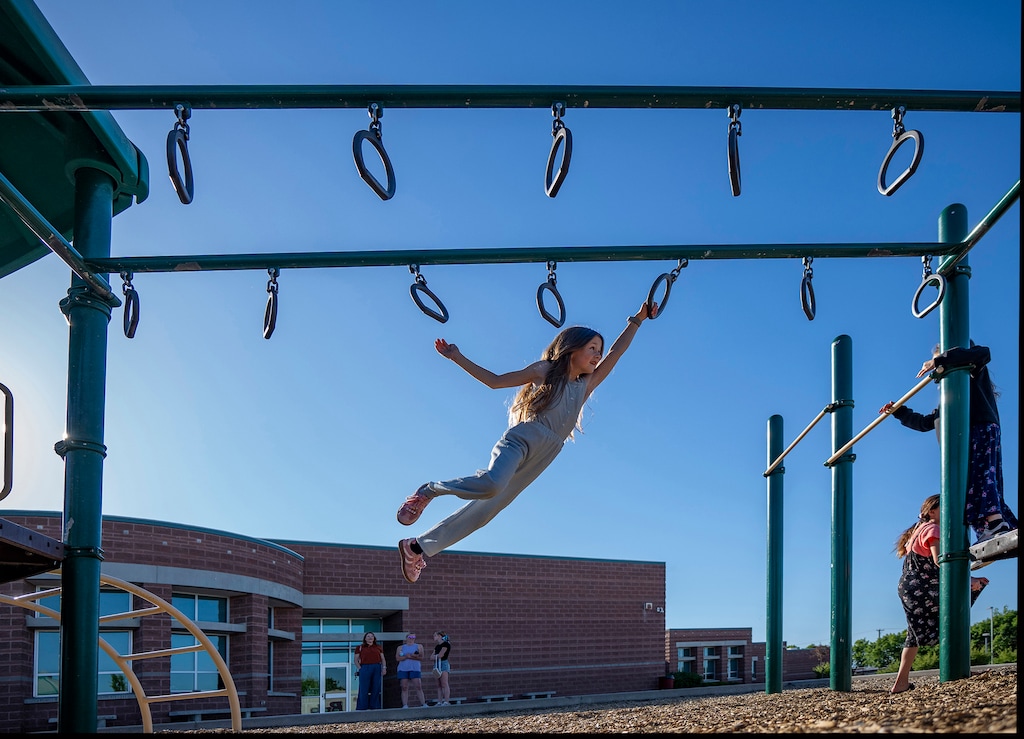
(Rick Egan | The Salt Lake Tribune) Samarra Pearce-Douros, Claire Caldwell and Isabella Caldwell play on the playground at Bluff Ridge Elementary School in Syracuse, on Friday, June 5, 2026.
In May, the principal tapped the Utah State Board of Education for an additional $120,000 in grant funding. Board members signed off on the funds during their regular meeting June 4.
“Our three kiddos, I know, are going to be so excited,” Fairbourn said of the students in wheelchairs. “And here’s the best part: All the other kids are going to be excited for them.”
What’s an all-abilities playground?
The project will top roughly $150,000, Fairbourn said, and it’s expected to be completed before school starts up again this fall.
Bluff Ridge’s existing playground will remain as is. The all-abilities equipment will be installed adjacent to the main playground on what’s currently an open, grassy plot.
(Rick Egan | The Salt Lake Tribune) Site for the new playground at Bluff Ridge Elementary School in Syracuse, on Friday, June 5, 2026.
It’ll feature an inclusive spinner, or what’s also called a playground “whirl.” Typically, whirls are raised, rotating platforms with bars children can grab to spin it like a merry-go-round. An inclusive whirl also spins, but its platform is level with the ground, so children in wheelchairs can easily roll onto the equipment.
Another addition will be an “inclusive glider,” which is a wheelchair-friendly platform that can be rocked back and forth.
Interactive sensory play equipment was also a must, she said, like activity panels and outdoor musical instruments.
“This all-abilities playground, I think, is going to touch even kids who have hidden disabilities,” Fairbourn said.
A case study for Utah
Bluff Ridge’s all-abilities playground is unique for another reason: It’ll also serve as a case study for the state board. That’s because the project was funded with federal mineral lease dollars, which come with specific requirements.
The funds are revenues generated from oil, gas and mineral development on federal lands, explained USBE spokesperson Marie Denson. The state gets a portion of that revenue, and the Legislature decides how to appropriate it.
(Rick Egan | The Salt Lake Tribune) Samarra Pearce-Douros, Claire Caldwell and Isabella Caldwell play on the playground at Bluff Ridge Elementary School in Syracuse, on Friday, June 5, 2026.
About 2.25% of Utah’s share are allocated to USBE, which amounted to roughly $3.3 million at the beginning of the fiscal year, Denson said. The money has limitations: It must be used “for research and innovation efforts aimed at improving student outcomes.”
That’s exactly what Fairbourn intends to do. Over the next year, the school will track various data points such as behavior referrals, recess participation, reading proficiency and attendance.
All of that will be compiled into a report that will include “recommendations for potential replication” at other schools around the state.
“This is a worthy enough research project,” Fairbourn said.
State school board was split on approval
(Rick Egan | The Salt Lake Tribune) Bluff Ridge Elementary School in Syracuse, on Friday, June 5, 2026.
While the state school board ultimately approved the grant, some USBE members were hesitant.
Board member Amanda Bollinger, for instance, said she felt there was already enough existing research on the benefits of all-abilities playgrounds and didn’t feel Utah needed to contribute.
“I don’t believe that this is our lane,” Bollinger said June 4. “I support the use of all-abilities playground equipment, but I do not think that that’s our role as a state board to use these funds for that reason.”
Bollinger added that it may set the wrong precedent because “what we do for one, we need to be able to do for all.”
Other board members disagreed, arguing the playground was an ideal use of the federal mineral lease funds.
(Rick Egan | The Salt Lake Tribune) Samarra Pearce-Douros, Claire Caldwell and Isabella Caldwell play on the playground at Bluff Ridge Elementary School in Syracuse, on Friday, June 5, 2026.
“We have a tremendous opportunity, because it’ll be homegrown data that we gather here,” board member Rod Hall said. “It will allow us, the state board, to be able to give guidance to the state as they get ready to build new buildings.”
Board member Joe Kerry concurred.
“We always talk about inclusion and how important that is,” Kerry said. “And now we have an opportunity to demonstrate inclusion.”
The vote passed 9-5, with the stipulation that the state’s superintendent work with school officials on a more “robust” research plan to present to the board in August.
As of May 28, approximately $1 million of USBE’s portion of the federal mineral lease funds remained, Denson said.