The following story was developed by The Utah Investigative Journalism Project and the University of Utah’s “Cold Case” class investigating unsolved murders in the state, in partnership with The Salt Lake Tribune. Students helped write and report the story through interviewing sources and filing records requests.
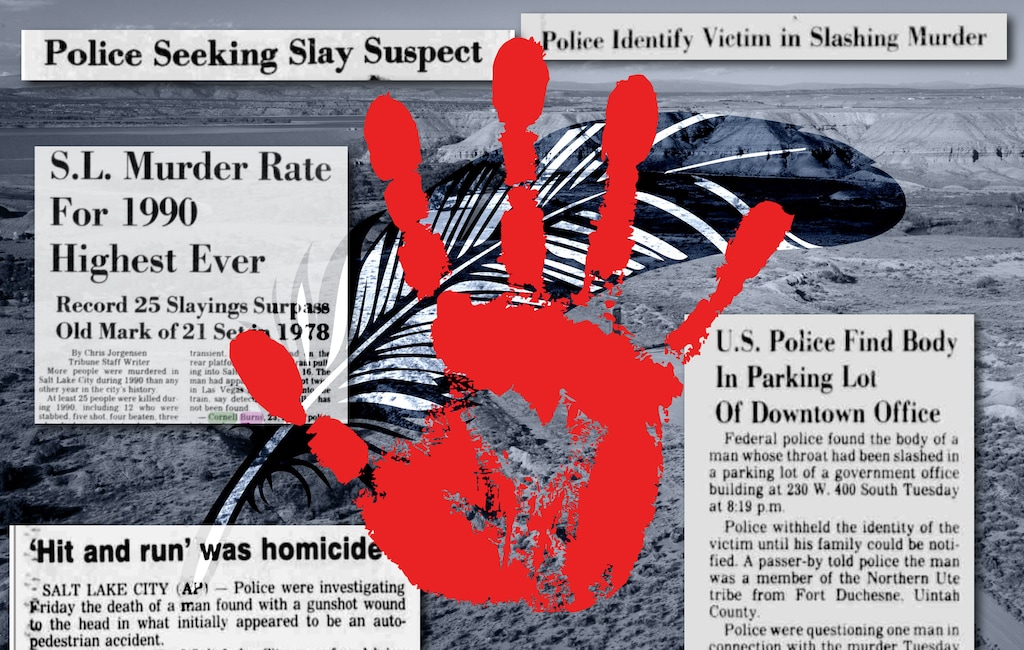
It was a quiet morning in May 1990 when Salt Lake City Police Detective Chuck Oliver responded to a crime scene near Liberty Park. He found a young Native American man lying face down in the gutter of a residential street with tire marks crossing his back.
It looked like a hit and run — until the coroner discovered a gunshot wound to his head. This was no accident; it was murder.
Identified as Cornell Burns, he became one more unsolved homicide statistic as police grappled with the most violent year in Salt Lake City in decades, thanks to an influx of heroin. Officers collected evidence, including a blood sample from a shoe that a man had taken to a cobbler for cleaning shortly after Burns’ murder. They had people of interest they wanted to talk to, but could never track them down.
Five years earlier, another Indigenous man had died violently on Salt Lake City’s streets. Larry Jack was found in a downtown parking lot with his throat cut, and the evidence police found included a bloodstained knife. They also had a suspect — a man described by a federal law enforcement agent as a “psychopath.” But prosecutors decided to support his extradition to Montana on an out-of-state warrant rather than pursue charges for murder.
In researching Jack’s and Burns’ deaths, The Utah Investigative Journalism Project discovered police had gathered evidence that could have potentially solved the murders through today’s DNA testing. But the Salt Lake City Police Department recently acknowledged that key evidence in both cases was thrown away years ago.
The Utah Investigative Journalism Project now has partnered with MMIR Utah and the University of Utah to help create a unique database of the state’s missing and murdered Indigenous persons.
The project, launched this week, aims to raise awareness of these cases, to coordinate with law enforcement and media that might be interested in examining them, and to give family members a place to honor and celebrate the lives lost.
Storytelling remains an important tool for the community to remember lives forgotten by local institutions. For Burns and Jack, just two of the people the database seeks to spotlight, it may also be the only tool for solving their murders.
The two men may have never crossed paths but they took similar journeys, leaving their homes on the Uintah and Ouray Reservation in eastern Utah and coming to Salt Lake City to try to make it in a challenging urban environment.
(Francisco Kjolseth | The Salt Lake Tribune) People traveled from surrounding towns to join a 2022 Bear Dance on the Uintah and Ouray Reservation at Whiterocks, Utah. The dance circle made of woven willow branches opens to the east, toward where the sun rises, and where the Ute Tribe believes the creator will arrive.
Decades earlier, U.S. Sen. Arthur V. Watkins of Utah had urged similar relocation for Native Americans in the state and elsewhere, spearheading policies that in the 1950s and ‘60s terminated the federal government’s recognition of certain tribes or members, including hundreds of Utes.
A devout member of The Church of Jesus Christ of Latter-day Saints, Watkins wrote in a 1954 letter to church leaders that forcing tribal members off reservations would lead to assimilation and “help the Indians … become a white and delightsome people as the Book of Mormon prophesied.”
Displacement wounds Indigenous people like Jack and Burns, said Tammy Dee Platero, a co-founder and director of MMIR Utah, a group advocating for solutions to the crisis of missing and murdered Indigenous persons.
Home is sacred to Native people, Platero said. The Dine, or Navajo, for example, sing songs about the four sacred mountains because the mountains encircle them and everything they know. Native people bury the umbilical cords of their newborns because they don’t see a distinction between themselves and the ground of their homelands.
“When people are removed from where they are from, that is a violent act,” Platero said. “It’s going down a dark path for folks.”
The Utah Investigative Journalism Project was unable to locate living relatives of Jack. Family members of Burns were contacted and information about the case and story were shared with them. Ultimately they declined to comment for this story.
Cops and cowboys
In the early 1990s, the Salt Lake City police department was trying to keep up with a heroin boom, said former detective Oliver. “Black tar heroin was a real problem (then) like fentanyl is today,” he said in a recent interview.
One cost of doing business in heroin could be measured in bodies. Oliver said those dropping the bodies predominantly were the Sinaloa Cowboys, a cartel gang from the Mexican state of the same name who had a penchant for wearing flashy western wear — and were known to police for rolling up dead bodies in rugs and dumping them outside the Salt Lake City airport.
In the year Burns was murdered at age 23, there was an alarming jump in violent crimes, according to the Salt Lake City Police Department 1990 Report. The city saw 25 homicides that year, “a 77.3% increase over the 1980’s average.”
Often people killed had been fronted drugs by a cartel, would sell the product and pay back the cartel with the money they earned, Oliver said. If they couldn’t pay what they owed, they paid with their lives.
Oliver said sources were wary of speaking out against a violent drug gang. There was a break, however, in the Burns case. An anonymous caller alleged that Burns had ripped off a woman for her drugs. In retaliation, the caller claimed, the woman and three “male Mexicans” picked up Burns in a car, shot him and dropped him off on Kelsey Avenue, did a U-turn and ran over his body.
(Rick Egan | The Salt Lake Tribune) Salt Lake City police take measurements in the 200 East block of Kelsey Avenue a few blocks west of Liberty Park, as neighbors looked on. The body of 23-year-old Cornell Burns was found on the residential street on May 18, 1990.
(Rick Egan | The Salt Lake Tribune) Salt Lake City Police collect evidence at 226 E. Kelsey Ave., where a man was discovered shot dead Friday morning. The murder was the second in three days, May 18, 1990.
The police file also had a bulletin shared with law enforcement to be on the lookout for a person of interest: A woman had a history of prostitution and drug use. And while she was not picked up at the time of the murder, she was arrested two months later by Salt Lake City police on misdemeanor charges, but was not apparently interviewed about Burns.
Oliver said back then it was easy for information to get stuck in silos between different divisions of the force.
The woman later had two more misdemeanor arrests and three felony arrests before she died in the early 2000s. What she knew went to the grave with her.
There were other clues. A week after Burns’ murder, a man running a shoe repair business notified police that a man came in wanting to get blood cleaned off some tennis shoes. The man claimed the shoes belonged to a friend who had gotten in a fight with someone. Police gathered blood and fiber evidence from the shoes; reports don’t indicate whether DNA testing was done.
DNA testing was a fledgling science at the time, Oliver said. Not a lot of cops understood it and when it was done, it took months to get results back. And there was not the same national database of offender data to compare results against.
The department now has the technology, just not the evidence.
Missing evidence
Sergeant Greg Wilking with the Salt Lake City Police Department said that the bloodied shoe is gone from police evidence, apparently discarded years ago.
“All that evidence was destroyed,” Wilking said. At the time, he said, the department didn’t realize how technology could change in the future.
“Which is unfortunate because there’s a lot of these (cases) that could have been solved, but they just didn’t have the ability to see in the future,” he said. Oliver agrees: “I think we could have probably solved a few more cases back in the day if we had the technology they have nowadays.”
While the bloodstained shoe might not have rated as key evidence, that explanation doesn’t apply to evidence missing from Jack’s case, five years before the Burns murder.
On Oct. 15, 1985, a Salt Lake City police officer on patrol was flagged over downtown by a woman working as a security guard. She said there was a man in a parking lot beside 230 W. 400 South who wasn’t moving. The officer asked her if the man might be drunk, but noted the “fear in her voice.” The guard replied that the man’s throat had been cut.
(Salt Lake City Police Department) On Oct. 15, 1985, Salt Lake City police responded to the parking lot of a building at 230 W. 400 South, where Larry Jack, 46, was discovered with his throat cut. His murder has never been solved. A bloody knife collected from a man in a group found nearby was later discarded from evidence.
(Salt Lake City Police Department) Salt Lake City police questioned a group found sitting on steps at The Southern Plantation, a closed cafe near the parking lot at 230 W. 400 South where Larry Jack, 46, was found with his throat cut on Oct. 15, 1985. A bloody knife collected from one of the men was later discarded from evidence.
Larry Jack, 46, was homeless at the time. A member of the Ute Tribe, like Burns he wound up on a dark path and was murdered. Unlike Burns, his case did not come in the middle of a drug-fueled crime spree. In fact, the police report noted that as soon as the discovery of the body was broadcast, patrol officers quickly homed in on a small group that had been loitering on the building steps of an empty cafe, The Southern Plantation.
Officers searched one of the men and recovered a brown handled buck knife with bloodstains on it. Near the group they found puddles of blood and also “bloody handprints on the wall of the porch and blood drops on the wall under the handprints.”
The group was taken in for questioning but denied knowing anything. Still, the officers had the bloody knife recovered from one of the men. Officers inquired about this possible suspect and learned he had been arrested in Montana for violent crimes. One officer consulted with a federal agent who said their suspect was “psycho and is feared locally.”
Salt Lake prosecutors decided against trying the man for murder and instead had him extradited back to Montana.
This knife was also discarded by the department, Wilking said adding the reasons were unclear.
The cold case detective still aims to solve the Burns case, and hopes someone who may have been at a party in Salt Lake City that Burns attended the night of his murder will reach out with any information they might have by calling 801-799-3000.
Indian termination
It’s hard to speculate on what drove Burns and Jack to leave the tribal reservation of eastern Utah to make their way in Salt Lake City. Unfortunately, they followed a trend of many Indigenous individuals who uprooted their lives only to die in cities away from home.
The Indian Termination Acts of the mid-20th century sound brutal, like policies of extermination. They were instead policies meant to terminate tribal dependence on the United State’s government.
Thomas Swensen is a professor of Ethnic Studies at the University of Utah and a member of the Tangirnaq Native Village tribe of Alaska. He said termination policies were propelled by the anti-communist sentiments of the post-World War II years, with public officials believing Native peoples were too dependent on reservations and the federal government for support. Termination policies were adopted in the interest of “emancipating the Indian from the shackles of government.”
That was the official line, Swensen said. The reality was different.
Termination helped push tribal members off their land and cut them off from access to natural resources on reservations. “This is all about money, right?” Swensen said. “Trying to get land, trying to get resources and gold mines and coal mines.”
Utah’s Sen. Watkins worked with Bureau of Indian Affairs Commissioner Dillon Meyer, whose previous experience involved relocating Japanese-American citizens to internment camps during World War II.
The two masterminded the Ute Partition Act of 1954, which Swensen said essentially forced the Ute Tribe to divide its own community into “full blood” and “mixed blood” members. Watkins and Meyer convinced the tribe that failure to do so would jeopardize the tribe’s ability to receive compensation for certain claims to damages and losses they experienced.
The government then still acknowledged full-blood Utes, but mixed-blood individuals lost their tribal status and federal protections. Families were broken up by this documentation, and Ute people had to verify their identity through classifications they had not invented.
The effect, Swensen said, was a sovereign nation coerced by the U.S. government into rejecting members of its own in order to receive compensation.
The drive for assimilation was strong. Termination policies also meant pushing Native members to leave reservations and receive job training in urban cities, including Salt Lake City.
Termination was not simply a law. It was a force that disrupted families, fractured communities, and pushed many Indigenous people into cities without support systems that could protect them.
It came as Indian boarding schools continued to attempt to assimilate-Indigenous youth. Former Utah Director of Indian Affairs Forrest Cuch was documented in a Ute Indian Oral History Project where he explained how as a child in the 1950s he was taught to give up his language and customs in order to fit into white culture. He described being viewed by white Utahns like a “creature, animal or a non-human thing. … Something that gets in the way.”
Rebuilding trust
(Rick Egan | The Salt Lake Tribune) Native Americans and advocates have been working for years to raise awareness of missing and murdered Indian women, girls and people. Ten Native American runners ran from Bears Ears National Monument to Salt Lake City to demonstrate resilience in overcoming this issue and others, seen here in the final stretch on Saturday, Sept. 5, 2020.
(Rick Egan | The Salt Lake Tribune) Carl Moore arranges names of murdered and missing indigenous women and girls at the Indigenous Peoples Day celebration on Oct. 12, 2020, at 900 South and 300 West in Salt Lake City. A new Utah database aims to raise awareness of missing and murdered Indigenous people and help solve their cases.
In 2018, a report from the Urban Indian Health Institute found Salt Lake City was one of the top 10 cities in the nation for the number of missing and murdered Indigenous cases in the country. The police department raised concerns with the report’s methodology and said it did not accurately describe Salt Lake City, while acknowledging crimes against Indigenous people are underreported.
Two years later, the Utah Legislature created the Murdered and Missing Indigenous Women and Girls Task Force to study the problem in Utah and develop solutions. Platero with MMIR Utah said the task force conducted meaningful research and came up with ideas, but she and others continue to wait for meaningful reforms to actually be implemented by the Legislature.
In this year’s session, Rep. Angela Romero, D-West Valley City, proposed legislation to create a training curriculum for law enforcement investigating the murder or disappearance of an Indigenous individual, but the Legislature adjourned before passing the bill.
(Tammy Dee Platero) Tammy Dee Platero is a co-founder and director of MMIR Utah, a group advocating for solutions to the crisis of missing and murdered Indigenous persons. MMIR Utah has partnered with The Utah Investigative Journalism Project and the University of Utah to create a unique database of the state’s missing and murdered Indigenous persons.
Platero noted other states have made greater progress, with nearby states designating dedicated MMIR cold case units.
“In Utah we’re way behind,” Platero said. “In New Mexico and other places, they at least have an office.”
One thing she was struck by with the Utah task force’s report was repeated calls for building trust between law enforcement and tribal communities. “That word is pasted everywhere,” Platero said.
“I think about trust and it’s obvious to me why it doesn’t exist. We’re asking folks from our communities to set aside some cultural taboos about talking about death and intense subjects and asking them to share that information and host it in a place not owned or operated by Indigenous folks,” she said.
She believes that building a comprehensive and human-centered database of MMIR cases in Utah will provide an opportunity to bridge trust between those afflicted and those who might want to help.
The database project, called Traces, starts by addressing that fundamental issue by following key data sovereignty principles. Family members who share the information know it will be hosted by an Indigenous-led organization on data servers hosted on Indigenous land.
Participants will also have complete authority over what they share and with whom. Some family members may wish to just share remembrances and stories of their loved ones. Others can opt in to be open to being contacted by interested journalists or law enforcement cold case investigators. In cases like Burns’ and Jack’s where key evidence has been lost, stories may be the only way to solve the cases.
While some police departments host sites with basic details about unsolved cases, Traces will be a place where family members can share information about cases and memorialize their loved ones as individuals instead of just grim statistics.
“I see it as a way where folks can know that it is based on an Indigenous cultural framework first,” Platero said, “instead of just being like a number.”
Individuals willing to share their stories are welcome to visit mmirutah.org/traces or reach out at hello@mmirutah.org.