 Andy Larsen
Who pays the postage price when voters don’t?
That’s the core issue at the heart of a quarrel between the offices of Utah County Clerk Aaron Davidson, in charge of his final election after being ousted by voters in June’s primary, and Utah Lt. Gov. Deidre Henderson.
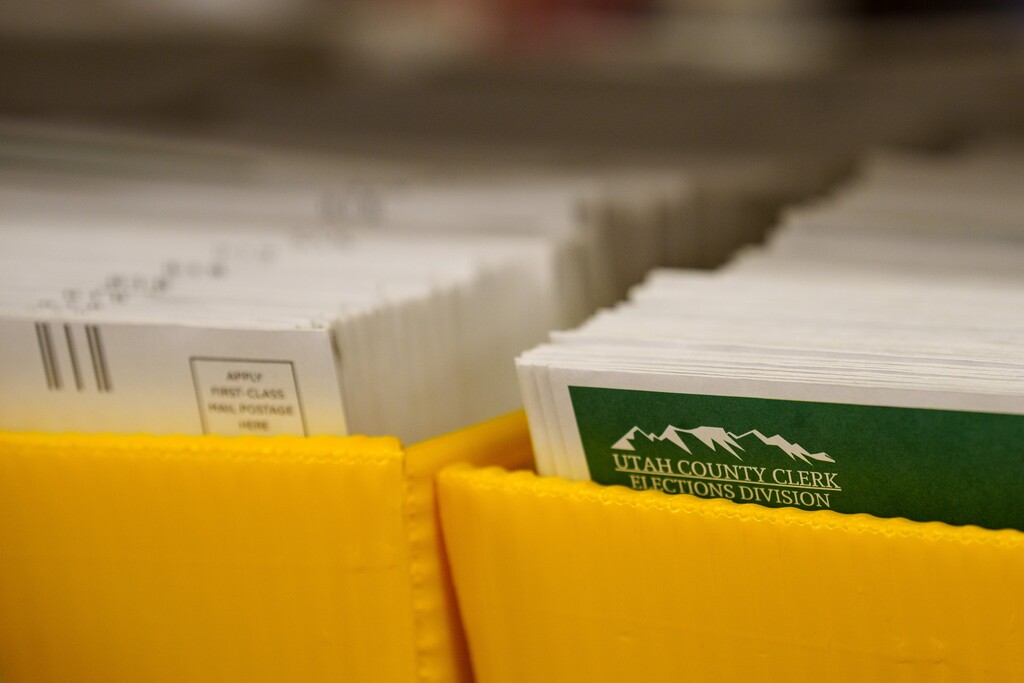
In most Utah counties — with heavily populated Salt Lake and Davis counties among the exceptions — voters are asked to affix a stamp to their mail-in ballots in order to send them back to their county clerk for counting. When they don’t, however, the United States Postal Service still sends the ballots to the clerks, and they’re still counted.
The USPS then later bills the counties for the cost of the postage. Generally, this happens automatically and without much fanfare, as most counties have charge accounts with the postal service.
A spat over email
But emails obtained by The Salt Lake Tribune through a public records request show Davidson telling the USPS that he won’t pay for Utah County’s share of the postage, and to bill the state instead.
“For the upcoming 2026 general election, Utah County is rescinding the authorization previously granted [for postage billing],” Davidson wrote the USPS in an email dated Aug. 14. “Based on Utah state statutes, Utah County believes the appropriate entity is the state Lieutenant Governor’s Office.”
The lieutenant governor’s office responded sharply to Davidson’s suggestion.
“Our office is not paying this postage,” Deputy Elections Director Shelly Jackson wrote in a short reply, just nine minutes after Davidson’s initial email. “Thank you.”
Davidson then also quickly replied, arguing that Jackson didn’t have the authority to respond to Davidson’s request. Writing to Jackson, Davidson said, “From my perspective, this decision does not fall within your purview. You were included on this email as a courtesy copy.”
He contended that any decision would have to come from Henderson or elections director Ryan Cowley.
Cowley responded about an hour later.
“Shelly has every right to answer the email you sent, especially when I am out of the office. I’m not sure what your problem is here, but you will treat her with the respect that is due her,” he wrote. “As I recall you had money in your budget for postage and then decided not to fund it any more. That was your decision and you can live with the results of that decision.”
“I’m sorry, but I disagree with your statement about Shelly,” Davidson responded later that day. “I would not expect my chief deputy to answer to financial decisions that would be expected [from] me [as] a county clerk.”
Lt. Gov.’s office insists there’s ‘no dispute’
In an email to Henderson, Cowley and Jackson, Davidson said a Utah law first passed in 2015 and modified in 2020 says a county that administers an election is not required to pay for return postage.
While the law doesn’t say who is tasked with paying up, Davidson said if it’s not the county’s responsibility, then the state is the only election authority left to pick up the tab. In an email to The Salt Lake Tribune last week, he also pointed out that Henderson, in her previous capacity as a state senator, voted for the bill that said counties weren’t required to pay return postage.
For her part, Jackson said “there is no dispute” between the state election office and any county about postage.
“The post office is just doing its job by returning its ballot to sender, which, by state law and state rule, is the county clerk,” she said. “The postage is just coming out of the county’s account just as it would for any other business that sends business mail.”
Other Utah counties do pay postage in this way.
With the lieutenant governor’s office disagreeing with Davidson’s interpretation of Utah law, the Utah County clerk then attempted to convince USPS to send the invoices directly to the state office for about seven weeks, between Aug. 17 and Oct. 8.
The USPS finally responded with an answer on that latter date: “Utah County will have to pay for the postage,” replied David W. James, a manager of customer relations for the postal service’s Nevada-Utah district. “All mail will be tendered to the county without delay, and the local post office will document all funds owed.”
USPS plans to continue billing county
On Oct. 12, Davidson changed tactics again, sending an email to Henderson, Cowley and Jackson seeking a public statement from Henderson. He asked the lieutenant governor to “encourage voters in Utah County to use county-provided drop boxes or to place a stamp on their ballot envelope unless they are genuinely unable to do so due to identifiable physical conditions.”
No such statement was ever made.
Meanwhile, Davidson continued to fight the postal service’s billing of Utah County for election postage. “The USPS has made three unauthorized withdrawals from Utah County’s postage account totaling $344.40,” Davidson wrote in a Oct. 20 email. “Unless you can provide written documentation, signed by both parties, that authorizes these withdrawals, they must cease immediately.” Davidson threatened a legal complaint.
The postal service forwarded Davidson’s email to its legal department, where it currently sits. Citing numbers from the 2024 election, Davidson estimates that the county’s bill for the unpaid postage will be roughly $10,000.
As Election Day approached, the postal service promised to continue delivering ballots back to Davidson, with or without postage.
“If a return ballot is nevertheless entered into the mailstream with insufficient or unpaid postage, it is the postal service’s policy not to delay the delivery of completed absentee balloting materials, including mail-in ballots,” USPS spokesperson Sherry Paterson said.
“In cases where a ballot enters the mailstream without the proper amount of postage, the postal service will deliver the ballot and thereafter attempt to collect postage from the appropriate board of elections.”
For now, that still means each county clerk.