 Jordan Miller
It’s not even Halloween yet, but a few Utah residents are already in the Thanksgiving mood.
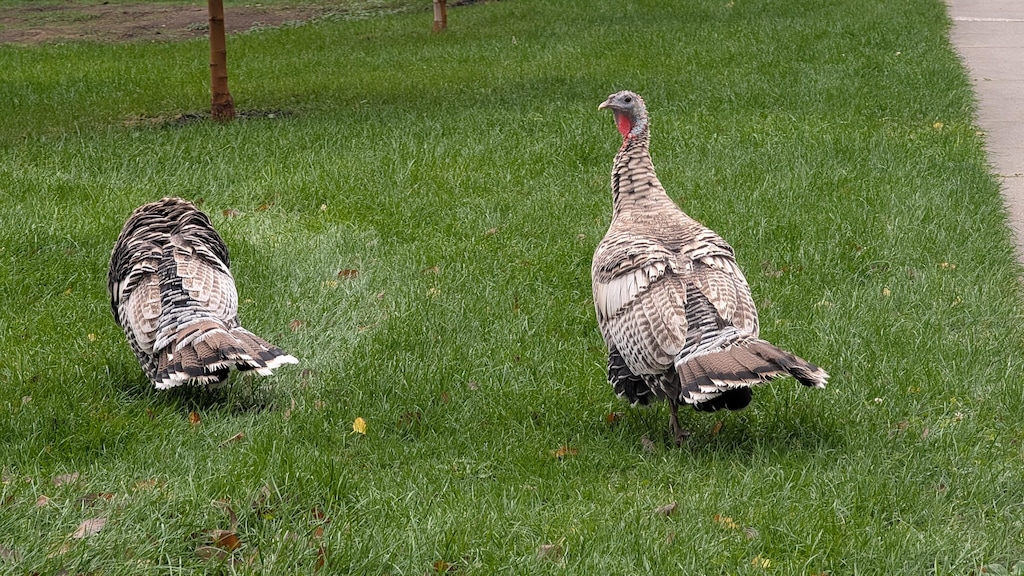
A flock of turkeys was seen near Liberty Park this week, strutting through streets and causing concern from Salt Lake City’s human residents, according to a Reddit post with photos of the birds. Over 30,000 turkeys call Utah home, but the gaggle of gobblers spotted by the park likely weren’t wildlife.
“If these have a lot of white on them, they’re not a wild turkey — they’re a domestic turkey,” said David Smedley, the central region manager for the Utah Division of Wildlife, after reviewing the photos from social media. “When you start to see all this white mixed into their feathers, that’s going to be like a hybrid or domestic breed.”
Domestic turkeys, or commercially bred turkeys, often have white feathers due to inbreeding — and because the small pin feathers that can remain on carcasses after meat processing are harder to see when the birds are white, according to the National Wild Turkey Foundation.
(Photo provided by Enrique Duque IV) Turkeys seen near Liberty Park on Tuesday, Oct. 13.
Turkeys typically don’t cause safety issues, and even in the busier areas of Salt Lake City, they don’t often get hit by cars, Smedley said. Drivers — and people — should just be careful and give the birds their space, but if they start causing problems, residents can call the Division of Wildlife at 801-538-4700.
Utah’s wild turkey population has “exploded” in recent years, Smedley said, and dealing with “urban turkeys” has become part of the job for the division’s wildlife managers.
When turkeys don’t have enough water or food — especially after a drought or during a harsh winter — they may venture into neighborhoods and parks more often.
“Urban areas provide food, there’s always lots of trees to roost in,” Smedley said. “Turkeys thrive in those areas because they have everything they need realistically.”
(Photo provided by Enrique Duque IV) Turkeys seen near Liberty Park on Tuesday, Oct. 13.
Right now, turkeys are fattening up in preparation for winter, Smedley said. When the snow hits, that’s when the wildlife agency often relocates turkeys that become nuisances looking for food in the valley.