 Tony Semerad
Open land in downtown Salt Lake City is at a precious all-time premium right now, especially near mass transit.
The urban core of Utah’s capital keeps adding residents and is desperate for fresh open space. New development continues to rise.
So what’s up with the beautiful, block-sized and otherwise undeveloped parking lot just south of the looming metallic cube that is the Orrin G. Hatch United States Courthouse?
Speculation is rife over the future of what is sometimes called Block 40, located between West Temple and Main Street and 400 South and 500 South. For many, it’s also known as the former home of the Hotel Newhouse.
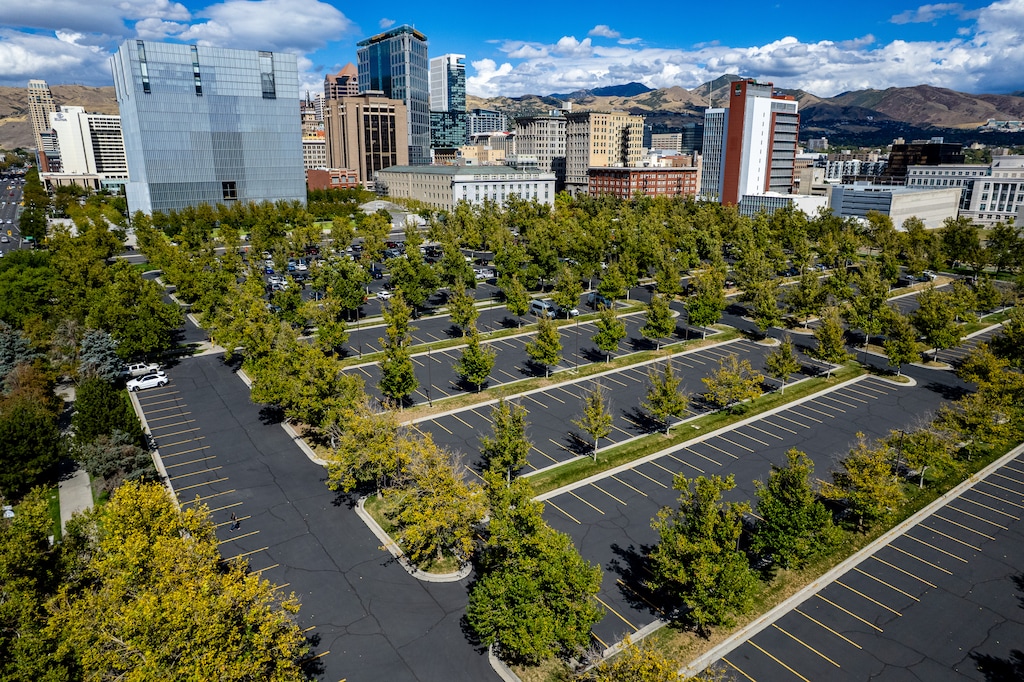
The storied block is today an open and contiguous 10 acres devoted to surface parking, laced with robust groves of trees and grassy knolls and about 590 stalls that all sit relatively quietly as downtown rapidly develops around them.
(Trent Nelson | The Salt Lake Tribune) The downtown parking lot between West Temple and Main Street and 400 South and 500 South in Salt Lake City on Thursday, Sept. 17, 2026.
The near-term answer: No immediate changes are planned for that spot, according to a spokesperson for its owner, City Creek Reserve, a real estate subsidiary of The Church of Jesus Christ of Latter-day Saints.
Block 40 and another church-owned full block of surface parking downtown, just west of Temple Square along 300 West, will both “be used to meet increased parking needs downtown for the next few years,” said church spokesperson Chris Moore.
No doubt a case in point: Up to five million expected visitors for the church’s open house showcasing the renovated Salt Lake Temple to the world, running from April to October.
Beyond “the next few years,” though, what could ultimately happen?
Colorful history of ‘a happening block’
Based on its history — as well as its current zoning — that block could someday turn into just about anything.
Since it was first platted into lots with Salt Lake City’s founding, Block 40 has seen myriad uses, some of them locally and even nationally known landmarks with key milestones in Utah’s history.
The spot held a historic 12-story, 400-room hotel built in 1912 by mining magnate Samuel Newhouse, viewed in its day as a secular competitor to the venerable church-owned Hotel Utah, now known as the Joseph Smith Memorial Building.
(The Salt Lake Tribune via Utah State Historical Society) The Hotel Newhouse in 1944.
The block was the site of a car dealership in the early days of U.S. automobiles, a building later converted to a spacious ballroom. Residents knew the venue by a range of names through the decades — Coconut Grove, the Rainbow Ballroom, Rainbow Randevu and Danceland — and as one of the largest ballrooms of its kind in the country.
It drew such acts as Lionel Hampton, Les Brown, Tommy Dorsey and others. By the early 1960s, the hall had been renovated into what was called the Terrace Ballroom.
Through the ’60s, the Terrace had business ties with Lagoon Amusement Park in Farmington and in colder months hosted many huge concert names, including Nat King Cole, the Beach Boys, The Doors, Led Zeppelin, The Who and Jefferson Airplane. In a retrospective article 11 years ago, The Salt Lake Tribune dubbed the stretch along Main Street between 400 South and 500 South “a happening block.”
Paved ‘paradise’ and put up a parking lot
Sinclair Oil executive Earl Holding and his Little America hotel to the south of Block 40 bought the then-aging Hotel Newhouse as well as the ballroom property in the late 1970s and early 1980s.
The Newhouse, which Holding eventually deemed unsafe, was imploded in 1983 before a large crowd, and many attendees reportedly carted its red bricks off as souvenirs. A teardown of the Terrace began in 1987, but a fire broke out mid-demolition and finished it off.
From then until 2009, Holding and his Sinclair Companies amassed all 18 separate parcels that now make up Block 40, eventually landscaping the block and using it as parking for Little America guests. Two years into the Great Recession, Holding sold it all to the church, along with 3 acres east of Main by the Matheson Courthouse.
Just as they do today, church officials described the acquired properties at the time as a long-term investment and said there were no immediate plans for development.
Its future? Sky’s the limit
Block 40 — owned by the same church subsidiary that holds downtown’s City Creek shopping center — enjoys what’s called D-1 zoning in city code.
That’s among city’s most permissive zones with regard to potential land uses and density and allows unlimited buildings heights.
So you are welcome to imagine a future development with housing, commercial uses, entertainment, education or job centers for technical workers to compete with Silicon Slopes, with some or all of that potentially rising high into the sky.
Based on the needs of downtown residents, a new park is near top of mind.
“Yes!” said Emily Sloan-Pace, chair of the Downtown Community Council. “Green space or literally anything else but more parking ... which is what already comprises 30% of downtown.”
With massive increases in population density across the urban neighborhood, Sloan-Pace added, “it’s pretty glaring that we are the only community in the county without a recreation center.”
Sloan-Pace said she learned to swim at the old Deseret Gymnasium on Main Street, demolished in 1997, “so this is not an unknown concept in downtown,” she said, “or to the church.”
You can also imagine a skyscraper of office spaces on that open block — or several.
In addition to what they’ve done in and around City Creek, church affiliates have built two such towers over the past two decades in the downtown area, 111 Main, opened in 2016; and 95 State at City Creek, which launched in 2022.
Both those high-end additions, however, started skyward before the pandemic, which has since greatly affected downtown office occupancy.
(Trent Nelson | The Salt Lake Tribune) A UTA TRAX train pulls into Courthouse Station, next to the massive Salt Lake City parking lot known as Block 40, Thursday, Sept. 17, 2026.
‘Housing has to come first’
Block 40, of course, also has a TRAX light rail station on its eastern flank along Main.
So you can think about transit-oriented development there with mixed uses: housing, retail, office, restaurants and open spaces combined, all serving residents and commuters who wouldn’t necessarily need cars.
“My own hopes for that block would be a mixed-use, transit-oriented development with open space that would hopefully save some of the trees,” said Salt Lake City-based urban planner, transit advocate and former planning commission member Mike Christensen.
“It is a policy failure,” Christensen said, “that the block has been a parking lot next to a busy TRAX station for over two decades now.”
According to the Salt Lake City Council member representing downtown-centered District 4, Jennifer Napier-Pearce, its location on a TRAX line “makes this site ideal for an iconic mixed-use development.”
“As much as I like the idea of another park with some sort of destination attraction,” said Napier-Pearce, “the city’s acute need for housing has to come first.”
She said she imagined several residential high-rises featuring a mix of condos and apartments available both at market rates and more affordable prices, with ground-floor retail spaces for shopping, a grocery store or a world-class restaurant — and a sizable open space built into the design.
Napier-Pearce also said she’d “love to save as many of the existing mature trees as possible, especially those along the perimeter of the development, and then transplant the rest around the city.”
Given the spot’s proximity to the Matheson Courthouse, she also said it would be fitting to name the open space in honor of “a fearless trailblazer” in Utah’s judiciary, former Utah Supreme Court Chief Justice Christine Durham.
Church’s pattern of mixed use development
There are lots of clues elsewhere the church might be inclined to someday build residential units on that block as part of a larger mixed-use vision.
A recent story in Bloomberg reports that the Utah-based faith is increasingly turning its focus and finances nationally to housing and master-planned communities, as part of making more of its multi-billion-dollar American landholdings.
The business publication’s piece on the church’s real estate empire — totaling at least 2.4 million acres across the U.S. — cites a number of church-backed mixed-use megaprojects in places like Florida, Colorado and Arizona.
Or just look closer to home at City Creek itself, which opened in 2012 and combines apartment and condominium high-rises, office towers, luxury retail outlets and eateries across two downtown blocks, along with a skybridge over Main.
Could Salt Lake City see another City Creek-like project on that south end of downtown?
Going by the church’s statements on its plans, one can — for now — only imagine.