 Andrew Christiansen
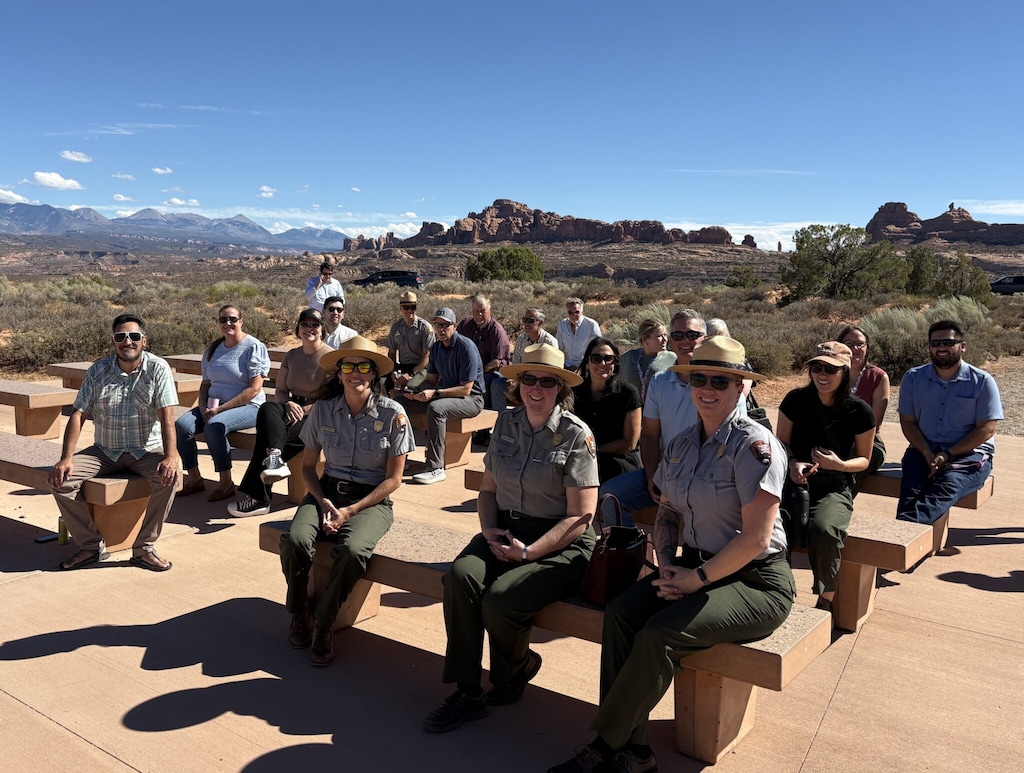
Federal, state and Grand County officials gathered at Panorama Point in Arches National Park Tuesday, Sept. 8, to celebrate the rapid rollout of the Moab-Arches shuttle and discuss how results from the six-month pilot could shape future transportation decisions.
The ceremony came one day before the county’s Sept. 9 official launch date and one week after the free service began carrying passengers during a soft launch.
The system connects four stop areas in Moab with the Arches Visitor Center, where riders transfer to an in-park route serving the Delicate Arch trailhead and The Windows. Agencies will track ridership, passengers’ destinations and parking conditions to assess whether the service offsets individual vehicle trips and eases parking congestion at two of the park’s busiest destinations.
Two shuttles carried officials and funding partners from the Moab Information Center to Panorama Point. The site is not a regularly scheduled stop, although Grand County spokesperson Melisa Jeffers said it can serve as an overflow destination if The Windows parking area closes because of congestion.
Grand County Commission Chair Melodie McCandless said the occasion represented more than the rollout of a new transit service.
“It is a celebration of what we can accomplish when we bring everyone to the table,” McCandless said. “Projects of this scale don’t happen in isolation. They require patience, vision, open communication and above all, collaboration.”
Backed by roughly $3 million in federal, state and county funding, the pilot advanced through three 4-3 Grand County Commission votes and drew a multitude of objections over its cost, accelerated timeline, planning process and ability to meaningfully reduce traffic.
The shuttle pilot comes after the National Park Service decided not to require advance timed-entry reservations at Arches in 2026 following four seasons of testing. The Park Service previously described the reservation system as successful in reducing congestion and improving visitors’ experiences.
Supporters have said operating the shuttle will provide information needed to evaluate questions about its effectiveness.
“This pilot gives us the chance to test, gather data, and refine our approach to regional transit,” McCandless said.
Jeffers said delayed shuttle-stop signs were being installed Wednesday, Sept. 9, in Moab and inside Arches. The signs state that a park pass is required and include a QR code for route, schedule and pass information. The county plans to begin limited public promotion once they are installed.
The town route operates every 30 minutes, while the route connecting the three in-park stops operates every 15 minutes.
Measuring the pilot
Lena Pace, superintendent of the National Park Service’s Southeast Utah Group, told The Times-Independent that park employees documented parking conditions at Delicate Arch and The Windows before service began and will compare them with conditions during the pilot.
Park employees are tracking when demand peaks, the percentage of spaces occupied and how often vehicles park outside designated spaces. Via Transportation, which operates the service under contract with Grand County, is collecting data on ridership, passengers’ destinations and how long they remain at each destination, Pace said.
Jeffers said information from the initial service period, including Park Service survey responses and Via ridership data, will be distributed to Park Service and county partners before the full pilot concludes.
The county expects to release reports and raw data publicly, although Jeffers did not provide a release date. She said the county hopes to release Park Service survey information but does not yet know what the agency’s data policy will allow.
Pace said the participating agencies have a monitoring plan and will use the information they collect to inform decisions about the service’s future.
“Until we have that data in hand, it’s hard to say where we’ll go with it, but tat’s why we’re doing a pilot,” Pace said.
Jared Beard, a Utah Department of Transportation Region 4 deputy director, said UDOT wants to learn how visitors use the service after contributing $1 million toward the pilot.
“I want to see the ridership,” Beard said. “I want to see how this is used, and then going forward, what’s next?”
Aaron Calkins, the Interior Department’s deputy assistant secretary for fish, wildlife and parks, said the shuttle furthered the Trump administration’s goal of keeping national parks open and accessible. He said he was eager to see the pilot’s ridership and lessons and that officials should be prepared to adjust the service as they learn what works.
“What things you may think today are, ‘This is the greatest thing,’ and a month from now we’re like, ‘Man, who thought that was a great idea?’” Calkins said.
The shuttles also display QR codes linking to the superintendent’s online comment form. Pace said the park had received 12 responses as of Tuesday, Sept. 8, all positive, and that some respondents asked whether the shuttle could serve more destinations.
The regular in-park route serves Delicate Arch and The Windows but does not reach Devils Garden or most other destinations in Arches.
“We are excited to look at opportunities to expand this at some point in the future,” Pace said.
From years of discussion to a rapid rollout
Shuttle concepts for Arches have circulated for years. A 2011-12 Park Service congestion-management study considered shuttle options but found the park’s long road system and the distances between key destinations posed significant barriers to effective service.
Grand County Commissioner Brian Martinez credited collaboration among local, state and federal agencies and contrasted the latest effort with years of earlier planning.
“The partnership of stakeholders has pulled this together, showing what’s possible … when we all commit to a common solution,” Martinez said. “Rather than wait another generation to study it, … we just hopped right on in and we got this thing rolling.”
The formal county process ran from May into August. Commissioners committed $500,000 in a 4-3 vote May 19, selected Via by the same margin July 7 and approved the Park Service agreement and conditionally authorized completion of the Via contract in another 4-3 vote Aug. 4.
The county signed the Via contract Aug. 14, and passenger service began Sept. 1.
Pace credited Grand County with initiating the latest effort in response to congestion inside Arches. She said even the Park Service initially questioned whether the agencies could establish the pilot on the proposed schedule.
“We told them we don’t think we can do it that fast,” Pace said. “And as Commissioner Martinez mentioned, here we are today. Much to our pleasant surprise, we were able to make it happen.”
Beard said UDOT’s involvement began at an April 27 groundbreaking at Lions Park for a paved trail connection along Highway 128. Martinez asked him, Gov. Spencer Cox and UDOT Executive Director Carlos Braceras for help funding the shuttle, and Cox directed UDOT to find the funding, Beard said.
Beard said the September launch target surprised him.
“When they told me that they were going to get this off the ground by September, I was like, ‘Are you kidding? Really?’” Beard said.
Redge Johnson, director of the Utah Department of Natural Resources’ Public Lands Policy Coordinating Office, said the shuttle was a priority for Cox and had been “years in the making, years in the idea stage.”
The pilot’s funding package consists of $1.5 million from the Park Service’s Federal Lands Transportation Program, $1 million from UDOT and $500,000 from Grand County. The county’s contract with Via is capped at $2.86 million.
UDOT’s contribution came from recreational hot spot funding previously allocated to the Moab-Arches area under a state program created in 2017.
Grand County’s contribution includes $350,000 from Fund 47, which receives revenue from an optional sales tax dedicated to transportation, and $150,000 in transient room tax mitigation funding.
The initial service period continues through Oct. 31. The shuttle is scheduled to return from March 1 through June 30.
This story was first published by The Times-Independent.