 Jose Davila IV
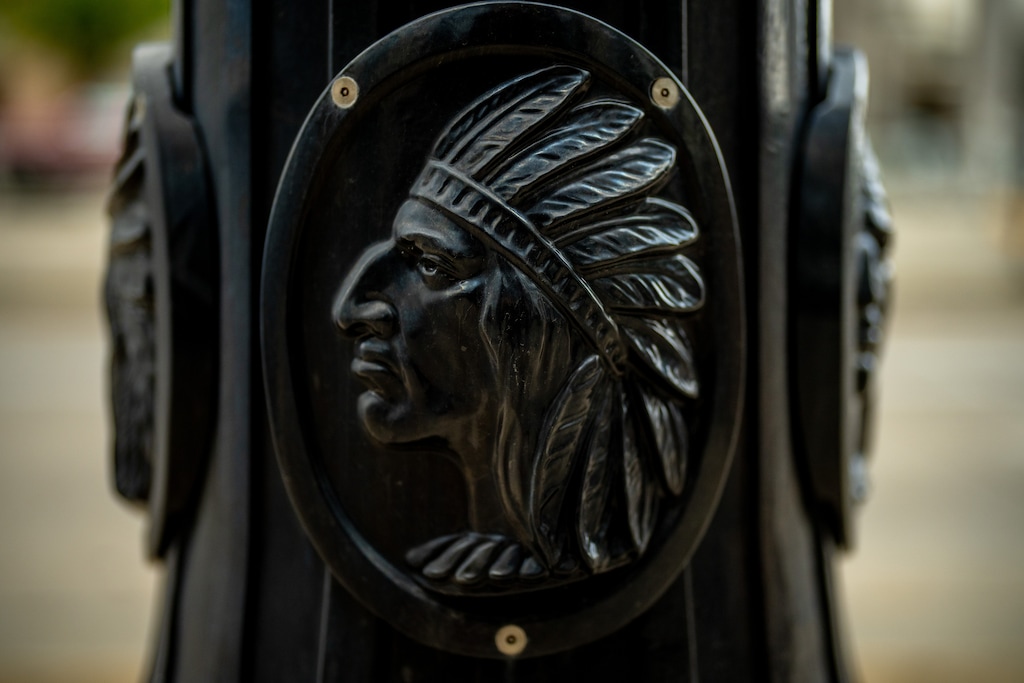
He’s wearing a feather headdress. He’s facing left. He’s over a century old.
Thousands of people walk by him every day and probably don’t even notice him.
He’s the Native American man who graces Salt Lake City’s ornamental downtown lampposts, but who is he, really? Turns out, the medallion found at the bottom of the poles doesn’t seem to be based on a real person.
“It’s just a stereotype, as far as I can tell,” Utah archaeologist and historian Rachel Quist said. “There are later stories that it’s about one of our more prominent chiefs, but I think that’s just people filling in past history.”
Quist wrote a post about the lampposts on her Salt Lake City history blog, slchistory.org, earlier this year. The earliest versions of these posts were installed in 1921 on State Street and 300 South, she found. Now, there are about 725 poles with the design that are still used as streetlights, Salt Lake City Public Utilities Department spokesperson Chloe Morroni said. The medallion is also used on posts that hold up the overhead lines for TRAX light rail cars and on some traffic signals.
There seem to be at least three slightly different designs of the man around downtown. That’s because the city has had to source replacements from different manufacturers over the past century.
When the lights were first installed, the Deseret News reported that they featured “Chief Timpanogos,” perhaps in reference to Chief Tabby-To-Kwanah, and recalled “the days when State Street” was used as a trail by Native Americans. But Quist said that neither of those claims is historically accurate.
In fact, 30 years later, a report in The Salt Lake Telegram said the Utah State Historical Society and Utah Power & Light Co., the historic Rocky Mountain Power precursor that installed the streetlights, agreed that the design was not supposed to represent a single person.
The medallion seems to be the work of the casting company that made the lampposts, Union Metal, with an assist from H. Allan Gardner of Utah Power & Light, Quist found. Union Metal later advertised the design in company catalogs.
No different from a mascot
Utah Indigenous rights advocate Carl Moore is critical of the medallion’s design.
“I do believe that it is racist, and this is the same thing with mascots,” he said. “It sets up an image that becomes the image that Indigenous people have to look like in order for them to be valid Indigenous people.”
(Trent Nelson | The Salt Lake Tribune) A lamppost in Salt Lake City, bearing a Native American face, on Thursday, Aug. 13, 2026.
Moore, who worked on the successful effort to change the mascot at Bountiful High School, said the medallions and similar designs reinforce stereotypes.
Moore is a member of the Hopi, Chemehuevi and Colorado River Indian Tribes, whose traditional homelands are in Arizona and California, so he feels he can’t say whether the medallions should be removed and what should take their place. He’d rather leave that up to a committee of leaders from Utah-based tribes.
“It needs to be approved by Indigenous people,” he said. “All that matters is that they say, ‘Yes, this is appropriate. This can represent us.’”
Leaders with the Ute Indian Tribe, the Northwestern Band of the Shoshone Nation and the Confederated Tribes of the Goshute Reservation did not reply to a request for comment. The Urban Indian Center of Salt Lake declined to comment.
Dave Pearson, who manages Salt Lake City’s streetlights, said Public Utilities has internally discussed replacing the medallions in the past, but that nothing came of it.
“It’d be fantastic if we got the council together of the tribes and met and got their feelings on it,” he said, “and explained the situation and explained what it would take to change them all out and what possibly we could do to maybe still honor them in some way that they felt like would be appropriate.”
Replacing the lampposts would be “quite an endeavor” and “expensive,” once labor and parts are factored in, Pearson said. He estimated it would take years and force the city to put other capital improvement projects on hold.
“If the city and the tribes think it’s best that we do this,” he said, “then it’s something we can do.”