 Jose Davila IV
Lester Wire was tired of standing in the rain and dodging dangerous, newfangled machines hurtling by him.
Wire, you see, worked as a traffic patrolman at the dawn of Utah’s automobile era. So, in 1912, he debuted the world’s first electric traffic light at 200 South and Main in Salt Lake City.
“It marked a turning point in Salt Lake City history, but [also] arguably in the nation and abroad, right?” City Council Chair Alejandro Puy said. “It’s a big deal, and I think it’s a missed opportunity not to highlight how important this was.”
Puy, who represents much of the west side, has now sparked a search for the first light and believes that the invention could be stashed at one of Salt Lake City’s properties. Others, including Utah archeologist and historian Rachel Quist, are under the impression that the first device and at least one of the subsequent metal models have been lost or destroyed.
At a July 21 council meeting, during a discussion about the city’s current traffic signals, Puy and fellow council member Chris Wharton implored officials to look for Wire’s first light.
“If anyone knows where it is, we need it,” said Wharton, who represents the Avenues, Capitol Hill and Guadalupe neighborhoods.
While Puy said he’s after the original light, he’d also welcome another early model.
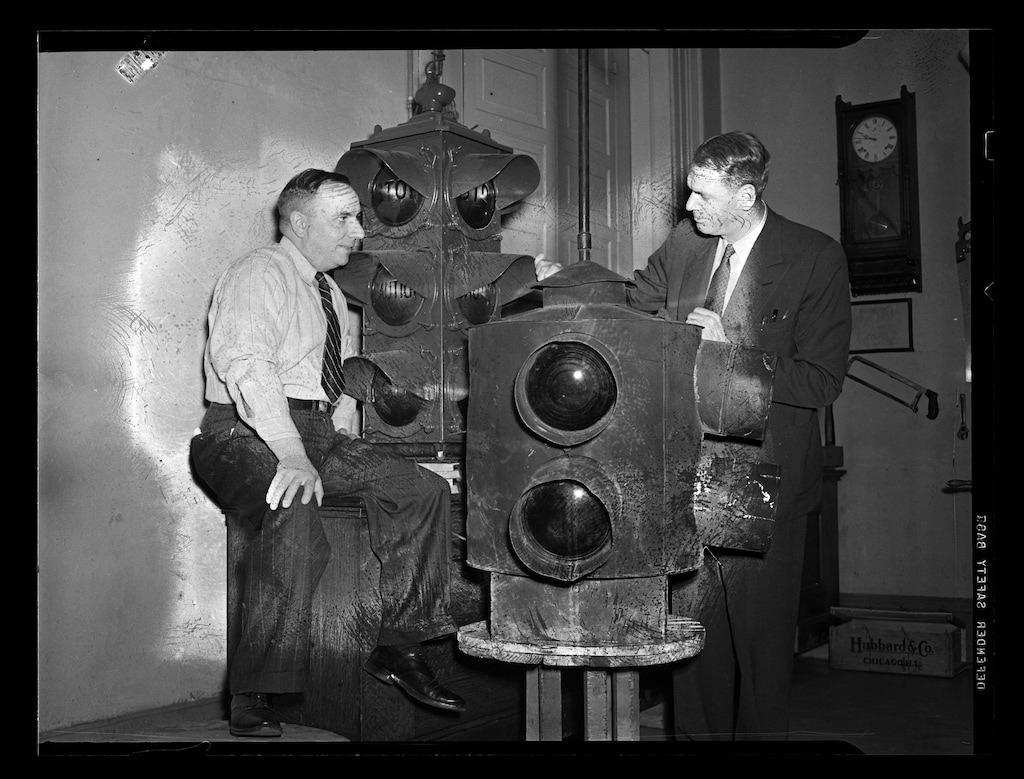
Wire’s first light was wooden and shaped like a birdhouse. Quist said it was something a tinkerer might make in their backyard with easily accessible materials.
The streets of Salt Lake City were a chaotic mess in the early automobile years, populated by people, horse-drawn carriages and trolleys. In fact, Wire’s first version was connected to the overhead electric trolley line, according to the Utah Department of Transportation. Cars had first arrived in Utah’s capital just over a decade earlier, Quist said.
To control the flow of traffic, a patrolman with the Salt Lake City Police Department would manually switch between the red and green lights at his discretion.
(Franciso Kjolseth | The Salt Lake Tribune) The world's first electric traffic light debuted at the intersection of 200 South and Main.
At one point, the original light moved to Tracy Aviary and was, after all, used as a birdhouse, Quist said. According to a biography of Wire written by his sister, Edith Wire, a later metal version was shipped off to New York and discarded in the 1960s.
If there is an early version of Wire’s invention in Salt Lake City’s possession, Quist believes it’s a key part of the Beehive State’s history that should go on display for residents to appreciate.
“Salt Lake and Utah in general has just a fascinating history of being the first, or the only, at doing things because we’re kind of oddballs in that sense,” she said. “And these tangible objects really help bring that history and understanding of our past to the forefront.”
Other notable Utah firsts include the first woman state senator, Martha Hughes Cannon, and Philo T. Farnsworth’s first all-electronic television system.
Quist hopes the missing traffic light will go on display at the new Museum of Utah. Puy would rather see it at City Hall as a part of a revamped collection there.
First, Puy and Wharton will have to find it. Puy said he’s been asking city departments with warehouses and yards to look through them.
“I’m hoping that we get lucky,” he said.