 Samantha Moilanen
 Andy Larsen
Andrew Katsohirakis lives a block away from the hill on Salt Lake City’s 800 South where a cyclist died after colliding with a turning car — and the death underscored the fear he feels every time he rides on that stretch.
“Is today, like, the day where I’m going to be killed just biking on my own street in front of my own home?” said Katsohirakis, an avid cyclist who takes that route several times a week.
Riding downhill, Katsohirakis said, can make it harder for cyclists to brake quickly or see oncoming traffic, particularly when cars are turning. The wide roadway also invites speeding, he said, even though the route runs near several schools including East High School and Rowland Hall Middle School.
Salt Lake City cyclists and advocates say Tuesday’s death may have been preventable, if the city had filled what they say are gaps in the city’s bike infrastructure.
On some Salt Lake City streets, bike lanes are separated from automobile traffic by raised concrete curbs. On other streets, like 800 South, only a single painted line separates cyclists from cars.
“It’s not actually safe infrastructure,” said Julian Jurkoic of Sweet Streets SLC, a group that advocates for safer streets for pedestrians and cyclists.
“What they’ve done is they created a place for [cyclists] to be, but not necessarily infrastructure,” Jurkoic said. “It’s not actually protecting anyone from cars.”
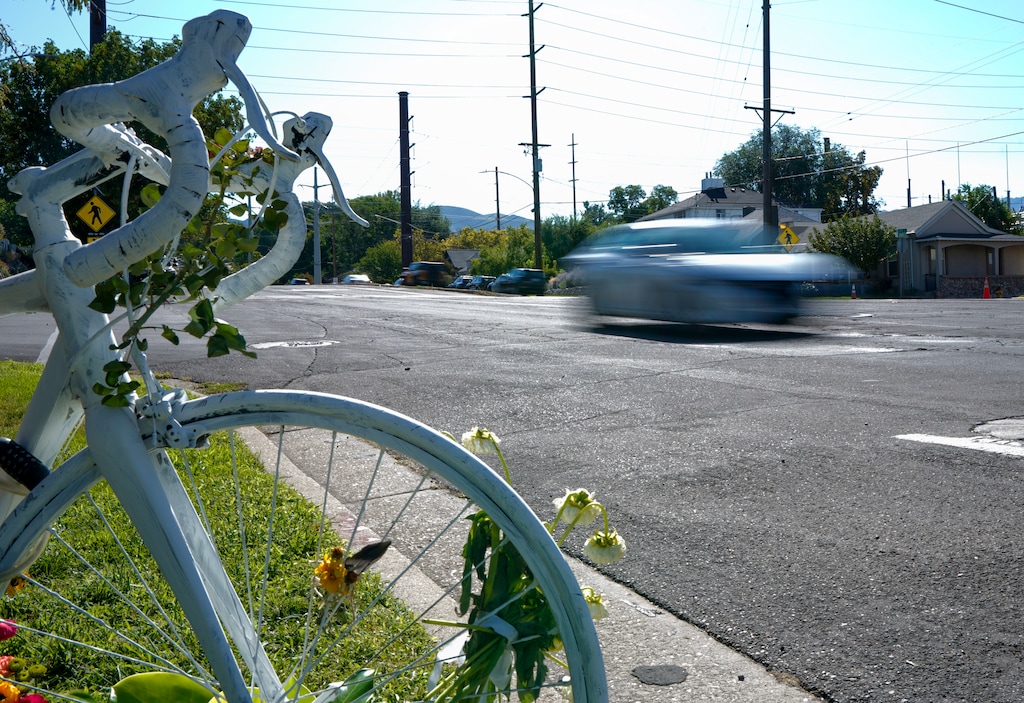
(Chris Samuels | The Salt Lake Tribune) Cars travel on 800 South in Salt Lake City, Thursday, Aug. 27, 2026.
The male cyclist who died Tuesday was riding downhill on 800 South near 1000 East when he collided with a turning car around 6:13 p.m., Salt Lake City police spokesperson Greg Wilking said. The man’s identity has not yet been released.
After the crash, many Utahns took to Reddit and other social media platforms to share their own experiences, raising concerns about bicyclist safety and recounting close calls with cars on Salt Lake City streets.
Some said the dangers have changed where and how they ride.
One commenter said they now stick to gravel and dirt paths, while another said each time they hear about a cyclist killed or injured, “especially that location, I hope I don’t know them. Selfish, yes.”
A white ghost bike, adorned with flowers, was placed near 800 South and 1000 East to memorialize the cyclist who was killed.
(Chris Samuels | The Salt Lake Tribune) A memorial is placed on 800 South for a biker killed Tuesday, Aug. 25, 2026, in a crash in Salt Lake City. This photograph was taken on Thursday, Aug. 27, two days later.
Before crash, some had complained
While Tuesday’s crash was the first at that intersection to result in a bicyclist’s death or serious injury, the city has received three complaints about the area, said Sofia Jeremias, a spokesperson for the Salt Lake City Transportation Division.
Two came through the city’s Livable Streets Survey in November 2024, and another was submitted through the mySLC app in June. Residents cited speeding, road conditions and drivers failing to stop at crosswalk signs, Jeremias said.
In the wake of the crash, transportation officials will consider whether changes to the street’s design could make the area safer and prevent another “tragedy from occurring at the intersection in the future,” Jeremias said.
The city’s “goal is to make every street in Salt Lake City safe for all users,” she said. This week, the city committed $2.3 million toward safety improvements at locations across the city, she said.
But the need for traffic-calming projects outpaces the transportation department’s annual budget, Jeremias said.
The department has received more than 2,500 comments through its Livable Streets Survey and roughly 17,000 transportation-related requests through the mySLC app, she said.
Salt Lake City also faces new restrictions on how it can make safety improvements to some streets under a new law passed this year. SB242 requires the city and UDOT to agree on a map dividing “critical capacity routes” into four tiers, with Tier 1 being the busiest and Tier 4 denoting quieter neighborhood roads.
Jeremias said that map has not yet been finalized.
However, if 800 South is ultimately designated as Tier 1, the law would prohibit the city from reducing traffic capacity or removing lanes, and would give UDOT veto power over certain safety and traffic-calming projects.
Salt Lake City residents spoke out sharply against SB242 when it was considered by the Utah Legislature, The Tribune reported in February. The bill’s sponsor, Sen. Wayne Harper, R-Taylorsville, denied assertions that the bill represented “a state takeover” of Salt Lake City’s roads.
Uptick in bicyclist deaths
Salt Lake County saw a steady decline in bicycle-involved crashes and bicyclist injuries from 2012 through 2022, according to Utah Department of Public Safety data. But those numbers have climbed again over the past three years, with 2026 on pace to surpass recent years.
So far this year, four bicyclists have died after collisions with cars in Salt Lake County — the most in a single year since 2022, when five bicyclists were killed, according to the data. Before that, the county last recorded five bicyclist deaths in 2010.
As a Salt Lake City cyclist, Katsohirakis said he has learned to stay vigilant. He doesn’t plan to stop riding, in spite of the risks.
He said he doesn’t bike every day, but often rides when he’s meeting someone downtown or heading to the Avenues. When he’s not commuting to work on the west side, he said he would rather bike or walk than drive. Getting an e-bike made that easier, he said, helping him tackle Salt Lake City’s hills and ride more often.
Still, riding in a bike lane can give cyclists a “false sense of security,” he said. Katsohirakis said he has had several close calls over the years, including an accident earlier this year while riding a GreenBike in Sugar House.
A driver pulled out of a driveway without looking and into his path, he said. Katsohirakis slammed on his brakes, sending the bike’s handlebars into his stomach and causing him to hit his head.
He was wearing a helmet, he said, but was left bruised and with a hematoma that is still healing nearly two months later.
On Tuesday, Katsohirakis said he was talking with neighbors when emergency vehicles began arriving at the intersection. He walked down to see what had happened, only to realize a cyclist had been killed on the same stretch of road he rides several times a week.
“This is just proof that it absolutely could happen,” he said, “and we’re not doing anything to try and solve it.”
Correction • 9:20 a.m., Aug. 29, 2026: This story has been updated to correct the first name of Julian Jurkoic.