 Brock Marchant
Weeks after a fire burned through the east side of Logan, officials have confirmed the cause of the blaze.
Brandon Stirland, Utah State University’s fire marshal, said the Canyon Road Fire all started with spontaneous combustion in a USU compost pile.
“The winds were about 50 miles an hour coming out of the east to the west,” he said. “So that’s what fanned the embers to get them going.”
The Salt Lake Tribune and Utah Public Radio contacted four agencies over several weeks to learn who was investigating and determining the fire’s cause. State and local officials could not agree on who was responsible for heading up the investigation.
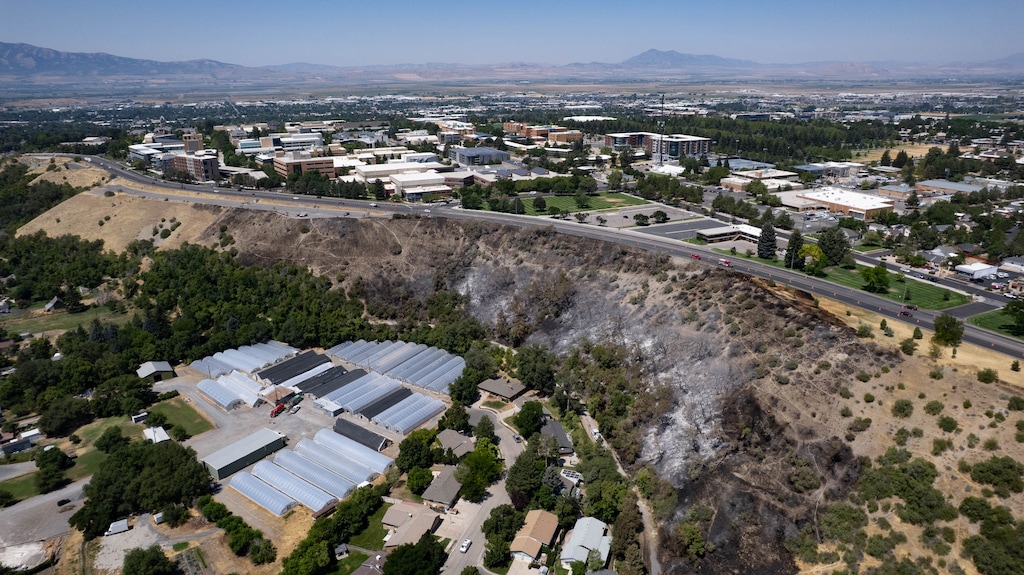
(Francisco Kjolseth | The Salt Lake Tribune) Rudy’s Greenhouse is pictured adjacent to the burn scar left by the Canyon Road Fire.
Kelly Wickens, a spokesperson for the Utah Division of Forestry, Fire and State Lands, explained that as organic material decomposes, it can create heat.
In hot, dry weather conditions, she said, this can ignite fires.
This, according to Logan Fire Marshal Aaron Walker, is what happened to cause the July 31 fire, which he said originated near USU’s challenge course off of Canyon Road.
“They have cameras up there on their property, and they had — earlier in the day — gone up there and unloaded a couple loads of compost,” he said. “Later in the day … the cameras picked up the flickering within that pile of compost, and of course they had the downslope winds blowing and carried some of those embers over into some of the nearby combustibles, and away it went.”
According to Wickens, the fire grew to just over 17 acres before being extinguished. Utah Fire Info reported that the blaze destroyed eight vehicles and an outbuilding, and damaged several other vehicles and a home.
(Francisco Kjolseth | The Salt Lake Tribune) Crews put out hotspots as they attend to the Canyon Road Fire.
Houses within 1.5 miles of 600 East and Canyon Road were evacuated, though not everybody living there who had registered for the city’s emergency alerts got the message to flee.
On Aug. 4, USU spokesperson Amanda DeRito acknowledged the school’s possible link to the fire, which the Logan fire marshal said at the time was still being investigated.
“We are conducting a comprehensive review of our wood chip and composting operations across campus,” she said in an email. “Because USU manages composting and wood chip materials in multiple locations, we want to ensure we are following best management practices to minimize the risk of similar incidents in the future.”
Note to readers • This reporting position is a partnership with Utah Public Radio, a division of Utah State University.
 I’m Brock Marchant, The Salt Lake Tribune’s Cache Valley reporter in partnership with Utah Public Radio. As a valley native, I’ve seen firsthand the issues that people face everywhere from Richmond to Avon — unaffordable housing, dwindling open space and a rapidly increasing population that has cities struggling to keep up. I want to explore local problems by reporting on the ground, not just quote elected officials and news releases. As residents work diligently to overcome challenges, I want to tell their stories and share their solutions. Smart, hard-working people have built the valley’s history, and I’m certain they will frame its future.
As a nonprofit newsroom we rely on donations from readers like you to make this work possible. Donate today to support this reporting.