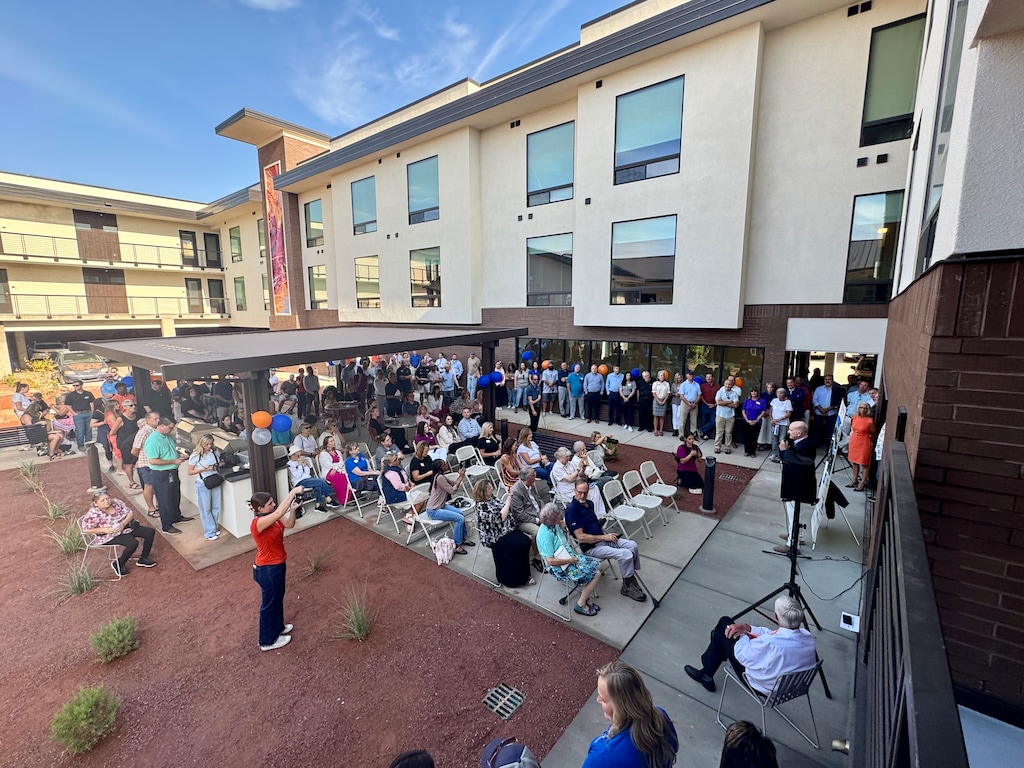
St. George • St. George’s first permanent supportive housing development debuted Thursday morning.
Built on the site of a former budget motel, the 110-apartment complex will offer income-based rent and on-site support for seniors, veterans and people leaving homelessness.
Switchpoint Red Hills, located at 999 E. Red Hills Parkway, aims to serve households living on roughly one-third of the area’s median income. Tenants are required to sign leases and typically pay about $550 a month for a studio and a little more than $600 for a one-bedroom apartment.
“Every single one of the 110 people pays their rent. Nobody gets free rent,” said Carol Hollowell, founder and CEO of Switchpoint. “A lot of them that are 80 years old just want to be safe and know they’re not going to get priced out of housing again.”
Founded in 2014 by Hollowell to fight rising homelessness in Washington County, Switchpoint began as an emergency shelter and food pantry in St. George. Since then, the growing nonprofit has expanded with new locations in Salt Lake City, Layton and Tooele.
While the organization already offers short-term housing in St. George, the new apartments provide permanent homes. Residents also gain access to on-site support and community amenities, including a clubhouse, fitness room, computer lab and a wellness room used for yoga, recovery meetings and religious services.
More than roofs and walls
(Mark Eddington | The Salt Lake Tribune) Carol Hollowell, founder and CEO of Switchpoint, addresses the crowd at the opening of Switchpoint Red Hills, St. George's first permanent housing development for people experiencing homelessness and housing insecurity, on Thursday, Aug. 13, 2026.
Hollowell said the project is as much about community identity as it is about roofs and walls.
“There is no power for change greater than a community discovering what it cares about,” she said, quoting author Margaret Wheatley. “This is an exact example of what happens when a community cares about something, and now we have 110 units of permanent supportive housing. They can age here in place and not have to move.”
Switchpoint Red Hills replaces Studio Six, a converted motel that offered 50 temporary apartments after opening in 2022. During the 2025 expansion, residents moved to other motels with stable rents. Construction gutted the original building to the studs and added a new wing with 60 additional units, according to Hollowell.
Switchpoint officials said the roughly $25 million project came together through a complicated financing stack. That includes about $15 million from federal low-income housing tax credits, $5 million from a state housing tax credit and $1 million from Intermountain Health.
They noted that the rest was filled in with private donations, about $600,000 in federal community development block grant funds from the city, and several million dollars in affordable housing funds from the state Office of Homeless Services.
(Mark Eddington | The Salt Lake Tribune) Switchpoint Red Hills, St. George's first permanent housing development for people experiencing homelessness and housing insecurity, on Thursday, Aug. 13, 2026.
Resident Bruce Raftery, a Marine Corps veteran nearing his 80th birthday, moved in when the property was still a motel and returned after the renovation. Living on Social Security and VA disability payments, he said he doubts he could have found another place he could afford.
“I don’t know where I’d be, but it sure as hell would not be near as nice,” he said, standing in his studio. “Everything is brand new.”
St. George Mayor Jimmie Hughes said the project reflects the small-town values residents want to preserve as the city grows.
“What’s happening here today … is us as a community coming together to take care of our neighbors who may be in need,” Hughes said. “Those complex issues are not solved by one city department, by one business, by one nonprofit, by one church or by one individual person.”
David Dangerfield, chair of Switchpoint’s board, said projects like Red Hills matter because they not only put roofs over people’s heads, but also give them a chance to learn, work and reconnect with others.
“Home is the foundation of our well-being, of our health, of our economic opportunities [and] our sense of dignity in who we are,” he added.