facebook-pixel

The rent went up. The food pantry shut down. But the need remains in this Utah community.

Clients “heartbroken” by the closure and hope a new home can be found.

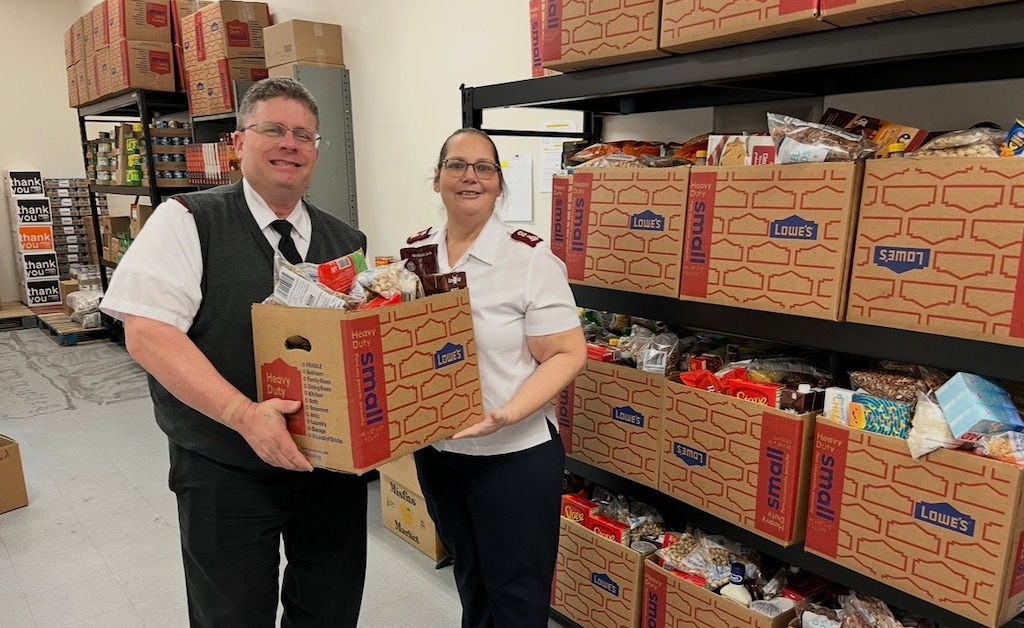
(Bob and Karen Schmig) Majors Bob and Karen Schmig, officers over the Salvation Army outpost in Washington City, hold a food box to be distributed to low-income families.

(Bob and Karen Schmig) Majors Bob and Karen Schmig, officers over the Salvation Army outpost in Washington City, hold a food box to be distributed to low-income families.

St. George • After serving as a lifeline for low-income families in southwestern Utah, the Salvation Army has closed its center in Washington City and shut down its food pantry while its leaders search for a new home.

Majors Bob and Karen Schmig, the husband-and-wife team who have led the area corps for four years, say the move was forced by steep rent increases and the end of their lease, not by any lack of demand.

“With the rent climbing and our budget already stretched,” Bob Schmig explained, “we just reached a point where we couldn’t stay here anymore, even though the need in the community is as great as ever.”

Staying past their July 31 lease expiration, he added, would have triggered a clause doubling the monthly rent. To avoid that penalty and give volunteers time to pack, the Schmigs closed the center July 20, moved furniture and equipment into storage and cleared out refrigerators and freezers by giving away the last of the perishable food.

(Mark Eddington | The Salt Lake Tribune) The Salvation Army's vacated center is seen in Washington City on Wednesday, July 29, 2026.

(Mark Eddington | The Salt Lake Tribune) Signs are posted on the door of the Salvation Army, seen here in Washington City on Wednesday, July 29, 2026.

Food pantry on hiatus

Bob Schmig noted that the most immediate loss is the four-day-a-week food pantry. Supported by donations from the Utah Food Bank, four Starbucks locations and a Maverik convenience store, the pantry provided food boxes filled with fresh vegetables, quality meats and other staples to 500 low-income families each month.

More than a pantry, the 6,000-square-foot building has served as a hub for providing utility assistance, gas vouchers and bus passes to individuals and families in need. During some months, especially when government funding lapsed, the center helped 20 to 30 families keep their lights on, according to Karen Schmig.

St. George resident Virginia Merrill, a single mother who relied on the center to get back on her feet, is “heartbroken” by the shuttering of the center. The organization not only supported her and her two daughters, she said, but also helped her parents when her father had cancer and contributed toward his funeral costs.

“I hope and pray that they get into another building before Christmas,” she said. “If that doesn’t happen, a lot of families who rely on the Salvation Army will be struggling.”

Keeping the help flowing

(Bob and Karen Schmig) Children hold gifts as part of an Easter outreach program the Salvation Army hosted for kids at the center.

With the center and pantry closed, the Schmigs and volunteers aim to keep the help flowing. They are still fielding requests via the office phone, collecting food donations and delivering them to housing complexes where people are in need. The couple have also moved their Sunday worship services to the King’s Row Senior Park clubhouse in Washington.

Phil Camitses, the center’s office manager, said he will miss the people more than the building.

“The best experience is the one-on-one contact I have had with people coming to the center to get their food boxes,” he said. “I’m the first point of contact with them, and I probably know 300 of them by their first names.”

For her part, Karen Schmig said serving others sans a building is scary. “But God has a place for us, and we just need to be patient.”

The Schmigs want a 3,000- to 6,000-square-foot space for under $7,000 a month to house their food distribution, offices and worship. However, they lament, high rents and their space requirements have slowed their search in the St. George area.

“We need funding,” Karen Schmig said, “or a good Samaritan who says, ‘Hey, I have a place.’”

Despite the disruption of needing to find a new home and the disappointment clients have expressed, the Schmigs say they are not upset or bitter about their circumstances.

“I’m now looking at this as an opportunity,” Bob Schmig said. “God wouldn’t let this happen if there wasn’t somewhere else he wants us [to go].”

Support free news for Utah

sltrib.com is now free to access — no subscription required. We made this decision because we believe access to trustworthy, independent news shouldn’t depend on what you can afford — especially as misinformation and AI-generated content continue to rise.

Free to read doesn’t mean free to produce. Our reporters show up every day to ask hard questions and hold powerful institutions to account. That work takes resources. As a nonprofit newsroom, we rely on support from people who believe it matters. Make a donation today to fund local news that serves Utah communities.

You can help us bring more local news to more communities today.